


Syllabus: GS3/Science and Technology
Context
- A worrying new trend of ‘fake patents’, in which education companies sell thousands of patents registered in the U.K. to academics from India and elsewhere, has raised concerns among research integrity experts.
About
- Some firms sell U.K. design registrations to Indian academics to artificially boost institutional rankings and individual CVs.
- These registrations, often granted in 11 days without novelty checks, are misrepresented as international patents despite lacking original research or physical prototypes.
Intellectual Property (IP) Rights
- Intellectual Property (IP) is generally defined as the ‘Product of Mind’.
- It is a property that results from the creations of intellect in industrial, scientific, literary or artistic fields.
- Intellectual Property Right (IPR) is the legally enforceable exclusive right granted to the owner of the intellectual property for a limited period.
- IPR rewards creativity & human endeavor which fuel the progress of humankind.
- Forms of IPR : Patents, Copyrights, Trademarks, Industrial Designs, Geographical Indications, Layout Design of Integrated Circuits, Protection of Plant Varieties & Farmers’ Rights, Protection of undisclosed information/ Trade Secrets.
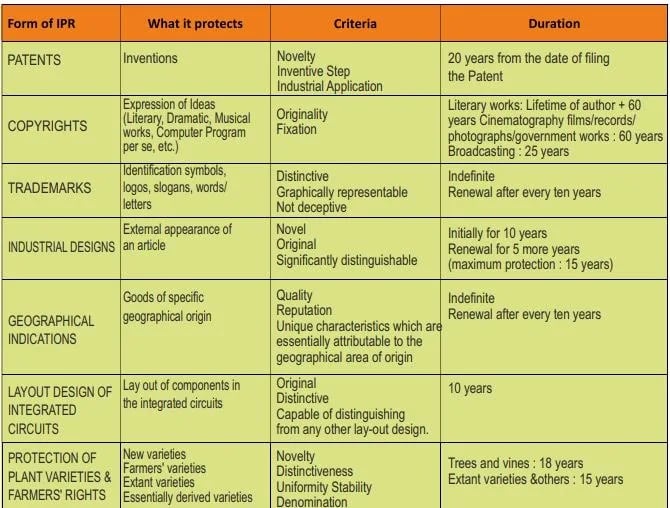
Is an Indian Patent valid in other Countries?
- Patent rights are territorial rights, which will be valid within the territory of the Country which has issued Patent.
- Hence, an Indian Patent, which is granted by the Indian Government, will be valid only in India.
Patent Co-operation Treaty (PCT):
- Patent Laws differ from Country to Country and there is nothing like “World Patent” or “International Patent”. However, there is an international filing system known as Patent Cooperation Treaty (PCT) system.
- When a PCT application is filed, an inventor of a member country of PCT can simultaneously obtain priority for his/her invention in all the PCT member countries.
- India joined PCT in 1998.
- All activities related to PCT are coordinated by the World Intellectual Property Organization (WIPO) situated in Geneva.
World Intellectual Property Organization (WIPO)
- It is a self-funding agency of the United Nations, that serves the world’s innovators and creators, ensuring that their ideas travel safely to the market and improve lives everywhere.
- History: WIPO was established in 1967 by the WIPO Convention.
- Members: The organization has 194 member states including both developing and developed nations like India, Italy, Israel, Austria, Bhutan, Brazil, China, Cuba, Egypt, Pakistan, the U.S. and the U.K.
- India joined WIPO in 1975.
- Headquarters: Geneva, Switzerland.
Challenges in India’s IP Regime
- Patent Backlog: Despite increasing filings, patent examination and grant delays remain a significant issue.
- IP Infringement: Weak enforcement mechanisms, leading to rampant counterfeiting and piracy.
- Low Patent Commercialization: Many patents filed in India do not get commercialized due to lack of industry-academia collaboration.
- Global Competitiveness: India’s innovation is dominated by foreign applicants, reflecting low domestic R&D investments.
India’s initiative
- National IPR Policy 2016 encompassing all IPRs into a single vision document setting in place an institutional mechanism for implementation, monitoring and review of IP laws.
- The policy encourages innovation and creativity by providing stronger protection and incentives for inventors, artists, and creators.
- Cell for IPR Promotion and Management (CIPAM): It has been set up to coordinate the implementation of the National IPR Policy.
- National Intellectual Property Awareness Mission (NIPAM), a flagship program to impart IP awareness and basic training in educational institutes.
- Scheme for Facilitating Startups Intellectual Property Protection(SIPP): It is introduced to foster innovation and entrepreneurship by providing a supportive ecosystem for startups to protect and manage their IP assets.
- Atal Innovation Mission (AIM): It was set up by NITI Aayog in 2016 to promote a culture of innovation and entrepreneurship in India. AIM has created four programs to support these functions:
- Atal Tinkering Labs
- Atal Incubation Centers
- Atal New India Challenges and Atal Grand Challenges
- Mentor India.
Source: TH
Previous article
UN Commission of Inquiry Report on on Gaza
Next article
News In Short 29-06-2026
