


Syllabus: GS3/Environment and Conservation
Context
- The Ministry of Environment, Forest, and Climate Change has announced a ‘National Designated Authority (NDA)’ to enable a carbon emissions trading regime.
About
- It is a mandatory requirement under the provisions of the 2015 Paris Agreement.
- Within the Paris Agreement, a section called Article 6 defines the contours under which such an emissions trading regime, or a market, can take shape.
- Composition: A 21-member committee headed by the Secretary of the Environment Ministry.
- Includes officials from the Ministry of External Affairs, the Ministry of Renewable Energy, NITI Aayog, and the Steel Ministry.
- Functions of NDA: Recommending to the Union government the list of activities that can be considered for the trading of emission reduction units from projects.
- Modifying them from time to time, keeping in view national sustainable goals, country-specific criteria, and other national priorities;
- receive projects or activities for evaluation, approval, and authorisation;
- authorise the use of emission reduction units from projects for use towards the achievement of Nationally Determined Contributions (NDC).
| Nationally Determined Contributions (NDC) – The NDC refers to commitments by countries to reduce emissions in line with diverting their energy consumption towards renewable energy sources, as well as taking action to reduce carbon concentrations in the atmosphere. – India’s NDC commits to reducing its GDP’s emission intensity by 45% by 2030 from 2005 levels, achieving 50% cumulative electric power capacity from non-fossil fuel sources by 2030, and creating an additional carbon sink of 2.5-3 billion tonnes of carbon dioxide equivalent by 2030 through afforestation. |
Carbon Markets
- Carbon markets are trading systems in which carbon credits are sold and bought.
- Companies or individuals can use carbon markets to compensate for their greenhouse gas emissions by purchasing carbon credits from entities that remove or reduce greenhouse gas emissions.
- One tradable carbon credit equals one tonne of carbon dioxide or the equivalent amount of a different greenhouse gas reduced, sequestered, or avoided.
- When a credit is used to reduce, sequester, or avoid emissions, it becomes an offset and is no longer tradable.
- There are broadly two types of carbon markets: compliance and voluntary.
- Compliance markets are created as a result of any national, regional, and/or international policy or regulatory requirement.
- Voluntary carbon markets – national and international – refer to the issuance, buying, and selling of carbon credits voluntarily.
India’s Position in the Global Carbon Pricing Landscape
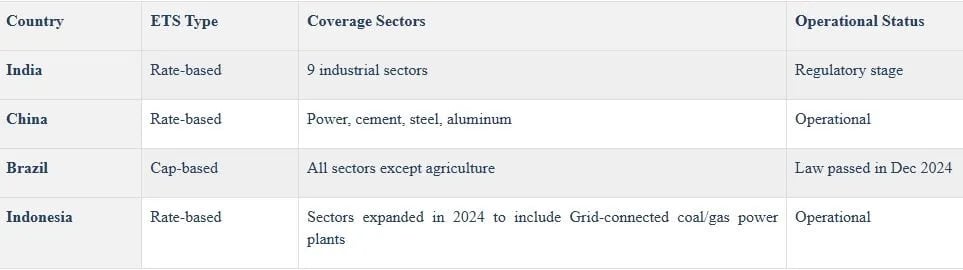
- India is moving towards a rate-based Emissions Trading System (ETS) with the adoption of the Carbon Credit Trading Scheme (CCTS) in 2024.
- Rate-based ETS refers to a system where total emissions are not capped, but individual entities are allocated a performance benchmark that serves as a limit on their net emissions.
- The national ETS will initially cover nine energy-intensive industrial sectors.
- The scheme focuses on emissions intensity, not absolute emissions caps.
- Credit Certificates will be issued to facilities that outperform benchmark emissions intensity levels.
| The Carbon Credit Trading Scheme (CCTS) – It involves two key elements: a compliance mechanism for obligated entities (primarily industrial sectors) and an offset mechanism for voluntary participation. – The CCTS aims to incentivize and support entities in their efforts to decarbonize the Indian economy. – CCTS laid the foundation for the Indian Carbon Market (ICM) by establishing the institutional framework. |
Government Steps to Strengthen Carbon Market Readiness
- As highlighted during the COP 27, India balances its developmental needs with lower carbon emissions through Common but Differentiated Responsibilities and Respective Capabilities (CBDR-RC) principles.
- India’s efforts include:
- Mission LiFE and the Green Credit Program to promote a sustainable lifestyle.
- Creation of the National Steering Committee for the Indian Carbon Market (NSCICM) and the Bureau of Energy Efficiency (BEE) under the Ministry of Power.
- Incentives for private sector participation.
Conclusion
- As global markets evolve and instruments like CBAM create external pressures, India is aligning its policies to maintain competitiveness while achieving climate goals.
- By focusing on emissions intensity rather than absolute caps, India’s rate-based ETS offers a pragmatic and flexible path forward, particularly for an economy balancing development with decarbonization.
Source: TH
Previous article
India Requires $50 Billion New Investment in Storage by 2032: Report
Next article
News In Short 27-August-2025
