


Syllabus: GS1/Tribal Groups
Context
- The Ministry of Tribal Affairs (MoTA) has written to the Registrar General and Census Commissioner, urging that particularly vulnerable tribal groups (PVTGs) be separately enumerated in the upcoming census.
- While data on Scheduled Tribes was collected during the 2011 Census, data separately for PVTGs was not collected.
Who are Particularly Vulnerable Tribal Groups (PVTGs)?
- In 1973, the Dhebar Commission set up a separate category for Primitive Tribal Groups (PTGs).
- In 1975, the Union identified 52 tribal groups as PTGs.
- In 1993, 23 more groups were added to the list. Later, in 2006, these groups were named PVTGs.
- PVTGs are a more vulnerable group among tribal groups in India.
- These groups have primitive traits, geographical isolation, low literacy, zero to negative population growth rate, and backwardness.
- Moreover, they are largely dependent upon hunting for food and a pre-agriculture level of technology.
- Out of more than 700 tribal communities, there are 75 tribal communities identified as PVTGs residing in 18 States and the Union Territory of Andaman and Nicobar Islands.
- As per the Ministry of Tribal Affairs, the PVTG population is estimated to be 45.56 lakh.
- Madhya Pradesh, Maharashtra, and Andhra Pradesh are the top three in terms of PVTG population.
Challenges Faced by the PVTGs
- Marginalisation: Due to their isolation, small population size, and distinct socio-economic and cultural traits.
- Limited Access to Services: Poor access to healthcare, education, and other basic facilities.
- Discrimination and Vulnerability: Subject to social discrimination and displacement from development projects and natural disasters.
- Lack of Political Representation: Minimal role in decision-making due to low political visibility.
Why the Census Matters?
- Better Resource Allocation: Helps the government to channel resources effectively for infrastructure, healthcare, and education.
- Targeted Welfare Schemes: It will enable the design and delivery of focused development programmes.
- Improved Planning: Provides data for long-term development strategies and policy decisions.
- Support for Research and Governance: Offers reliable information for the judiciary, policymakers, and scholars to study trends in migration, urbanisation, employment, and fertility.
Government Initiatives
- PM-JANMAN Scheme: It was launched on the occasion of Janjatiya Gaurav Divas in 2023 in Jharkhand, targeting 75 PVTGs communities.
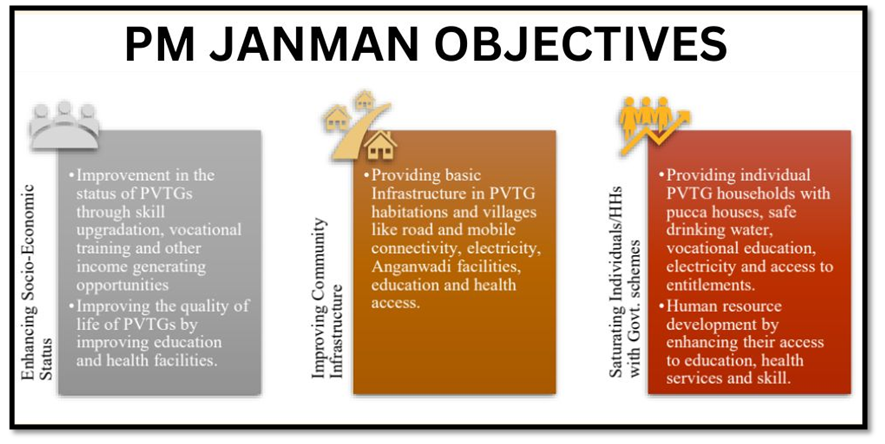
- Particularly Vulnerable Tribal Groups (PVTGs) Development Program: The PVTG program targets the most vulnerable tribal communities, focusing on improving access to healthcare, education, clean water, and electricity.
- Around 7 lakh PVTG families across 22,000 habitations in 200 districts benefit from comprehensive development plans under this initiative.
Conclusion
- PVTGs are one of the most marginalized and socio-economically backward vulnerable sections of the population. Thus, it was imperative to have a “consolidated database” on their population and socio-economic indicators.
- The precise enumeration of PVTGs will help the implementation of targeted welfare schemes.
Source: TH
Previous article
News In Short 26-August-2025
