


Syllabus: GS2/ Education
Context
- The Comprehensive Modular Survey (CMS: Education) conducted under the 80th Round of the National Sample Survey (NSS), April–June 2025, has revealed that households spend nearly nine times more per child in private schools compared to government schools.
Key highlights of the survey
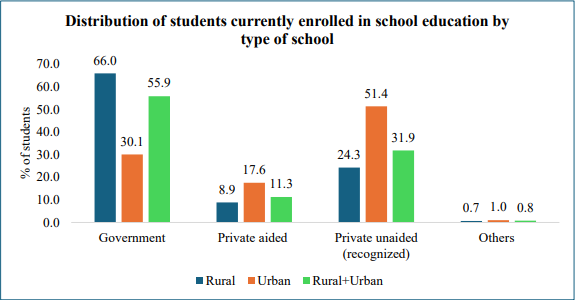
- Dominant enrolment in Government schools: Government schools accounting for 55.9% of total enrolments.
- It is higher in rural areas, where two-thirds (66.0%) of students are enrolled, in comparison to urban areas (30.1%).
- The average per student expenditure made by households on school education during the current academic year in government schools was estimated at ₹2,863, while it was significantly higher (₹25,002) in non-government schools.
- Only 26.7% of students enrolled in government schools reported paying course fees, in contrast to 95.7% of students in non-government schools.
- Family funding: 95% of students in India reported that the first major source of their funding was from other household members.
- Prevalence of private coaching: Nearly a third of all students (27.0%) were taking or had taken private coaching during the current academic year.
- This trend was more common in urban areas (30.7%) than in rural areas (25.5%).
Reasons for Such a Trend
- Rural–Urban Divide: Rural households are more dependent on government schools due to affordability, but urban families often choose private schools.
- Perceived Quality Gap: Parents usually prefer private schools due to perceived better teaching standards, infrastructure, and English-medium instruction.
- Inefficient Learning Outcomes: Challenges in teacher availability and accountability in government schools push parents towards private institutions.
- Shadow Education Dependence: Growing reliance on coaching reflects limitations in classroom learning effectiveness.
Government Initiatives
- Samagra Siksha Abhiyan (SSA): It is an overarching scheme for the school education sector extending from pre-school to class XII.
- The Scheme subsumes the three erstwhile Centrally Sponsored Schemes of Sarva Shiksha Abhiyan (SSA), Rashtriya Madhyamik Shiksha Abhiyan (RMSA) and Teacher Education (TE).
- PM SHRI Schools: Development of 14,500 schools as exemplary institutions with modern infrastructure and pedagogy.
- Right to Education (RTE) Act, 2009: Free and compulsory education for children aged 6–14, with 25% reservation in private schools for disadvantaged groups.
- National Education Policy (NEP) 2020: Focus on foundational literacy, teacher training, digital integration, and equitable access.
- Digital Initiatives: DIKSHA, SWAYAM, and PM e-Vidya to bridge resource gaps.
Way Ahead
- Enhancing Government School Quality: Invest in modern infrastructure, digital learning tools, and continuous teacher training to restore confidence in public education.
- Learning Outcome Focus: Shift policy emphasis from enrollment numbers to measurable improvements in literacy, numeracy, and higher-order skills.
- Affordable Private Participation: Encourage low-cost private schools and public–private partnerships with strict quality benchmarks to expand access.
- Bridging Rural–Urban Divide: Special schemes for rural and remote regions to provide digital connectivity, qualified teachers, and adequate infrastructure.
- Parental & Community Engagement: Strengthen School Management Committees and awareness campaigns to create ownership of government schools at the grassroots.
- Data-Driven Governance: Regular surveys should be integrated into policymaking to monitor progress and course-correct.
Source: PIB
