


Syllabus: GS3/ Infrastructure, Energy
In Context
- India has crossed 50% installed power capacity from non-fossil sources five years early. The next challenge is rapidly scaling up Energy Storage Systems (ESS) to meet rising demand, cut costs, and keep power affordable.
What are Energy Storage Systems (ESS)?
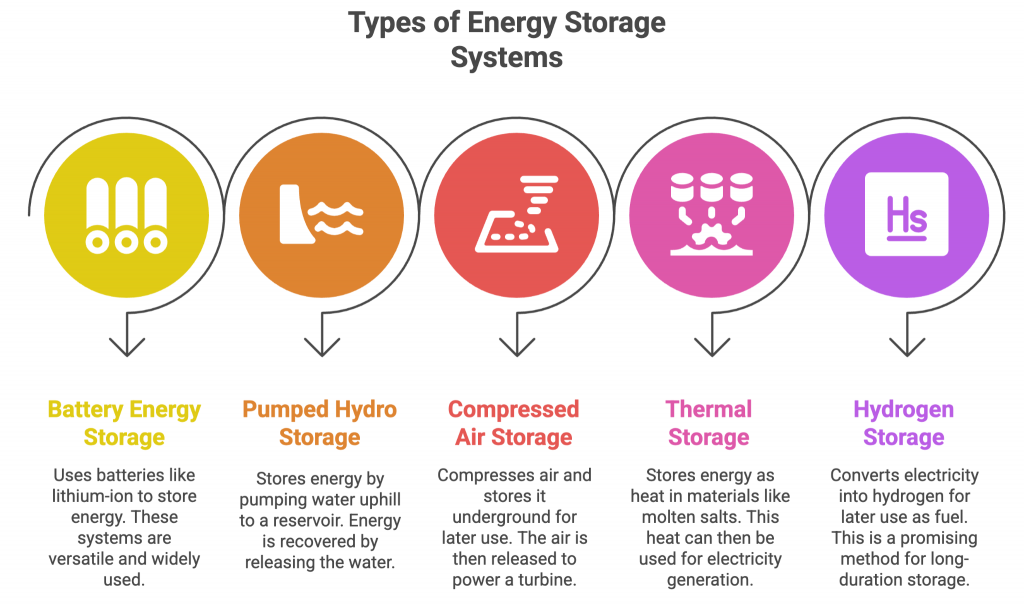
- Energy Storage Systems store energy when supply exceeds demand and release it when demand peaks. They provide flexibility, reliability, and stability to the power grid, especially when renewable sources like solar and wind are intermittent.
- States leading storage deployment: Gujarat, Rajasthan, Maharashtra, Uttar Pradesh, Andhra Pradesh, and Telangana.
Why is ESS Crucial for India?
- Round-the-clock Renewable Energy (RE): Solar and wind are variable; storage balances supply-demand.
- Peak Load Management: Batteries can release power during evening peaks when solar declines.
- Grid Stability: Reduces frequency fluctuations and blackout risks.
- Economic Gains: According to a 2025 study by the India Energy & Climate Centre (UC Berkeley) and the Power Foundation of India, large-scale ESS could save consumers $7 billion (₹60,000 crore) annually by 2032.
- Avoiding Stranded Assets: With storage, coal plants can be used sparingly, reducing the risk of under-utilised capacity.
- Climate Commitments: ESS is key to achieving India’s 500 GW non-fossil capacity by 2030 and Net Zero by 2070.
Challenges in ESS Deployment
- High Upfront Costs: Despite falling prices, large-scale projects need massive investment.
- Policy Gaps: Lack of clear storage obligations for discoms.
- Revenue Models: No clear rules for “revenue stacking” (multiple uses of batteries).
- Revenue stacking means making money from one battery system in many different ways at the same time.
- Domestic Manufacturing: Dependence on imported lithium and other critical minerals.
- Stranded Coal Assets: 50–70 GW of thermal capacity may run below 30% PLF by 2032.
Policy Support & Government Initiatives
- Production-Linked Incentive (PLI) Scheme for Advanced Chemistry Cells (ACC).
- Viability Gap Funding (VGF): To support early storage projects.
- National Green Hydrogen Mission (NGHM): Hydrogen as long-duration storage.
- Battery Recycling Rules: To ensure circular economy and reduce import dependence.
- Critical Minerals Policy: Securing lithium, cobalt, nickel supply chains.
- Draft National Electricity Plan (NEP): Identifies storage as key for renewable integration.
Conclusion
- India’s energy future depends on swift expansion of energy storage, supported by robust policy, investment, and technology. This transition will enable sustainable, reliable, and affordable clean power—making the country a global leader in the renewable energy revolution.
Source: DTE
