The Government of India Act, 1919 or Montagu-Chelmsford Reforms was passed by the British Parliament in response to appease the support of Indians in World War I and to address the Rise of Indian Nationalism. The act was also an outcome of the previously failed Minto-Morley Reforms of 1909 that had provided few council seats without real powers.
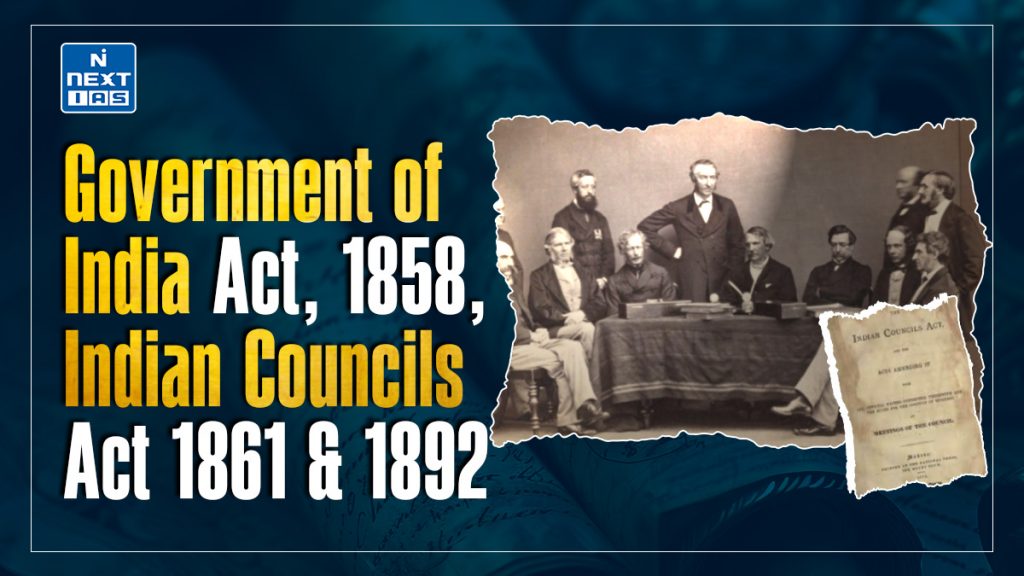
The Indian Councils Act, 1861 introduced the ‘Policy of association’wherein nowIndians were involved in law making. As a result, the Raja of Benaras, the Maharaja of Patiala, and Sir Dinkar Rao were nominated by the Viceroy Lord Canning as the ‘Non-Official’ Members. The Viceroy was also designated with the power to make Ordinances valid for 6 months. The Indian Councils Act, 1892 was the first ‘Indirect’ step towards a representative government because the act allowedlocal bodies to recommend non-official members and discuss the budget but cannot vote.
Government of India Act, 1858
- The Government of India Act 1858, also known as the Act for the Good Government of India, marked a significant transition in India’s governance.
- It abolished the East India Company and transferred the administration of India to the British Crown. Various political and administrative challenges drove this transformation.
Causes Behind Government of India Act, 1858
- Revolt of 1857: The immediate cause was the widespread crisis resulting from the Revolt of 1857, which exposed the inefficiencies of the Company’s governance.
- Demand for Crown’s Administration: The revolt amplified calls for direct control of Indian administration by the British Crown, as many believed that the Company had failed in governance.
- Ministerial Responsibility: There was a need to align India’s administration with the principles of British political systems, ensuring ministerial responsibility.
- Dual Control Issues: The cumbersome and ineffective dual control by the Court of Directors and the Board of Control had long been criticized for causing delays and confusion in administration.
Features of Act for the Good Government of India
- Abolition of Dual Control: The Act ended the double government system by abolishing the Board of Control and the Court of Directors.
- Secretary of State for India: A new office was created, with the Secretary of State being a member of the British Cabinet, holding complete authority over Indian administration. The Secretary was assisted by a 15-member advisory council.
- Governor-General as Viceroy: The Governor-General of India was re-designated as the Viceroy, becoming the Crown’s direct representative. Lord Canning was the first Viceroy of India.
- Transfer of Armed Forces: The Company’s armed forces were transferred to the Crown.
Analysis of Act for the Good Government of India
- The Act formalized British Crown control over India, centralizing authority in London.
- However, it did not bring structural changes to the Indian administration or include Indians in governance.
- Despite calls for representation, Indians were excluded from legislative councils, signaling the continuation of British dominance.
Indian Councils Act, 1861
The Indian Councils Act, of 1861, followed the Government of India Act 1858, to address governance issues and decentralise certain administrative powers.
Causes Behind Indian Councils Act, 1861
- Lack of Indian Participation: The exclusion of Indians from administration after the Revolt of 1857 highlighted the need for their involvement in governance.
- Inefficiency of Centralized Administration: Centralization of legislative functions in the Governor-General’s Council since 1853 proved inadequate for provincial needs.
- Improved British-Indian Relations: British authorities recognized the importance of including Indian elites in administration to stabilize governance.
Features of the Act
- Expanded Legislative Council: The Viceroy’s Legislative Council now included 6 to 12 additional members, half of whom were non-officials. Indian elites such as the Raja of Banaras and Maharaja of Patiala were nominated.
- Decentralization of Legislative Powers: Legislative functions were restored to Bombay and Madras, with subsequent legislative councils created in Bengal (1862), NWFP (1886), and Punjab (1897).
- Portfolio System: The Viceroy was empowered to assign business portfolios to members of his council, introduced by Lord Canning.
- Emergency Ordinances: The Viceroy could issue ordinances during emergencies without council concurrence.
Analysis of the Act
- The Act marked the beginning of Indian involvement in governance, though limited to elites loyal to the British.
- It decentralised some powers and introduced new administrative tools like the portfolio system.
- However, legislative councils functioned more as consultative bodies than forums for real debate or decision-making.
Indian Councils Act, 1892
The Indian Councils Act, 1892, aimed to address the inadequacies of the 1861 Act by increasing Indian participation and introducing elements of representative governance.
Causes Behind Indian Councils Act, 1892
- Rise of Nationalism: Indian nationalism gained momentum after 1861, culminating in the formation of the Indian National Congress (1885), which demanded legislative reforms and elections.
- British Political Strategy: To counter nationalist demands, the British sought to expand their support base among moderate Indians.
- Administrative Challenges: The British realized that involving Indians in governance could help reduce criticism of bureaucratic inefficiencies.
Salient Features
- Expanded Legislative Councils: The number of additional members in the Central Legislative Council increased to 10–16, with half being non-officials.
- Limited Elections: A system of indirect elections (termed “nominations”) was introduced. Non-official members were recommended by provincial councils, district boards, municipalities, universities, and trade associations.
- Budget Discussions: Members could now present observations on the budget and discuss policies, though their influence remained limited.
- Questions in Councils: Members were empowered to ask questions with prior notice, improving transparency.
Analysis
Though the Act introduced limited elections, it fell short of nationalist aspirations for real representation. However, the provisions for budget discussion and questioning allowed Indian leaders to highlight grievances and demand reforms.
Conclusion
The period from 1858 to 1892 was marked by significant legislative developments aimed at restructuring Indian governance under British control. The Government of India Act, 1858, centralized authority under the Crown, while the Indian Councils Acts of 1861 and 1892 gradually introduced elements of decentralization and Indian participation. Although these acts did not satisfy nationalist aspirations, they laid the groundwork for future demands for self-governance and representative institutions in India.
GS - 1