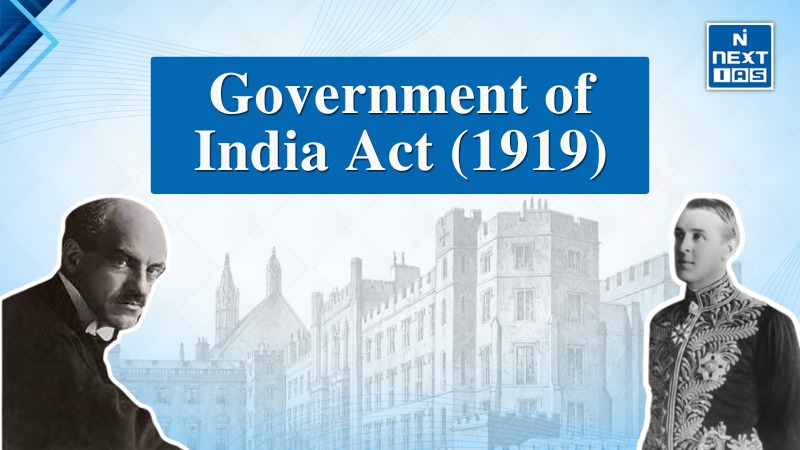
The Government of India Act, 1919 or Montagu-Chelmsford Reforms was passed by the British Parliament in response to appease the support of Indians in World War I and to address the Rise of Indian Nationalism. The act was also an outcome of the previously failed Minto-Morley Reforms of 1909 that had provided few council seats to Indians without real powers.
The Act established dyarchy or dual government under which ‘Reserved Subjects’ like Finance, Police were kept by the Britishers whereas ‘Transferred subjects’ such as Health, Education were given to Indian Ministers at the ‘provincial level’. The bicameral legislative system consisted of a Council of State (Upper House) and a Central Legislative Assembly (Lower House) for central government that came into effect in 1921 after its 1919 enactment.
The key features of the act includes 1st time voting right to women in India with limited suffrage and also provided the provision of central public service commission for the 1st time in India to fulfill Britisher’s long pending promise of the August Offer of 1917.
Causes Behind Government of India Act, 1919
- Failure of the Indian Councils Act, 1892: The Act failed to meet the demands of nationalist leaders for meaninThe reforms failed to satisfy nationalist aspirations, with both Hindus and Muslims growing discontented with British policies.
- Unity in Congress: The 1916 Lucknow session witnessed the reunion of moderates and extremists in the Congress, alongside Hindu-Muslim cooperation.
- World War I: India’s substantial contributions to the war effort fueled demands for constitutional reforms.
- Growing Nationalism: Increased political consciousness and activism necessitated British attempts to appease Indian demands.
- Montagu Declaration: The British promise in 1917 to introduce a responsible government in India heightened reform expectations.
Salient Features of Montagu-Chelmsford Reforms
- Preamble: The Montagu Declaration (1917) emphasising self-government for India was incorporated as the Act’s preamble.
- Dyarchy in Provinces: Provincial subjects were divided into categories of transferred (under elected ministers) and reserved (under Governors).
- Bicameralism: Introduced at the central level with a Legislative Assembly (145 members) and a Council of State (60 members).
- Direct Elections: Introduced for legislative bodies, but suffrage was highly restricted based on property, education, and taxes.
- Separate Electorates: Extended to Sikhs, Anglo-Indians, Christians, and Europeans, perpetuating communal divisions.
- Public Service Commission: Established to improve the recruitment process for civil services.
- Provincial Budget Separation: Provincial budgets were separated from the central budget.
- Indian Ministers: Three Indians were required in the Viceroy’s Executive Council, increasing Indian participation.
Analysis of Montagu-Chelmsford Reforms
- The Act aimed to appease Indian demands while maintaining British supremacy.
- The introduction of dyarchy needed to be revised. The illogical division of subjects between transferred and reserved categories undermining governance separate electorates deepened communal divides.
- Although the reforms allowed more extraordinary legislative powers and increased Indian involvement, they fell short of granting full responsible governance.
- Indians could influence but not control the legislative or administrative process.