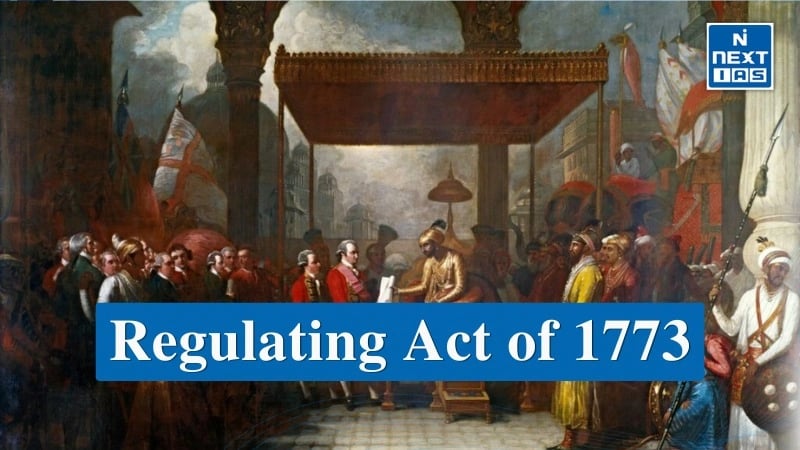
The act is considered the First involvement of the British Parliament in the internal affairs of East India Company. The ‘Governor’ of Bengal was renamed as the ‘Governor General’ of Bengal and Madras and Bombay presidencies were made subordinate to Bengal. This became the First step towards centralization of power in British India. Before 1773, the presidencies were independent of each other. The Supreme Court With one Chief Justice Elijah Impey and 3 other judges was established at Fort William Calcutta in 1774. The act also prohibited private trade by company servants and compelled them not to accept gifts or bribes from local people. For the 1st time the court of directors were required to submit civil, revenue and military reports to the secretary of state in England.
About Regulating Act of 1773
- The advent of British political dominance in India began with the Treaty of Allahabad in 1765, granting the East India Company Diwani Rights (revenue collection) in Bengal.
- Lord Clive’s introduction of the Dual Government system, where the Company controlled revenues while Indian officials managed administration, marked the Company’s initial governance.
- However, the Company’s mismanagement soon necessitated intervention, leading to legislative measures such as the Regulating Act of 1773 which laid the foundations for British Parliament rule in India.
The Regulating Act was the British Parliament’s first step toward controlling and recognising the East India Company’s political and administrative functions in India. Several factors necessitated this legislation:
- The Company’s financial crisis culminated in a demand for a £1 million loan in 1772.
- There is a need to define the relationship between the Company and the British government.
- Criticism of the Company’s governance in Bengal and unethical practices of its officials.
Salient Features
- The Governor of Bengal was elevated to Governor-General of Bengal (Warren Hastings being the first).
- A four-member Executive Council assisted the Governor-General, concentrating legislative powers.
- Governors of Bombay and Madras presidencies were subordinated to the Governor-General of Bengal.
- A Supreme Court was established in Calcutta (1774) with Sir Elijah Impey as its first Chief Justice.
- Servants of the Company were prohibited from engaging in private trade or accepting bribes.
- The Court of Directors was required to report on the Company’s revenue and military affairs in India.
Analysis of the Act
The Act laid the groundwork for a unitary form of governance in India and resolved issues of dual administration. However, its implementation faced challenges:
- The Governor-General lacked overriding powers, leading to legislative deadlocks.
- The undefined jurisdiction of the Supreme Court caused conflicts with the Governor-General’s Council.
- Despite its shortcomings, the Act began centralized governance in India.
Legacy of the Act
- The Regulating Act of 1773 laid the structural framework for British administration in India.
- These measures gradually transferred authority from the East India Company to the British Crown, culminating in the Crown’s direct control over India in 1858 after the Sepoy Mutiny.
- These Acts reflect the evolution of British governance in India, transitioning from mercantile exploitation to centralised colonial administration.
- They also underscore the beginning of India’s political and economic integration under colonial rule.
FAQs about Regulating Act of 1773
What was the Regulating Act of 1773?
The Regulating Act of 1773 was the first major legislation by the British Parliament to regulate the governance of the East India Company in India. It aimed to address corruption, improve administration, and establish central control over the company’s territories in India, introducing significant changes like the appointment of a Governor-General of Bengal and setting up a Supreme Court in Calcutta.
Who introduced the Regulating Act of 1773?
The Regulating Act of 1773 was introduced by the British Parliament under the guidance of the then Prime Minister, Lord North.