


Syllabus: GS3/ Economy
Context
- India sold over two million EVs in 2024, a 27 percent rise over the previous year which is driven by FAME I/II, PM E-DRIVE and the automotive PLI scheme.
- Also, India is going to target 30 percent EV penetration by 2030, that would create a battery market worth INR 25.05 trillion (US$300 billion).
- However, this transition rests on critical minerals such as lithium, cobalt, nickel, and graphite for which India is almost entirely import dependent mainly on China.
- This exposes India’s clean mobility ambitions to geopolitical and supply chain risks.
Scale of Mineral Demand
- Rising Battery Demand: India’s lithium ion battery market is projected to grow from 10.8 GWh in 2022 to 160.3 GWh by 2030.
- NITI Aayog estimated that for producing 100 GWh of batteries annually India need around 193,000 tonnes of cathode active material and 98,000 tonnes of anode active material, alongside copper, lithium, and aluminium.
- Structural Dependence: A February 2026 NITI Aayog assessment found mineral demand under a net zero scenario would be 51 percent higher than under current policy, indicating the dependence will intensify, not ease, as India scales up.
- Widening Trade Deficit: India’s critical mineral import bill more than doubled from US$3.03 billion in 2020-21 to US$8.01 billion in 2023-24 which will widen the trade imbalance.
Scale of Mineral Demand
- Growing Battery Demand: India’s lithium ion battery market is expected to expand from 10.8 GWh in 2022 to 160.3 GWh by 2030. NITI Aayog projects that for 100 GWh of batteries to be produced annually India will require around 193,000 tonnes of cathode active material and 98,000 tonnes of anode active material, along with copper, lithium and aluminium.
- Structural Dependence: NITI Aayog’s February 2026 assessment found that mineral demand under a net zero scenario would be 51 percent higher than under current policy, indicating that the dependence will intensify, not ease, as India scales up.
- Critical Mineral Import Bill: Critical mineral import bill of India has more than doubled from US$3.03 billion in 2020-21 to US$8.01 billion in 2023-24 which will increase the trade imbalance.
The China Factor
- Import Dependence: India is 100 percent import dependent for lithium, cobalt and nickel, imports over 90 percent of its copper needs and 60 percent of natural graphite.
- China supplies over 80 percent of India’s lithium imports and dominates cobalt, nickel and graphite processing.
- Global Processing Chokehold: China currently controls about 90 percent of global rare earth processing, 68 percent of nickel refining, 65 percent of lithium chemical processing, and 74 percent of cobalt refining. Even minerals mined elsewhere often must be processed in China, meaning extraction abroad is not enough without parallel access to refining.
- Weaponisation Risk: The use of supply chains for geopolitical leverage is not new, as Japan’s 2010 rare earth embargo showed.
- Vertical Integration Advantage: Not just mining, China has created an end to end ecosystem from extraction to cell manufacturing and recycling, and has poured money into mineral rich nations like Congo, Indonesia, Argentina and Peru, extending its control upstream too.
Domestic Constraints
- Geological Limitations: Although India has abundant manganese, iron, aluminium, and copper resources with established mining infrastructure, but only inferred lithium resources (5.9 million tonnes in Jammu and Kashmir), and negligible cobalt, nickel, and battery grade graphite deposits.
- Processing Gap: India lacks lithium refining capability though one battery grade lithium refinery with 1,000 TPA capacity has begun operations. Cathode and anode material production remains at the pilot stage.
- Regulatory Bottlenecks: Exploration has historically been dominated by public sector agencies with limited private participation.
- Multiple overlapping clearances, environmental and coastal regulation zone restrictions on rare earth bearing monazite sands, and restricted private entry into strategic minerals slow project development.
- Financing Difficulty: Midstream refining and recycling require large upfront capital with long gestation periods and volatile commodity prices, making private capital reluctant to enter until commercial viability is demonstrated.
Government Initiatives
- Demand & Infrastructure: The FAME policies and the recent PM E-DRIVE initiative (with an INR 109 billion outlay) launched to rapidly scale up electric buses, two-wheelers, and charging infrastructure.
- National Critical Minerals Mission (NCMM): It is a ₹34,300 crore ($4.1 billion) initiative launched to secure self-reliance in 30 critical minerals (including lithium, cobalt, and rare earth elements).
- Spanning FY 2024-25 to 2030-31, it targets domestic exploration, overseas asset acquisition, mineral recycling, and technology development for clean energy and defense.
- Production Linked Incentives: The ₹25,938 crore Production Linked Incentive (PLI) Scheme for the Automobile and Auto Component Industry is a core government initiative driving India’s shift toward Advanced Automotive Technology (AAT).
- It provides financial incentives ranging from 8% to 18% of sales value to companies manufacturing zero-emission vehicles (EVs, hydrogen fuel cell) and their critical components.
- International Partnerships: India has signed lithium exploration agreements with Argentina and critical minerals cooperation with Australia also participating in the Minerals Security Partnership, Quad Critical and Emerging Technologies Working Group and the India EU Trade and Technology Council.
Way Forward
- A 4-Pillar Strategic Framework to mitigate vulnerabilities, India must adopt a multi-faceted approach to diversify its supply chains away from China:
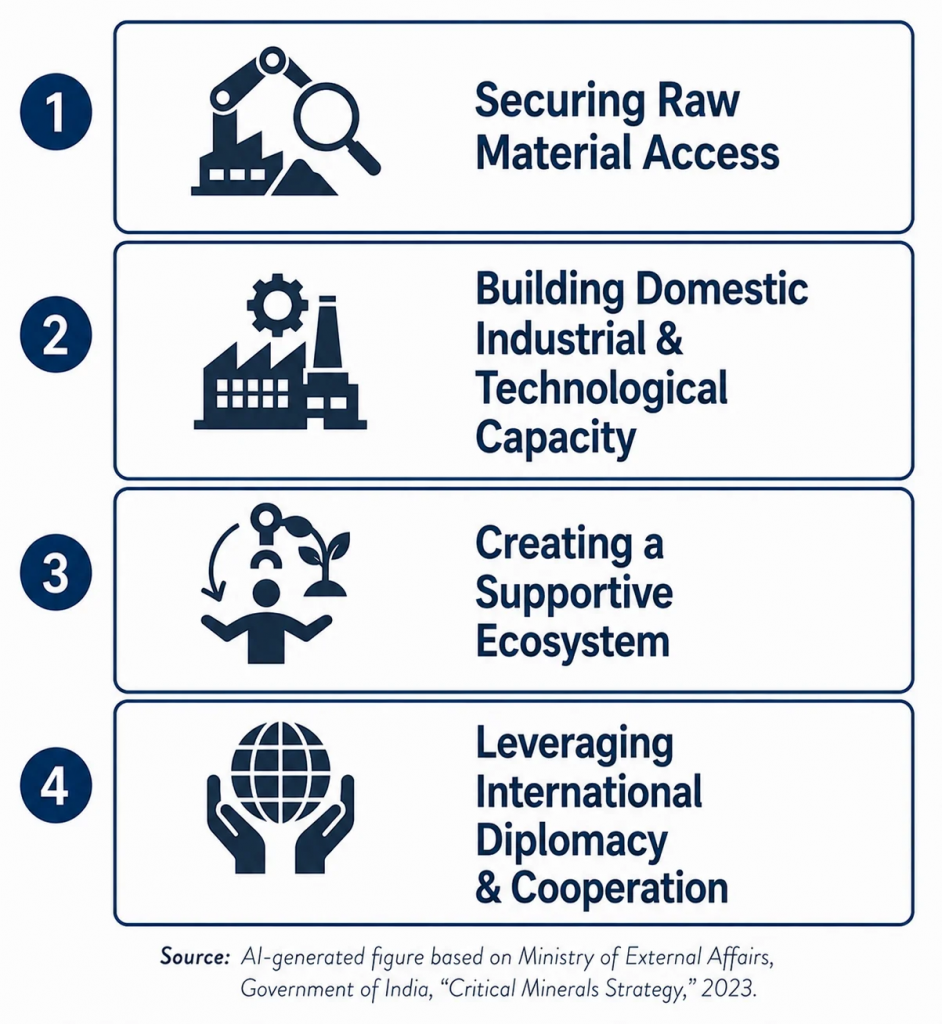
- Securing Raw Material Access:
- Domestic Exploration: Streamline fragmented environmental clearance processes and create risk-sharing incentives to boost private sector participation in domestic exploration
- Global Acquisitions: Expand the NCMM’s mandate to acquire overseas mineral blocks, building on recent lithium partnerships with Argentina and investments in Australia
- Building Domestic Industrial & Technological Capacity:
- Midstream Processing Islands: Partner with non-Chinese technology licensors (e.g., Japan, South Korea, EU) to build advanced domestic smelting and refining hubs
- Alternative Chemistries: Accelerate domestic R&D via grants and tax incentives to develop alternative batteries (like sodium-ion and solid-state) that rely on readily available raw materials
- Urban Mining: Create a robust recycling ecosystem with mandatory extended producer responsibilities to extract secondary lithium, cobalt, and nickel from retired EV batteries
- Creating a Supportive Ecosystem:
- Blended Finance: Establish a National Critical Minerals Fund to deploy blended finance, viability gap funding, and political risk insurance to de-risk long-term private investments
- Public Procurement: Mandate local-sourcing thresholds in public-sector fleets to send strong demand signals for localized value chains
- ESG & Traceability: Implement digital traceability (like blockchain) and strict Environmental, Social, and Governance (ESG) certification standards to build trust with global non-Chinese suppliers
- Leveraging International Diplomacy:
- Plurilateral Alliances: Deepen engagement with the US-led Minerals Security Partnership (MSP), the Quad Critical and Emerging Technologies Working Group, and the India-EU Trade and Technology Council
- Regional Frameworks: Form an Indo-Pacific Critical Minerals Partnership alongside Australia, Japan, and South Korea to coordinate upstream exploration and technology sharing
Conclusion
- India’s transport energy transition is not merely a technological upgrade, it is an exercise in geopolitical statecraft
- The choices made in this decade regarding mining regulations, circular economy policies, and mineral diplomacy will determine India’s economic resilience and its strategic autonomy in the global clean-energy ecosystem.
Source: ORF
Previous article
The Real Crisis in India’s Fisheries
