


Rajbanshi
Syllabus: GS1/History /GS1/Society
In News
- West Bengal announced that the state government would work towards including the Rajbanshi language in the Eighth Schedule of the Constitution.
Rajbanshi
- It is an Eastern Indo-Aryan language spoken across parts of Nepal, India, and Bangladesh.
- It is a closely related language variety in India and Bangladesh often known as Rangpuri or Kamtapuri.
- In Census 2011, “Rajbangsi” was recorded as a mother tongue grouped under Bengali. It is not counted as a separate language.
Eighth Schedule
- The Eighth Schedule to the Constitution of India lists the languages officially recognised by the Government of India.
- Articles 344(1) and 351 of the Constitution contain provisions relating to the Eighth Schedule.
- Article 344(1): Provides for the President to constitute a Commission after 5 years and subsequently after every 10 years to recommend the progressive use of Hindi for official purposes of the Union, with representation from Eighth Schedule languages.
- Article 351: Directs the Union to promote and develop Hindi as a medium of expression of India’s composite culture by enriching it through vocabulary and expressions from Sanskrit, Hindustani and other Eighth Schedule languages.
- There are no fixed or formally established objective criteria in the Constitution of India or government rules for including a language in the Eighth Schedule.
- Pahwa Committee (1996) and Sitakant Mohapatra Committee (2003) were set up to evolve objective criteria. Neither produced an accepted framework.
Source: TH
Asia Power Index 2026
Syllabus: IR; Miscellaneous
Context
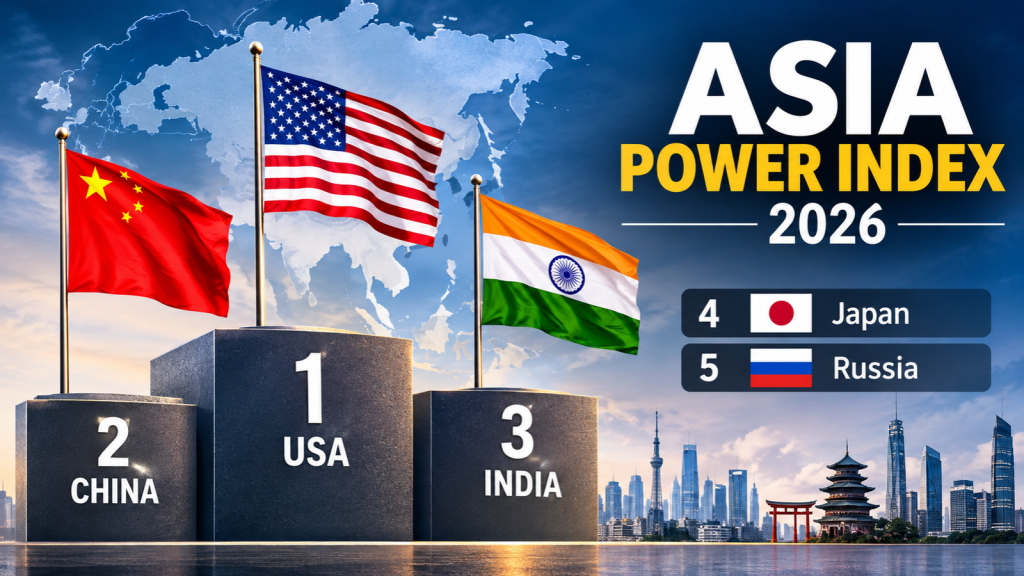
- Australia’s Lowy Institute has released the 2026 Asia Power Index, assessing the distribution of power and influence across the Asia-Pacific region.
About the Index
- Launched in 2018, the index ranks 27 countries and territories based on their capacity to shape their external environment.
- It evaluates power through eight measures, 30 thematic sub-measures and 131 indicators, covering military capability, economic strength, diplomatic influence, cultural influence and resilience, among others.
Key Findings
- The United States tops the rankings with 78.9 points, followed by China at 73.6 points. Their gap has narrowed to just 5.3 points, its lowest level since the index began in 2018.
- India retained third position, with its score rising by 0.5 points to 40.5. Its strongest gains were in cultural influence (+2.3 points) and defence networks (+2.1 points).
- Prime Minister Narendra Modi was ranked the second-most effective regional leader, after China’s Xi Jinping.
Source: IE
Construction and Infrastructure Equipment (CIE) Scheme
Syllabus: GS3/ Economy
In News
- The Union Cabinet has approved the Scheme for Enhancement of Construction and Infrastructure Equipment (CIE) Manufacturing Ecosystem with a financial outlay of ₹11,000 crore.
About the Scheme for Enhancement of Construction and Infrastructure Equipment (CIE) Manufacturing Ecosystem
- What is it? A Central Sector manufacturing incentive scheme aimed at strengthening India’s domestic manufacturing ecosystem for technologically advanced Construction and Infrastructure Equipment (CIE) and critical components.
- Ministry: Ministry of Heavy Industries (MHI).
- Duration: FY 2026–27 to FY 2033–34.
- Objective: Reduce import dependence, strengthen indigenous manufacturing capabilities and make India a competitive global manufacturing and export hub for CIE.
Key Features
- Eight year timeline:
- Gestation: Two years, FY 2026–27 to FY 2027–28, for setting up plants.
- Incentive disbursement: Five years, FY 2028–29 to FY 2032–33.
- Final year (FY 2033–34): Settlement of claims on FY 2032–33 incremental sales.
- Sales linked incentive: Paid on incremental sales value, to two categories of applicants: OEMs and Component Manufacturers. The rate is graded from 13% down to 8% over five years.
- Testing facility: A grant of up to ₹375 crore, structured as Viability Gap Funding.
- Target equipment: Ship to Shore Cranes, Tunnel Boring Machines (TBMs), Hydraulic Excavators and Off Highway Trucks.
Need
- Delays in TBM deliveries from China for the Mumbai–Ahmedabad Bullet Train pushed the government to strengthen domestic manufacturing of high end equipment.
- Curbs on Chinese investment and procurement followed the 2020 border clashes.
- This would strengthen self-reliance in a strategically important capital goods sector.
Source: PIB
Hapus GI Tag Dispute
Syllabus: GS3/Economy
Context
- Mango growers in Maharashtra’s Konkan region have opposed Gujarat’s application for a separate GI tag for Valsad Hapus, citing concerns over the use of the name ‘Hapus’.
About the Dispute
- Alphonso, popularly known as Hapus or the “King of Mangoes”, is a major horticultural product of Maharashtra’s Konkan region.
- It is cultivated extensively in Ratnagiri, Sindhudurg, Raigad and Thane along the Konkan coast, which accounts for over 40% of Maharashtra’s mango production.
- In 2018, Konkan Alphonso received a GI tag covering Ratnagiri, Sindhudurg, Raigad, Thane and Palghar districts.
- In 2023, Bharatiya Kisan Sangh, Gandhinagar, and Navsari Agricultural University filed an application seeking a separate GI tag for Valsad Hapus.
- Gujarat’s argument: Valsad has a long tradition of cultivating Alphonso mangoes with distinct characteristics, including taste, fragrance and harvesting season. A separate GI tag would help establish the region’s identity.
- Konkan growers’ objection: They argue that sharing the name ‘Hapus’ could confuse consumers and dilute the reputation and market value of Konkan Alphonso. They maintain that Valsad should seek recognition under a distinct name.
- Economic significance: Konkan Hapus generates an estimated ₹200 crore in domestic revenue and ₹80 crore through exports.
Source: IE
Estates Management Scheme
Syllabus: GS3/Economy
In News
- The Union Cabinet approved the continuation of the Estates Management Scheme of the Department of Posts during the 16th Finance Commission cycle, FY 2026–27 to FY 2030–31.
Estates Management Scheme
- It is a central sector scheme to develop postal infrastructure, improve the work environment in post offices, and improve delivery of postal services in a cost-effective way.
- It is administered by the Department of Posts under the Ministry of Communications.
- It aims to comprehensively transform and modernize the estates infrastructure of the Department of Posts.
- It focuses heavily on the construction, re-construction, renovation, uniform branding of post offices and residential colonies, along with the preservation of India’s heritage postal buildings.
Source :PIB
Venice Art Biennale
Syllabus: Miscellaneous
In News
- The India Pavilion won the Visitors’ Lion for Best National Participation at the 61st International Art Exhibition, La Biennale di Venezia
Venice Biennale
- It is widely called the Olympics of the art world.
- It is one of the longest-running cultural festivals in the world.
- It is an international art exhibition, founded in 1895 by the Venetian City Council.
- It draws up to 600,000 visitors a year, shows creative and often politically challenging works, creates worldwide art trends and gives a boost to budding artists and architects.
India Pavilion
- The India Pavilion at the Venice Biennale 2026, titled “Geographies of Distance: Remembering Home”, was presented by the Ministry of Culture.
- It explored home as an emotional connection shaped by memory, culture, materials and traditions
- It featured five artists: Alwar Balasubramaniam (land and memory), Ranjani Shettar (nature and craftsmanship), Sumakshi Singh (memory and belonging), Skarma Sonam Tashi (Ladakh’s traditional architecture and sustainability), and Asim Waqif (urban transformation through bamboo art).
Source: PIB
Previous article
India’s Satellite Manufacturing Supply Chain Faces Import Dependence
Next article
News In Brief 26-11-2026
