


Syllabus: GS3/Economy
Context
- Geographical Indication (GI) tags have emerged as a powerful tool for protecting India’s cultural heritage while creating economic opportunities for local communities.
Geographical Indication (GI)
- A geographical indication (GI) is a sign used on products that have a specific geographical origin and possess qualities or a reputation that are due to that origin.
- In order to function as a GI, a sign must identify a product as originating in a given place.
- Geographical indications are typically used for agricultural products, foodstuffs, wine and spirit drinks, handicrafts, and industrial products.
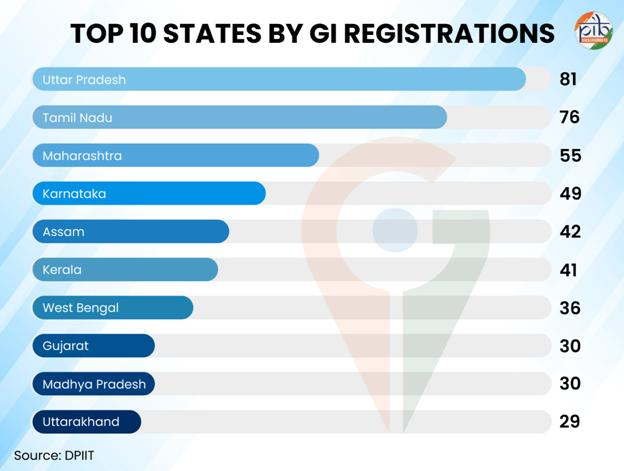
- Darjeeling Tea from West Bengal was the first product in India to receive a GI tag.
Significance of GI goods
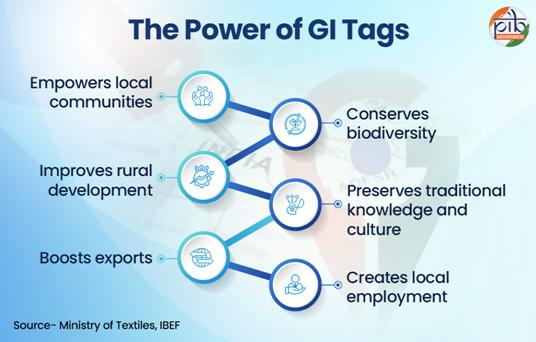
- A GI tag serves as a seal of authenticity for artisanal crafts, safeguarding them against imitation, misuse, and unauthorised commercialisation.
Can a GI tag be revoked?
- A GI registration may be revoked or cancelled if:
- It was obtained through fraud or misrepresentation.
- It is no longer protected in its country of origin or has fallen into disuse.
- Its use is likely to deceive consumers, violates any law, or contains scandalous or obscene matter.
GI Exclusions: What Cannot Be Registered
- Generic product names no longer protected in their country of origin.
- Indications that mislead consumers or falsely suggest a different geographical origin.
- Indications that offend religious sentiments or contain scandalous, offensive, or obscene matter.
- Indications not eligible for legal protection or that violate any law in force.
Regulation of GI
- As a form of intellectual property, GIs are recognised internationally under the Paris Convention for the Protection of Industrial Property and the World Trade Organization’s (WTO) Agreement on Trade-Related Aspects of Intellectual Property Rights (TRIPS).
- In India, their registration and protection are overseen by the Geographical Indications Registry under the 1999 Act.
- India established a legal framework for protecting products linked to specific regions through the Geographical Indications of Goods (Registration and Protection) Act, 1999 and the accompanying Rules notified in 2002.
- The framework became operational in 2003, and GI registrations commenced in 2004–05.
- The registration of a geographical indication is valid for a period of 10 years.
- The Geographical Indications of Goods (Registration and Protection) Rules, 2002, were amended in 2025.
Source: PIB
Previous article
India’s Tea Majors Face Rising Competition from Cheaper Alternatives
Next article
News In Short 04-08-2026
