


Syllabus: GS3/ Agriculture and Animal Husbandry
Context
- Observed every year on 26 November, National Milk Day commemorates the birth anniversary of Dr. Verghese Kurien, the Father of India’s White Revolution.
Milk Production in India
- India is the world’s largest milk producer, contributing 24.76% of global milk output.
- Milk production increased by 69.41 percent, rising from 146.31 million tonnes in 2014-15 to 247.87 million tonnes in 2024-25.
- Leading milk-producing States were Uttar Pradesh (15.66 percent), Rajasthan (14.82 percent), Madhya Pradesh (9.12 percent), Gujarat (7.78 percent), and Maharashtra (6.71 percent). These five States accounted for 54.09 percent of total Milk production in the country.
- Per capita milk availability rose by 52.03 percent, from 319 grams per person per day in 2014-15 to 485 grams in 2024-25.
- India exported 97,524.82 MT of dairy products during 2025-26. Major export destinations included the UAE, Saudi Arabia, the USA, Bhutan, and Bahrain.
Operation Flood
- Operation Flood, also known as India’s White Revolution, was a dairy development programme launched in 1970 by the National Dairy Development Board (NDDB) under Dr. Verghese Kurien.
- It aimed to establish a nationwide milk grid by connecting milk producers in rural areas with urban consumers through dairy cooperatives.
- It was based on the Anand Pattern, a three-tier cooperative structure comprising:
- Village-level Dairy Cooperative Societies.
- District-level Milk Unions.
- State-level Milk Federations.
Role of Dairy Cooperatives in India’s White Revolution
- India’s dairy cooperative movement connects village-level dairy societies with district milk unions and state federations.
- It provides farmers with organised milk procurement, processing and marketing facilities, reducing dependence on informal intermediaries.
- Role of NDDB Dairy Services: The National Dairy Development Board (NDDB), through its wholly owned subsidiary NDDB Dairy Services (NDDB-DS), facilitates the establishment of Milk Producer Organisations (MPOs).
- MPOs are farmer-owned Producer Companies that organise milk producers into professionally managed institutions.
- They facilitate collective milk procurement, transparent pricing, direct bank payments and better market linkages.
Significance of Dairy Sector
- Economic Contribution: India’s dairy is the single largest agricultural commodity, contributing 5 per cent to the national economy and directly employing more than 8 crore farmers.
- Nutritional Security: Milk is a major source of protein, calcium, and vitamins, improving dietary diversity.
- Export Potential: India is emerging as a supplier of dairy products like skimmed milk powder, butter, and ghee to Asia and Africa.
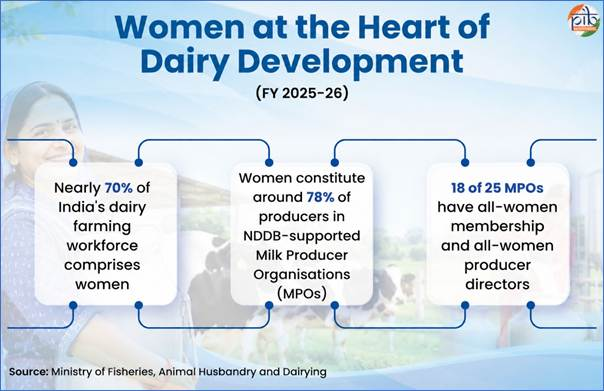
- Women’s Empowerment: Women constitute nearly 70% of India’s dairy workforce, making the sector an important avenue for women’s economic participation.
- Agricultural Resilience: Dairy farming diversifies rural income sources and provides financial support to farmers during crop failures and seasonal fluctuations.
Government Initiatives to Strengthen the Dairy Sector
- White Revolution 2.0: Launched on 25 December 2024, it aims to expand dairy cooperative coverage in uncovered villages and Panchayats and increase milk procurement by cooperatives by 50% over five years.
- By 2028-29, the initiative aims to establish 75,000 new Dairy Cooperative Societies in uncovered villages and Panchayats and strengthen 46,422 existing Dairy Cooperative Societies.
- National Programme for Dairy Development (NPDD) seeks to enhance milk production and strengthen dairy infrastructure across the country. It operates through two components;
- Strengthening Milk Procurement and Quality Infrastructure: Supports milk procurement networks, chilling facilities, milk testing laboratories and processing infrastructure, particularly in the North-Eastern Region, hilly areas and Union Territories.
- Dairying through Cooperatives: Supports dairy processing and marketing infrastructure and strengthens producer-owned institutions to improve farmers’ access to organised markets.
- Nationwide Artificial Insemination Programme (NAIP) aims at enhancing Artificial Insemination coverage and delivering quality Artificial Insemination Services at farmer’s doorstep with semen of high genetic merit bulls including indigenous breeds.
- The Animal Husbandry Infrastructure Development Fund (AHIDF) supports modern dairy processing, value addition and cold-chain infrastructure in the private sector and cooperatives.
- Bharat Pashudhan: Animals registered in the Bharat Pashudhan database are identified by a unique 12-digit ear-tag number, known as “Pashu Aadhaar”.
- It acts as a primary key for registering all types of transactions done on the animals, such as Vaccination, Breeding, Treatment, etc.
- The database provides a digital record of identified animals and supports livestock management.
Challenges in India’s Dairy Sector
- Breed Productivity Gaps: Yields still lag behind advanced dairy nations, especially among indigenous breeds.
- Average yield of Indian cows is 1.64 tonnes/year vs. 7.3 tonnes in EU and 11 tonnes in US.
- Land & Fodder Constraints: Unlike New Zealand, India lacks abundant pasture land.
- Reliance on crop residues and purchased feed makes dairying costly.
- Fragmented dairy production: A large number of small and marginal farmers own only a few milch animals, limiting economies of scale.
- Shortages of veterinary professionals, diagnostic facilities and timely doorstep healthcare affect livestock health, particularly in remote rural areas.
- Climate Impact: Extreme heat reduces yields and drives up prices.
- Post-Harvest Losses: Inadequate cold-chain and processing infrastructure cause wastage.
- Quality concerns: Milk adulteration, bacterial contamination, antibiotic residues and inadequate quality testing undermine consumer confidence and export competitiveness.
Way Ahead
- India needs to improve milk productivity through scientific breeding, better animal nutrition, and accessible veterinary services.
- Strengthening dairy cooperatives, expanding milk processing and cold-chain infrastructure, and improving market access can enhance farmers’ incomes and reduce post-production losses.
- Promoting value addition, climate-resilient dairy practices and scientific cattle waste management is essential for building a competitive and sustainable dairy sector.
Source: PIB
Previous article
The Economic Impact of Inequitable Toilet Access
Next article
Proposed US Tariffs on India
