


Syllabus: GS3/ Economy
In News
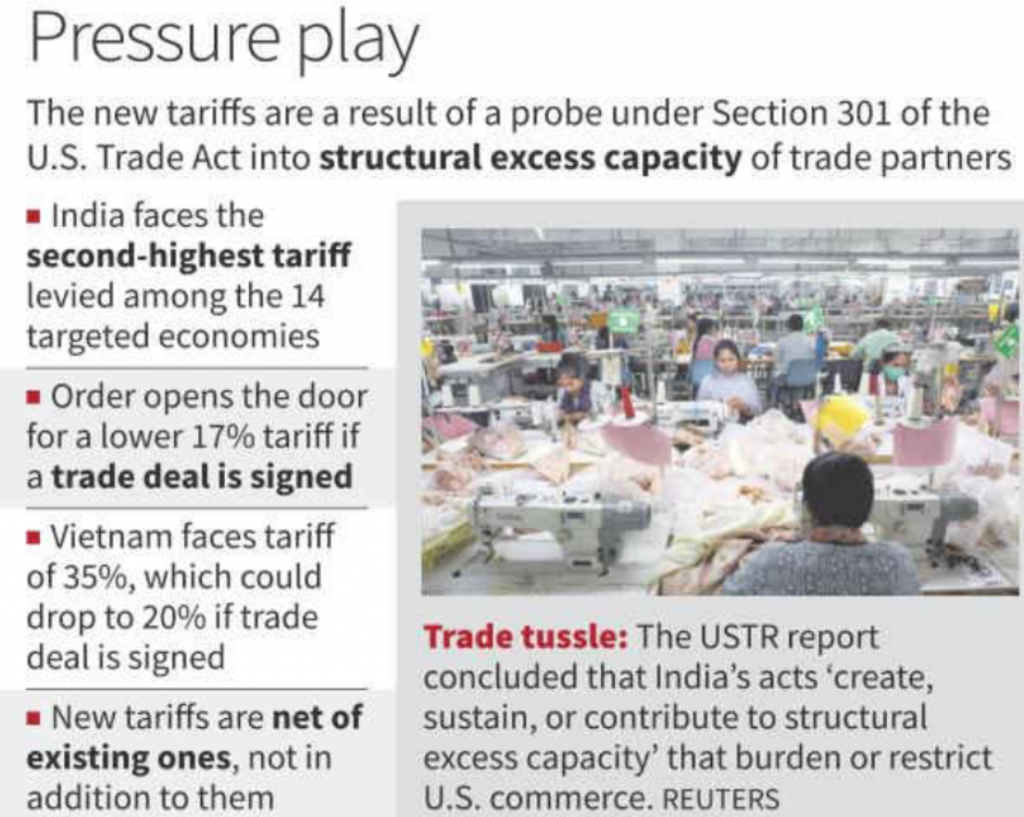
- The Office of the US Trade Representative (USTR) has proposed a 25% tariff on Indian goods under Section 301 of the US Trade Act, 1974.
Reasons Cited by the US
- Excess Capacity: The USTR claims Indian subsidies and industrial policies create surplus capacity in pharmaceuticals, medical devices, steel, solar energy and ICT, hurting US producers and jobs.
- Five Core Allegations: The USTR cites:
- State backed industrial expansion plans.
- Inadequate labour protections.
- Financial repression.
- Persistent market access barriers.
- Failure to curb global overcapacity.
- Non Market Economy Links: US officials flagged security risks from Indian sectors that rely on inputs and FDI from non market economies such as China.
- Bargaining Lever: Analysts such as GTRI see the gap between the 25% penalty rate and the 17% deal rate as pressure to sign bilateral deals on US terms.
Legal Framework of US Tariffs
| Law | Purpose and Current Use |
| Section 301, Trade Act, 1974 | USTR can act against “unreasonable or discriminatory” foreign practices. Basis for the 10% and proposed 25% tariffs |
| Section 232, Trade Expansion Act, 1962 | President can impose tariffs on national security grounds. 50% global tariff on steel and aluminium |
| Lindsey O. Graham Sanctioning Russia and Iran Act, 2026 | Allows tariffs of up to 100% on large buyers of Russian oil. Currently paused |
| IEEPA (emergency powers) | Basis of the 50% tariff of August 2025, struck down by the US Supreme Court in February 2026 |
Implications for India
- Trade Exposure: The US is India’s largest export market. India exported USD 87.31 billion to the US in FY26, with a trade surplus of USD 34.41 billion.
- Margin Pressure: A 25% tariff hurts price competitiveness across pharmaceuticals, engineering goods, textiles, solar modules and electronics. Labour intensive MSMEs are the most exposed.
- Pressure to Conclude the BTA: At 17%, India would gain a small edge over the deal rates of Vietnam (20%) and Bangladesh and Indonesia (18%).
- Risk to Industrial Policy: US scrutiny directly targets PLI schemes and import substitution in solar, pharma and ICT.
- Supply Chain Costs: Reducing reliance on Chinese inputs may force exporters to restructure upstream supply chains, raising short term costs.
- Macro Effects: Lower exports can widen the current account deficit and add pressure on the rupee.
India’s Response
- Rejecting the Charge: The Commerce Ministry stated that India does not have structural excess capacity in any sector, and that the notice is under examination.
- Negotiation over Retaliation: India wants concerns addressed within the Bilateral Trade Agreement talks, announced on 2 February 2026 and followed by a Joint Statement on 7 February 2026.
Concerns
- Unilateralism: Section 301 duties bypass WTO dispute settlement and revive bilateral managed trade.
- Weaponisation of Trade: Tariffs are increasingly used to extract concessions rather than to correct specific trade harms.
- Policy Uncertainty: Frequent changes in legal basis and rates create uncertainty for exporters and investors.
Way Forward
- Balanced BTA: Secure the 17% tier while protecting agriculture, dairy and MSMEs.
- Evidence Based Rebuttal: Submit sector data before 5 January 2027 and at the hearings. The aim is to show that Indian capacity serves domestic infrastructure and supply chain diversification, not dumping.
- Resolve Non Tariff Issues: Address standards, regulatory and customs friction through bilateral working groups.
- Diversify Markets: Fast track trade pacts with the EU, UK, EFTA, ASEAN and the Middle East.
- Strengthen Value Chains: Build domestic upstream capacity to reduce dependence on non market economy inputs.
Source: TH
Previous article
National Milk Day
