

Syllabus: GS2/ IR
Context
- India rejected the Boundary Joint Commission set up by Pakistan and China, saying that the body has no legal basis to decide on arrangements related to Indian territory under illegal occupation.
Background
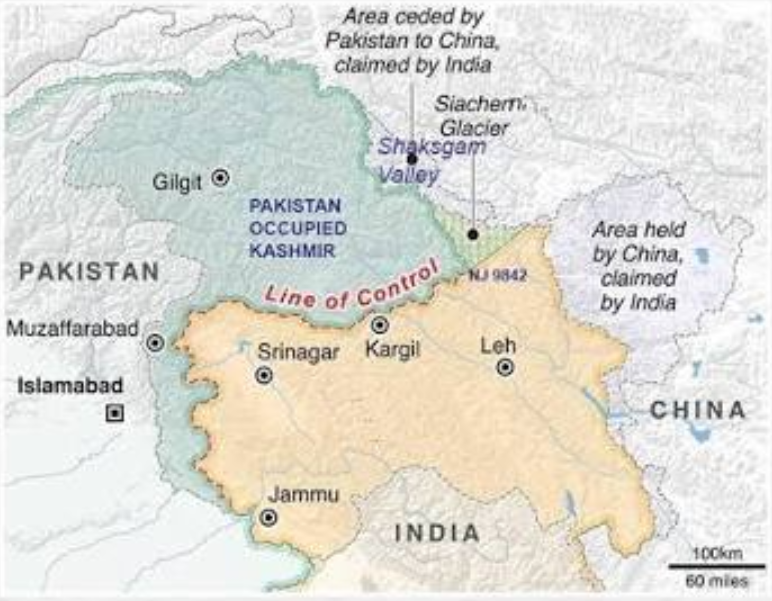
- Pakistan and China signed a Boundary Agreement in 1963, under which Pakistan purportedly ceded around 5,800 sq km of territory in the Shaksgam Valley to China.
- The first meeting of the newly constituted Pakistan-China Boundary Joint Commission was held in Islamabad.
- Pakistan has stated that the commission is intended to promote border management, joint surveys, trade flows and people-to-people connectivity.
India’s Position on the Boundary Joint Commission
- India maintains that the entire Union Territories of Jammu and Kashmir and Ladakh are integral and inalienable parts of India.
- India considers the 1963 Sino-Pakistan Boundary Agreement illegal and invalid, as Pakistan lacked the legal authority to alter the status of Indian territory.
- India has rejected attempts by China and Pakistan to undertake boundary cooperation involving territories claimed by India, arguing that such arrangements cannot affect India’s sovereignty.
Geographical Significance of Shaksgam Valley
- The Shaksgam Valley lies north of the Karakoram range, adjoining China’s Xinjiang region and Pakistan-occupied Gilgit-Baltistan.
- The territory also forms part of the wider India-China-Pakistan strategic triangle in the western Himalayas.
- Under the 1963 agreement, Pakistan agreed to transfer control of the territory to China, subject to a future settlement of the Kashmir dispute.
India’s Concerns on China-Pakistan Economic Corridor (CPEC)
- India’s objections also extend to the China-Pakistan Economic Corridor (CPEC) because parts of the corridor pass through areas of Pakistan-occupied Jammu and Kashmir.
- CPEC forms an important component of China’s Belt and Road Initiative (BRI) and connects Kashgar in Xinjiang with Gwadar in Balochistan through Gilgit-Baltistan.
Implications for India
- Territorial Sovereignty: China-Pakistan arrangements over areas claimed by India may create attempts to legitimise the 1963 agreement and the transfer of the Shaksgam Valley.
- Border Security: Greater China-Pakistan connectivity can strengthen infrastructure and logistical links near India’s northern and western frontiers.
- Strategic Convergence: The commission further institutionalises China-Pakistan cooperation, adding to India’s strategic challenges on its two sensitive frontiers.
- Connectivity Concerns: CPEC strengthens China’s access to the Arabian Sea through territory claimed by India.
Way Ahead
- India needs to maintain a consistent diplomatic and legal position on territorial sovereignty while preventing developments on the ground from creating precedents regarding disputed territories.
- Greater diplomatic engagement with neighbouring countries and sustained monitoring of infrastructure developments can help safeguard India’s strategic interests.
Source: TH
Previous article
India Sets Terms for WTO Plurilateral Agreements
