


Syllabus: GS3/Infrastructure, Transport and Logistics
Context
- Indian Railways is seeking to increase its freight-carrying capacity by decongesting High Density Networks (HDNs) through multitracking and accelerating the development of additional Dedicated Freight Corridors (DFCs).
Importance of Freight Transportation
- Freight earnings contribute over 65% of Indian Railways’ total earnings, helping subsidise passenger services.
- Railways accounted for around 27% of India’s freight transport and carried 1,670 million tonnes of freight in 2025–26.
- Rail freight is relatively cheaper and has lower emissions than road transport, but network congestion and weak last-mile connectivity limit its competitiveness.
- Indian Railways aims to increase freight loading to 3,000 million tonnes by 2030.
About High-Density Networks (HDNs)
- HDNs are heavily utilised passenger-freight routes where train movements frequently approach or exceed the designed line capacity.
- The 11,051 km HDN constitutes only about 16% of the railway network but carries more than 40% of total railway traffic, making it critical to the functioning of the network.
- The seven major HDNs connect Howrah–Delhi, Howrah–Mumbai, Mumbai–Delhi, Delhi–Guwahati, Delhi–Chennai, Howrah–Chennai and Mumbai–Chennai.
- A network utilisation level of around 70–80% is considered desirable for smooth train operations.
- However, only 4.6% of the HDN operates below 80% capacity, while substantial portions operate at 100–120%, 120–150% and above 150% of capacity.
- Congestion particularly affects freight trains, contributing to the relatively low average freight-train speed of around 25 kmph.
Multitracking for Capacity Augmentation
- Multitracking involves adding additional railway lines on heavily utilised routes so that passenger and freight services can operate with greater flexibility.
- The Railways is seeking to four-line the seven HDNs, with the objective of converting overloaded routes into routes with adequate spare capacity.
- Significance:
- Additional lines can reduce conflicts between passenger and freight services and thereby reduce transit delays.
- Shorter transit times can also reduce wastage, deterioration and handling-related losses in goods movement.
- According to the Ministry of Railways, the approximate transportation cost is ₹1.60 per tonne-km by rail compared with ₹3.60 per tonne-km by road, indicating the potential for shifting more freight towards rail.
Dedicated Freight Corridors
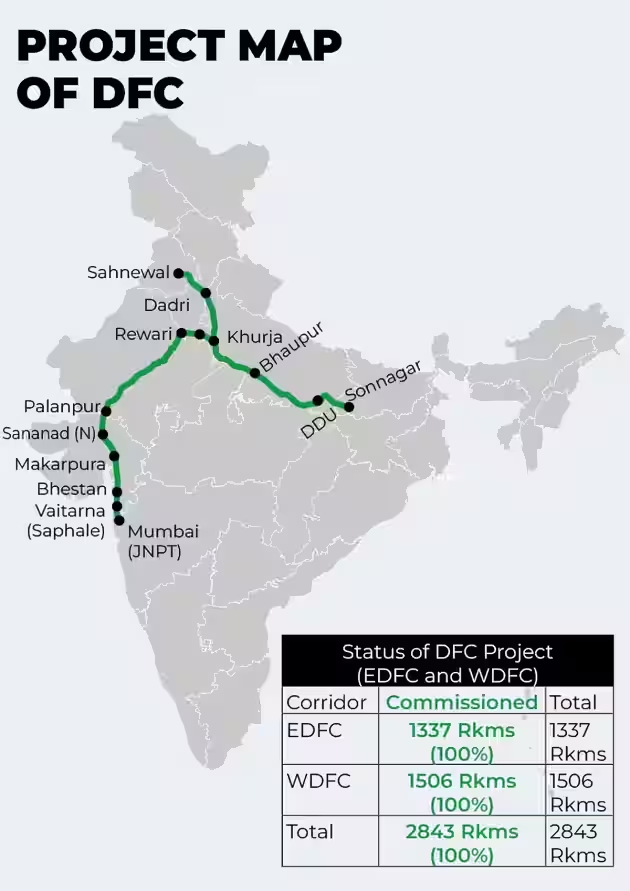
- Dedicated Freight Corridors are specialised railway routes designed primarily for freight trains, allowing goods traffic to move without competing directly with passenger services for capacity.
- They may run parallel to existing railway routes or take alternative alignments to bypass congested passenger terminals and sections.
- Eastern and Western DFCs: Eastern Dedicated Freight Corridor (EDFC) is from Ludhiana to Sonnagar and the Western Dedicated Freight Corridor (WDFC) is from Jawaharlal Nehru Port Terminal (JNPT) to Dadri.
What are the challenges?
- Inadequate last-mile connectivity increases handling time and costs, particularly when railway terminals are not directly connected to industrial clusters, ports, mines and consumption centres.
- Congested terminals and loading facilities can offset the time savings achieved through faster movement on the main railway network.
- Dependence on bulk commodities such as coal limits the diversification of railway freight towards containers, automobiles, agricultural produce and other higher-value goods.
Conclusion
- Expanding freight capacity is only the first step; its real economic value will depend on how efficiently the expanded network is integrated with the wider logistics system.
- A stronger rail freight network can help India achieve lower logistics costs, more reliable supply chains and a greater shift towards sustainable freight transportation.
Source: IE
Previous article
India Rejects Pakistan-China Boundary Joint Commission
Next article
E20 Petrol in India
