


Syllabus: GS2/Governance; GS3/Economy
Context
- India’s 60-plus population is projected to touch 347 million by 2050, underscoring the need for a robust caregiving ecosystem.
About
- As per the NITI Aayog’s recent report India’s 60-plus population, estimated at approximately 149 million in 2022, is projected to touch 347 million by 2050, forming roughly 20.8% of the total population.
- The caregiving ecosystem will be at a serious juncture if India doesn’t plan now.
Data on India’s Ageing Population
- As per the report of the Technical Group on Population Projections constituted by the National Commission on Population, the proportion of the population of the 60 years and above is projected to increase from 10 crores in 2011 to 23 crores in 2036.
- This is an increase in their share of the total population from 8.4 to 14.9 percent.
- Kerala is expected to see its elderly population surge from 13% in 2011 to 23% by 2036, making it the state with the oldest population.
- In contrast, many northern and eastern states have fewer older people for now, but their numbers are growing fast.
Challenges Faced by Elderly
- Health: Stigmatised mental health conditions (dementia, Alzheimer’s), rising disabilities, inadequate geriatric infrastructure, Urban-rural divide in access to medical services.
- Economic: Insufficient social security provisions, rise of living and medical expenses, limited financial resources.
- Social: Weakening family support systems, social isolation, neglect, lack of companionship etc.
- Digital divide: Technology adoption barriers, lack of training and accessible devices.
- Infrastructure: Inadequate literacy, emergency response system overlooking elderly as vulnerable group. Public spaces and transport in India is largely not elderly-friendly since ramps, handrails and accessible washrooms are missing in many areas.
What is Care Work?
- It mainly consists of two overlapping activities: direct, personal, and relational care activities, such as feeding a baby; and indirect care activities, such as cooking and cleaning.
- Unpaid care and domestic work, such as nursing an ill partner or cooking for a family member, is care work provided without monetary compensation.
- Paid care work such as domestic services provided by domestic workers is performed by care workers in exchange for some form of remuneration.
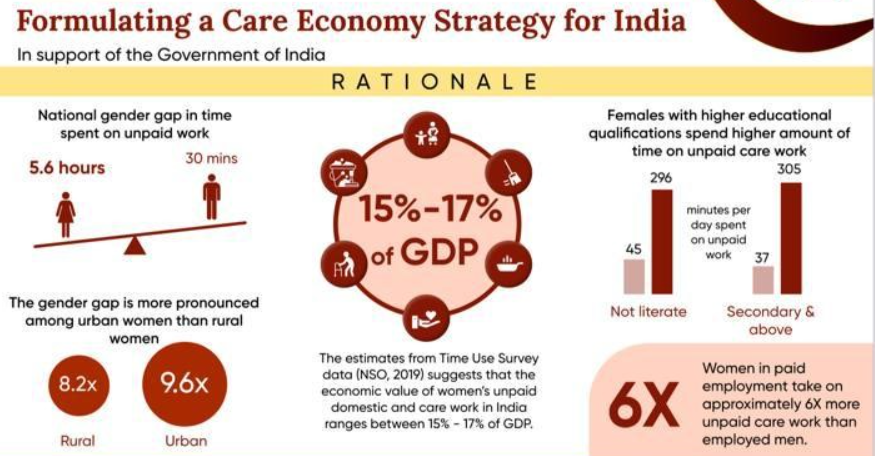
- Future Projections: Evidence from the International Labour Organisation suggests that increasing investments in the care services sector have the potential to generate 475 million jobs globally by 2030.
- For India specifically, direct public investment equivalent to 2% of GDP can potentially generate 11 million jobs, nearly 70% of which will go to women.
Significance of a Formal Caregiving System
- Ageing population: India’s population aged 60 and above is projected to increase, necessitating the demand for elderly care.
- Recognition of unpaid work: Formal training can transform informal family caregivers into recognised and skilled professionals.
- Employment generation: A structured care economy can create employment opportunities, particularly for women, and strengthen the healthcare support system.
- Improved quality of care: Training in emergency response, medicine management, elderly care and mental health can improve the well-being of older persons and persons with disabilities.
Major Challenges in Creating a Care Economy
- Gender inequality: Women spend significantly more time than men on unpaid domestic work and caregiving, limiting their employment and economic independence.
- Shortage of trained caregivers: The planned training of 1.5 lakh caregivers remains small compared with the scale of existing and future care requirements.
- Limited training coverage: Programmes such as Kerala’s K4 Care and elderly-care training for ASHA workers have yet to achieve widespread coverage.
- Lack of standardisation: The absence of a sufficiently developed national framework for certification, quality assurance and professional recognition limits the growth of the sector.
- Complex care requirements: Conditions such as Alzheimer’s and Parkinson’s disease require specialised knowledge of cognitive decline, behavioural management and emotional support.
Government Initiatives
- Budget 2026–27: Training of 1.5 lakh caregivers under the National Skills Qualifications Framework (NSQF) framework.
- Kudumbashree’s K4 Care: A Kerala-based programme that trains members of self-help groups as certified geriatric, patient and disability care executives.
- ASHA worker training: The National Health Systems Resource Centre (NHSRC) has developed an elderly-care training manual for ASHA workers, with training delivered through Ayushman Bharat Health and Wellness Centres.
- The Integrated Programme for Senior Citizens (IPSrC) provides grant-in-aid to various implementing agencies including State Governments, Union Territory Administrations through Registered Societies.
- SAPSrC (State Action Plan for Senior Citizens): Each State/UT is expected to plan taking into account their local considerations and frame their own State Action Plans for the welfare of their senior citizens. SAPSrC is being implemented from FY 2019-20.
- RVY (RashtriyaVayoshriYojana): The scheme aims for providing Physical Aids and Assisted Living Devices for Senior Citizens below poverty line and with the family income not exceeding to Rs. 15,000/-per month.
- Elderline: The National Helpline for Sr Citizens (14567) is to generate awareness about the Act, schemes & programmes being executed by different Central & State Governments and to provide a platform to redress grievances of Sr Citizens across the country.
Way Forward
- Recognise and upskill informal caregivers: Provide accessible training, certification and pathways to formal employment for existing family caregivers.
- Expand training networks: Scale up K4 Care and ASHA-based training, enabling trained caregivers to train others and expand coverage.
- Establish a National Caregiver Council: As proposed by NITI Aayog, India can standardise curricula, establish quality benchmarks and oversee caregiver certification and a national caregiver portal.
- Promote gender parity: Encourage the participation of men in caregiving through family-based training and awareness programmes, ensuring that responsibilities are shared more equitably.
- Integrate specialised care: Include geriatric mental health, dementia care, emergency response and behavioural management in national training curricula.
Source: TH
Previous article
News In Short 12-10-2026
Next article
AI-Based Mechanisation in India’s Coffee Sector
