


Syllabus: GS3/Economy
Context
- Recently, the Insurance Regulatory and Development Authority of India (IRDAI), in a consultation paper, proposed a slew of distribution reforms.
Key Highlights
- Aim: The regulation would put in place a customercentric, competitive, efficient and transparent distribution ecosystem, while enabling better and sustainable outcomes for policyholders, insurers and distributors.
- The key proposals include recalibration of expenses of management (EoM) through lower limits with a phased glide path.
- Expenses of Management (EoM) refer to the total operational, administrative, and distribution costs incurred by an insurance company to run its business.
- For life insurers, the EoM limit would move to a company level basis linked to Gross Direct Premium Income (GDPI), with the limit proposed at 15% within two years and 12.5% within five years.
- For general insurers, the basis would shift from Gross Written Premium (GWP) to domestic Gross Direct Premium Income (GDPI), with the EoM limit reducing from 30% of GWP to 20% of GDPI within five years.
- Other Reforms: The proposals include revising commission norms, easing entry and capital requirements, removing restrictions on non-insurance business opportunities for intermediaries and curbing regulatory arbitrage.
- Simplified Distribution Structure: Existing arrangements would be reorganised into three categories: Insurance Distribution Entities (IDEs), Insurance Distribution Persons (IDPs) and Market Infrastructure Institutions (MIIs).
Concerns Raised by the Insurance Industry
- Insurance Companies: Insurers have expressed reservations about the potential adverse impact of the proposed changes on their operations and business models.
- Employment and Competition: Insurance Brokers Association of India (IBAI) has warned that the proposed reforms could lead to job losses, slower industry growth and reduced competition.
- Demand for Impact Assessment: IBAI has urged the government to ensure that no commission or expense-limit regulations are notified without a published impact assessment covering policyholders, employment, public-sector insurers and foreign investment.
- It has also argued that the existing 2023 framework should continue until its scheduled review in 2028.
Indian Insurance Sector (FY24)
- Market Performance: Total insurance premium grew by 7.7%, reaching ₹11.2 lakh crore in FY24. Reflects continued momentum despite global and domestic economic volatility.
- Insurance Penetration: Overall insurance penetration declined slightly from 4.0% in FY23 to 3.7% in FY24. Life Insurance Penetration dropped from 3.0% to 2.8%.
- Non-Life Insurance Penetration remained stable at 1.0%.
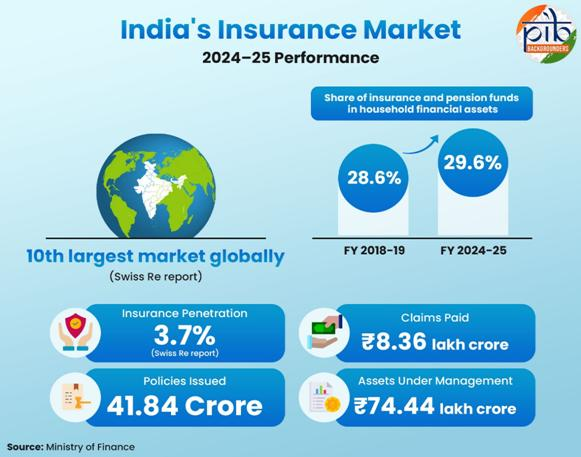
- Future Outlook: The Swiss Re Institute has projected India’s insurance sector to grow at a rate of 11.1% and is expected to become the fastest-growing market among the G20 nations over the next five years (2024-2028).
- An expanding middle class, technological advancements, and supportive regulatory measures will likely drive this growth.
- Insurance Companies: At present, there are 24 life insurance companies, and 34 general insurers in the country.
- Among the life insurers, Life Insurance Corporation (LIC) is the sole public sector company.
- In addition to these, there is a sole national re-insurer, namely General Insurance Corporation of India (GIC Re).
Insurance Regulatory and Development Authority of India (IRDAI)
- IRDA was constituted in 1999 as an autonomous body after the recommendations of the Malhotra Committee report to regulate and develop the insurance industry.
- It was incorporated as a statutory body in 2000.
- The Authority has the power to frame regulations under Section 114A of the Insurance Act, 1938.
- Objective: The main objective of the IRDA is to protect the interests of the policyholder and regulate the insurance industry.
- IRDAI is under the jurisdiction of the Ministry of Finance.
- It has framed regulations ranging from registration of companies for carrying on insurance business to protection of policyholders’ interests.
Challenges Faced by the Sector
- Low Penetration: With an overall insurance penetration rate of 3.7 per cent, below the global average of 7 per cent, there is a notable gap in coverage that presents opportunities for insurers to expand their reach.
- Claims Settlement Issues: Delays, rejections, and lack of transparency in the claims process create customer dissatisfaction.
- Distribution Limitations: There is limited reach in rural areas, and insurance distribution remains urban-centric, relying heavily on agents.
- Affordability: High premiums and the underpricing of certain products affect accessibility for low-income groups.
- Fraud and Mis-selling: Fraudulent claims and mis-selling by agents are common problems, damaging customer trust.
- Rising Costs: Increasing medical and claims costs impact affordability and profitability for insurers.
Initiatives Taken by the Government of India
- Sabka Bima, Sabki Raksha (Amendment of Insurance Laws) Act, 2025: The amendment raises the FDI limit in Indian insurance companies from 74% to 100%.
- GST exemption is granted on all individual life insurance policies and health insurance policies (including family floater) along with reinsurance w.e.f. 2025.
- Shortening of Moratorium Period: Moratorium period in health insurance is a fixed timeframe after which insurance companies cannot deny claims on the grounds of non-disclosure except on grounds of established fraud.
- IRDAI reduced the moratorium period from 8 years to 60 months (5 years) in 2024.
- Standardized 30-day free-look period: IRDAI introduced a standard 30-day free-look-period for policies with a term of one year or more. The free-look-period is the period given to a policyholder to assess and review the policy document.
- Third-Party Administrators (TPA) Performance Monitoring: To increase the accountability of TPAs, performance monitoring is done by insurers to ensure efficient and effective service delivery by them.
- Bima Sugam initiative: It aims to empower all insurance stakeholders by connecting them all through a single platform.
- The platform uses advanced technology to simplify processes for insurance companies, policy holders’, intermediaries, insurance repositories and external data sources etc.
- Bima Vahak: Focus on last-mile delivery of insurance in rural areas through trained agents (Bima Vahaks).
- Mandatory e-insurance: IRDAI mandated the digitisation of insurance policies across all categories to streamline processes, enhance efficiency, and improve accessibility for policyholders.
- IRDAI has decreased the health insurance waiting period from 48 months to 36 months.
- The waiting period refers to the duration during which policyholders are not eligible to claim benefits for any pre-existing health conditions they might have during the purchase of the insurance policy.
Way Ahead
- By targeting tier 2 and 3 cities and rural areas where awareness and accessibility are limited, insurers can tap into new customer segments and stimulate growth.
- Increase Financial Literacy: Conduct educational programs to enhance understanding of insurance products among the population.
- Simplify Regulations: Streamline regulatory processes to make product approvals faster and less complex, while ensuring consumer protection.
- Improve Claims Settlement: Ensure faster, transparent, and more efficient claims processing to build trust and reduce disputes.
- Expand Distribution Networks: Leverage digital platforms and mobile technology to reach underserved rural and semi-urban areas.
- Enhance Health Coverage: Expand coverage to include critical illnesses, hospitalization, and post-treatment care.
Source: TH
Previous article
Five Years of PM GatiShakti
Next article
News In Short 13-10-2026
