


Syllabus: GS3/Agriculture/Science and Technology
Context
- The Coffee Board of India has proposed a collaborative initiative with IIT Roorkee, IIT Dharwad and planters’ associations to develop AI-based farm equipment and harvesting technologies suited to Indian conditions.
AI-Based Mechanisation in Coffee Sector
- Customised harvesting prototypes: The Coffee Board of India is collaborating with IIT Roorkee to develop harvesting machinery that is suited to Indian coffee plantations.
- Pest and disease detection: Tools such as eCrop by Precision Grow aim to support coffee-farm monitoring.
- AI-based image recognition and drone-mounted cameras can help identify visible signs of pest infestation and crop diseases at an early stage, enabling timely intervention.
- Precision farming: Drone-based imaging and machine-learning models can monitor crop health, map plantation conditions and identify areas requiring targeted treatment.
- Irrigation management: Soil-moisture sensors combined with AI-based irrigation algorithms can adjust water application according to crop requirements and local conditions.
Coffee Sector of India
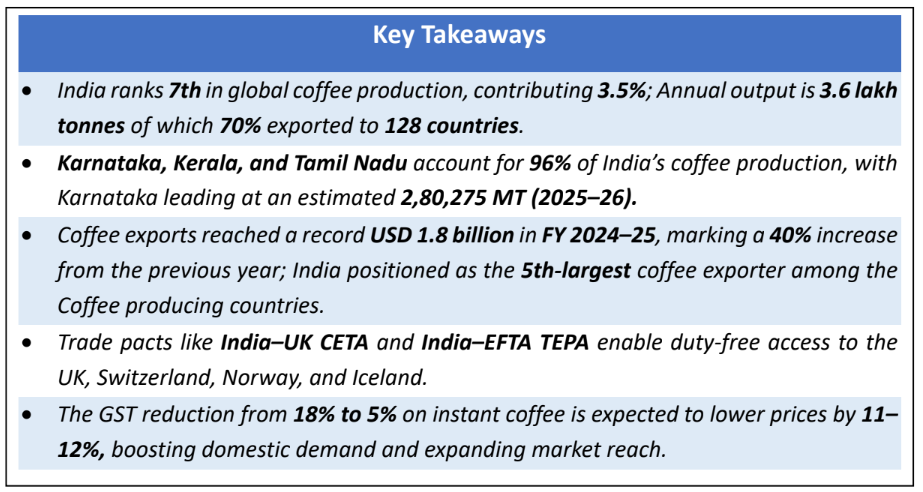
- India ranks as the fifth-largest exporter of coffee.
- The top 5 export destinations for Indian coffee are Italy (18.09 per cent), Germany (11.01 per cent), Belgium (7.47 per cent), the Russian Federation (5.28 per cent), and the United Arab Emirates (5.09 per cent).
Geographical Condition for Coffee Production
- Climate: Coffee grows well in tropical climates. It requires a warm, humid climate with mild winters. Shade is essential for healthy growth, and coffee is often grown under tree cover.
- Soil: Requires well-drained, fertile soils, rich in humus and organic matter.
- Soil should be slightly acidic, with a pH of 6.0–6.5.
- Temperature: Ideal annual temperature ranges between 15°C and 28°C.
- Frost is harmful to coffee plants, and extreme hot or dry conditions also reduce yield.
- Precipitation: Coffee thrives in hilly regions with elevations of 600–1,600 metres above sea level.
- Sloping terrain ensures proper drainage and prevents waterlogging.
- Major Coffee producing states are Karnataka (largest producer, contributes nearly 70% of India’s coffee), Kerala, and Tamil Nadu.
- Other emerging states are: Andhra Pradesh, Odisha, and the North-Eastern region (mainly Arunachal Pradesh, Nagaland, and Meghalaya).
Indian coffees with GI tags
- Coorg Arabica coffee: Grown in Kodagu district, Karnataka.
- Wayanad robusta coffee: Cultivated in Wayanad district, Kerala.
- Chikmagalur Arabica coffee: Produced in Chikmagalur district, Karnataka.
- Bababudangiri Arabica coffee: Grown in Chikmagalur, known for hints of chocolate.
- Monsooned Malabar robusta coffee: A distinctive speciality from Kerala, renowned for its unique taste.
- Araku coffee: Cultivated in the hilly terrains of the Visakhapatnam district in Andhra Pradesh and the Odisha region, at elevations of 900-1100 metres above sea level.
Coffee Board of India
- It was established under the Coffee Act VII of 1942.
- It functions under the Ministry of Commerce and Industry.
- Headquarters: Bengaluru.
Source: TH
Previous article
India Needs a Trained Workforce for Elderly Care
Next article
Nobel Prize in Economics Sciences
