


Syllabus :GS3/Economy
In News
- The Pradhan Mantri Matsya Sampada Yojana (PMMSY) has significantly advanced the fisheries sector by making it ecologically sustainable, economically viable, and socially inclusive five years since its launch.
Background
- The Blue Revolution, launched in 2015, aimed to boost fish production and modernize the fisheries value chain.
- While it improved productivity and infrastructure, gaps remained in areas like post-harvest handling, traceability, fisher welfare, and market access.
- To address these, the government launched the Pradhan Mantri Matsya Sampada Yojana (PMMSY) in 2020, building on the Blue Revolution’s progress with a more comprehensive and integrated approach.
About Pradhan Mantri Matsya Sampada Yojana (PMMSY)
- It was announced in the Union Budget 2019–20 to unlock growth in the fisheries sector by addressing critical gaps in production, technology, infrastructure, value chains, traceability, and fishers’ welfare.
- It was launched in September 2020 and aimed to drive a “Blue Revolution”.
- It has addressed key gaps in production, quality, technology, and infrastructure, while continuing to inspire impactful success stories across India.
Structure and Components
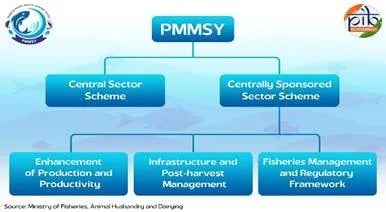
Aims and objectives
- Harnessing of fisheries potential in a sustainable, responsible, inclusive and equitable manner.
- Enhancing fish production and productivity through expansion, intensification, diversification and productive utilization of land and water.
- Modernizing and strengthening of value chain – post-harvest management and quality improvement.
- Doubling fishers and fish farmers’ incomes and generation of employment.
- Enhancing contribution to Agriculture GVA and exports.
- Social, physical and economic security for fishers and fish farmers.
- Robust fisheries management and regulatory framework.
Milestones and Achievements
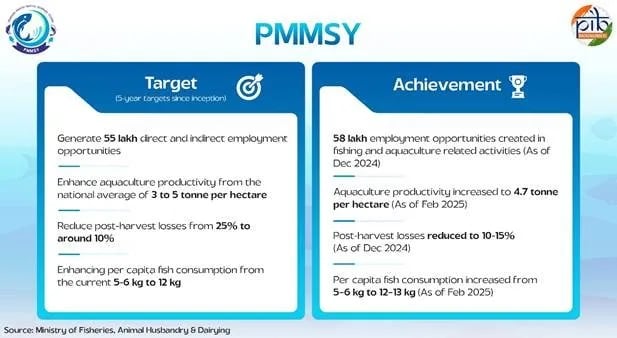
- India achieved a record fish production of 195 lakh tonnes in 2024–25, a sharp rise from 141.64 lakh tonnes in 2019–20.
- The country has emerged as the second-largest fish producer in the world, contributing nearly 8% of global fish production.
- Fisheries exports have shown robust growth, increasing from ₹46,662.85 crore in 2019–20 to ₹60,524.89 crore in 2023–24, strengthening India’s position in the global seafood market.
- PMMSY promotes women’s participation in fisheries by providing up to 60% of total project cost as financial assistance (up to ₹1.5 crore/project) under beneficiary-oriented activities and the Entrepreneur Model
Challenges
- Coastal ecosystems face rising threats from warming seas and extreme weather.
- Inadequate cold storage and transport infrastructure in remote areas.
- Overfishing & Resource Depletion are major areas of concerns.
- Limited Awareness & Access because many small-scale fishers remain outside formal schemes.
Conclusion and Way Forward
- In five years, the Pradhan Mantri Matsya Sampada Yojana (PMMSY) has delivered record fish production of 195 lakh tonnes, created 58 lakh livelihoods, empowered over 99,000 women, and built climate-smart value chains, strengthening India’s global fisheries position.
- Building on the Blue Revolution, which transformed the sector through growth, sustainability, and inclusion, PMMSY continues to drive progress.
- Looking ahead, strategic investments, community empowerment, and ecological stewardship will be vital to realizing the sector’s full potential.
Source :PIB
