


Syllabus: GS3/Economy
Context
- A recent working paper from the International Monetary Fund (IMF) has highlighted how India’s public administration digitalization reforms have improved productivity in micro, small, and medium enterprises (MSMEs).
Major Highlights
- The business environment reforms undertaken in India between 2010-11 and 2014-15 were mainly through digitalisation of business-related public administration.
- The paper lists reforms into six areas: tax systems, construction permits, environment and labour compliance, inspections, commercial disputes and single-window clearances.
- States that implemented more of these reforms recorded higher total factor productivity.
- Digital tools reduced administrative burdens, especially for small firms.
MSMEs in India
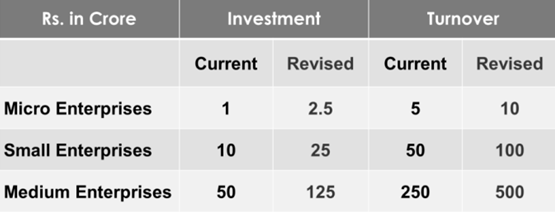
- MSMEs are businesses that are defined by their investment and turnover levels.
- They are considered an important sector of the economy as they create jobs, generate income, and promote entrepreneurship.
- Globally, MSMEs represent the most dominant segment of the business ecosystem, accounting for nearly 90% of enterprises and over 50% of total employment.
- In India, MSMEs account for ~35.4% of manufacturing, ~48.58% of exports, and 31.1% of GDP in India; with 7.47 crore+ enterprises employing 32.82 crore+ persons.
- MSMEs are the second-largest employer in India after agriculture.
Challenges Faced by the MSMEs in India
- Access to Finance: MSMEs struggle to secure capital due to a lack of collateral, limited credit history, or inadequate access to formal financial institutions.
- Increased Competition: MSMEs face stiff competition from larger, more established companies that have greater resources and market influence.
- Lack of Technological knowledge: Many MSMEs lack the technical expertise needed to modernize their operations, adopt new technologies, and stay competitive in the market.
- Marketing and Networking Opportunities: Limited resources and networks prevent MSMEs from effectively marketing their products and services.
- Regulatory Burden: Complex compliance with tax laws, labour regulations, and licenses increases operational difficulty.
- Skilled Labour Shortage: There is a lack of access to skilled and trained manpower in the sector.
- Vulnerability to External Shocks: MSMEs are highly susceptible to disruptions like COVID-19, inflation, and global slowdown.
Key Initiatives to Support MSMEs
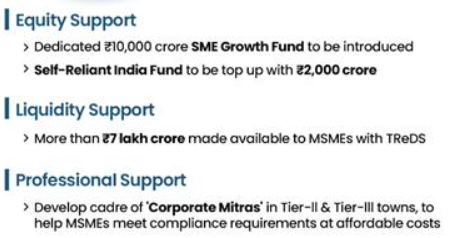
- The Union Budget 2026-27 proposed a three-pronged approach to help MSMEs grow as Champions by providing equity, liquidity and professional support.
- PM Vishwakarma: Launched in 2023, it is a central sector scheme for 2023-24 to 2027-28.
- It aims to uplift traditional artisans and craftspeople by enhancing product quality and connecting them to wider markets.
- Credit Guarantee Scheme for Micro and Small Enterprises (CGSMSE): A Credit Accessibility Breakthrough, the CGSME provides credit guarantees for credit facilities extended by Member Lending Institutions to MSEs without collateral security or third-party guarantees.
- Udyam Registration Portal: It was launched in 2020, offers a free, paperless, and self-declared registration process for MSMEs.
- Prime Minister’s Employment Generation Programme (PMEGP): PMEGP is a credit-linked subsidy scheme that supports self-employment by helping set up micro-enterprises in the non-farm sector.
- MSME Hackathon 4.0 (2024): Supports 500 young entrepreneurs with funding up to Rs. 15 lakh each for innovation and incubation.
- MSME-TEAM Scheme (2024): A trade enablement initiative with an outlay of Rs. 277.35 crore, supporting 5 lakh MSEs (including 2.5 lakh women-led) in digital onboarding, cataloguing, logistics and packaging.
- Khadi and Village Industries: The Government is promoting the Khadi and Village Industries (KVI) sector through the Khadi and Gramodyog Vikas Yojana (KGVY), a Central Sector Scheme with no state component.
- International Cooperation Scheme supports MSMEs in entering global markets by facilitating participation in international fairs, exhibitions and knowledge-sharing events on a reimbursement basis.
Conclusion
- MSMEs are revolutionising India’s growth story by driving innovation, generating employment, and empowering local communities.
- With strong policy support, digital tools, and access to new markets, these enterprises are becoming engines of sustainable and inclusive development.
Source: IMF
Previous article
Fall in Reservoir Levels in Eight States
Next article
Forest Rights Act (FRA), 2006
