


India’s Diminishing Cotton Productivity
Syllabus: GS3/ Agriculture
Context
- The stagnation in India’s cotton productivity has led to a debate on whether new genetically modified (GM) cotton technologies alone can improve productivity or whether greater emphasis is needed on soil health and agronomic practices.
About
- India is the world’s largest cotton producer by area (37% of the entire global cotton land) and one of the largest producers of cotton globally.
- Bt cotton, especially Bollgard-II, has led to an 88 percent productivity increase of cotton between 2002 and 2013.
- However, cotton productivity has stagnated since 2014–15 due to structural challenges such as soil degradation, climate variability, pest resistance, and inadequate agronomic practices.
Soil Degradation Causing Stagnation of Cotton Productivity
- According to FAO, nearly 32 per cent of Indian land is degraded and 25 per cent faces desertification.
- Soil organic carbon in Indian croplands averages just 0.3-0.6 percent, far below the globally accepted minimum of 1-1.5 percent for productive soils, with critically low levels below 0.25 percent recorded across cotton-growing regions of Rajasthan, Gujarat, Madhya Pradesh and Maharashtra.
- Low Soil Organic Carbon reduces soil fertility, moisture retention, nutrient availability, and resilience to drought and climate stress.
Geographical Condition for Cotton Cultivation
- Cotton is a semi-xerophyte, is grown in tropical & sub tropical conditions.
- A minimum temperature of 15°C is required for better germination at field conditions.
- The optimum temperature for vegetative growth is 21-27°C & it can tolerate temperature to the extent of 43°C but temperature below 21°C is detrimental to the crop.
- Cotton is grown on a variety of soils ranging from well drained deep alluvial soils in the north to black clayey soils of varying depth in the central region and in black and mixed black and red soils in the south zone.
- Cotton is semi-tolerant to salinity and sensitive to water logging and thus prefers well drained soils.
Source: IE
GAGAN: Navigating India’s Skies with Precision
Syllabus: GS3/Science and Tech; Space
Context
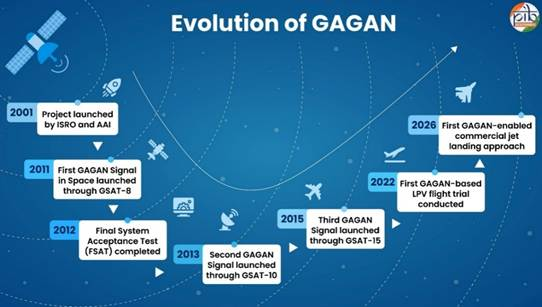
- India has achieved a major milestone in satellite navigation with GAGAN (GPS Aided GEO Augmented Navigation) becoming the first Satellite-Based Augmentation System (SBAS) certified for the equatorial region.
- The DGCA also recently conducted India’s first satellite-based landing system approach on a commercial aircraft using GAGAN.
About GAGAN
- GAGAN is India’s indigenous Satellite-Based Augmentation System (SBAS), jointly developed by the Indian Space Research Organisation (ISRO) and the Airports Authority of India (AAI).
- Operational since 2015, it enhances the accuracy, availability, and integrity of GPS signals by providing real-time correction information.
Significance
- First SBAS certified for the equatorial region, where ionospheric disturbances affect satellite navigation.
- Enhances resilience against GPS spoofing and jamming.
- Strengthens India’s indigenous navigation capabilities under Aatmanirbhar Bharat.
- Places India among a select group of countries with an operational SBAS.
Applications
- Besides aviation, GAGAN supports:
- Maritime navigation
- Intelligent transport and fleet management
- Railway operations
- Disaster management
- Defence, telecom synchronisation, and geospatial mapping.
Do you know?
- The integrated architecture of GAGAN forms an important part of India’s broader satellite navigation programme. Alongside GAGAN, India has developed the Navigation with Indian Constellation (NavIC), its indigenous regional navigation satellite system.

Source: PIB
India’s First PinS Instrument Approach Procedure for Helicopter Operations
Syllabus: GS3/Science and Technology
Context
- India has achieved a major milestone with the approval of the country’s first Private Point-in-Space (PinS) instrument approach procedure for helicopter operations at Undavalli Heliport.
About
- It was developed by the Airports Authority of India (AAI) and approved by the Directorate General of Civil Aviation (DGCA).
- It has been designed in accordance with DGCA regulations and the International Civil Aviation Organization (ICAO) Standards.
- PinS procedures use advanced satellite-based navigation technology to enable helicopters to conduct safe and precise instrument approaches to heliports that do not have conventional instrument landing infrastructure.
- PinS is particularly beneficial during adverse weather conditions and in areas where ground-based navigation aids are not available.
- Application: The approval is expected to pave the way for the development of similar PinS procedures across the country, benefiting emergency medical services, disaster relief operations, tourism, offshore activities, pilgrimage services, corporate aviation, and regional connectivity.
- It will enable safer Instrument Flight Rules (IFR) operations to remote and strategically important locations and improve operational reliability.
Source: AIR
31st Chief of the Army Staff
Syllabus: GS3/Defence
Context
- General Dhiraj Seth took charge as the 31st Chief of the Army Staff from General Upendra Dwivedi, who superannuated after more than four decades of distinguished service to the nation.
Chief of the Army Staff (COAS)
- COAS is the professional head and highest ranking serving officer of the Indian Army.
- COAS is responsible for the command, training, administration, discipline and operational readiness of the Indian Army.
- But under Article 53(2) of the Constitution, the President of India is the Supreme Commander of the Armed Forces.
- The COAS is appointed by the Appointments Committee of the Cabinet (ACC) for a tenure of three years or up to the age of 62 .
- The COAS works within the civilian-led defence structure headed by the Cabinet Committee on Security (CCS) and the Ministry of Defence.
Latest Announcements
- The new Chief of Army Staff has launched the “VIJAY” roadmap to reorient the Indian Army into a technology-centric, future-ready force capable of operating in conventional, hybrid and emerging domains of warfare.
- The roadmap focuses on Vigilance (operational readiness), Innovation and Transformation (modern technologies and doctrine), Jointness and Integration (greater synergy amongst the armed forces and a Whole-of-Nation approach), Atmanirbharta (indigenous defence technologies), and Yodha First (soldier welfare, training, veterans and Veer Naris).
- The vision is to bolster national security and boost self-reliance and military preparedness in line with the Decade of Transformation and Viksit Bharat 2047.
Source :Air
Transcaspian marinka (Schizothorax pelzami)
Syllabus: GS3/Species in News
In News
- A clan in Arunachal Pradesh’s East Kameng district has started a conservation campaign to protect the ray-finned fish Schizothorax pelzami (Transcaspian marinka).
Transcaspian marinka (Schizothorax pelzami)
- Habitat type: Freshwater, benthopelagic (bottom-dwelling in rivers).
- Distribution: It is found in rivers of Turkmenistan, Afghanistan, and northeastern Iran, thriving in temperate benthopelagic environments.
- IUCN Red List Status : It has been assessed as Least Concern due to its large range and the lack of widespread threats in this area.
- Latest Conservation in India : The Sangno clan of Arunachal Pradesh’s East Kameng district has started a community-based conservation initiative with 52 fingerlings of the Transcaspian marinka (Schizothorax pelzami), locally called Ngarsing, released into a mahseer-free stretch of the Richaso stream.
Source :TH
Previous article
PM Calls for Citizen-Centric Reforms and Self-Reliance
Next article
Maritime Piracy and Security
