


In News
- The Viksit Bharat-Guarantee for Rozgar and Ajeevika Mission (Gramin) (VB-G RAM G) Act, 2025, has come into effect from 1st July.
Background of VB-G RAM G
- In the past, India launched a number of rural wage employment programmes to alleviate poverty, to increase agricultural productivity and to provide jobs to underemployed rural workers.
- Among the early programmes were the Rural Manpower Programme (1960s) and the Crash Scheme for Rural Employment (1971).
- This resulted in the introduction of more structured programmes in 1980s and 1990s such as National Rural Employment Programme, Rural Landless Employment Guarantee Programme, Jawahar Rozgar Yojana (1993) and Sampoorna Grameen Rozgar Yojana (1999) to improve coordination and coverage.
- The Maharashtra Employment Guarantee Act (1977) was a major turning point which introduced the concept of a legal right to work.
- These developments led to the national legislation of the MGNREGA (2005) which provides a statutory basis for rural employment generation in India.
- Recently, India has replaced the MGNREGA, 2005 with the VB-G RAM G Act, 2025 (Viksit Bharat – Guarantee for Rozgar and Ajeevika Mission) to modernise rural employment policy in line with Viksit Bharat @2047.
VB-G RAM G Act, 2025
- It was Passed by Parliament in December 2025 and replaces the two-decade-old Mahatma Gandhi National Rural Employment Guarantee Act (MGNREGA), 2005.
- It shifts the focus from a standalone welfare intervention to an integrated instrument of development and resilient infrastructure.
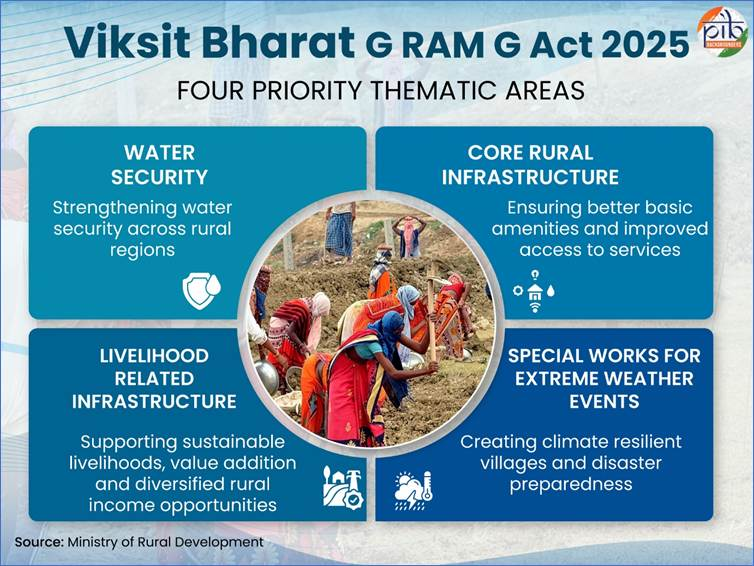
Key features of VB-G RAM G
- Increased guaranteed wage employment days: The VB-G RAM G Act increases the number of working days from 100 to 125.
- Pause in employment guarantee during agriculture season: VB-G RAM G provides for a 60-day pause in the scheme during the peak agricultural sowing and harvesting seasons to ensure the availability of farm labour.
- States to share funding burden: Departing from MGNREGA, the VB–G RAM G Act proposes a higher share of states in the funding of the rural job programme.
- Unlike MGNREGS, where the Centre paid 100% of the wage bill, VB-G RAM G shifts 40% of the funding burden onto states.
- The exceptions to this are the northeastern and Himalayan states as well as Union Territories (UTs) with a legislature, where the Union government will bear 90% of the funding burden. As for UTs without a legislature, the Centre will bear the complete funding burden.
- Top-down resource allocation approach: It also flips the MGNREGS model of Central allocations based on state labour budgets, with the Centre now determining the devolutions.
- New rules: The Ministry of Rural Development has issued eight draft rules under the VB-G RAM G scheme covering governance, grievance redressal, administrative expenses, transition provisions, fund allocation norms, wage and unemployment allowance payments, a central monitoring council, and expenditure procedures for states and UTs, aimed at ensuring smooth and transparent implementation.
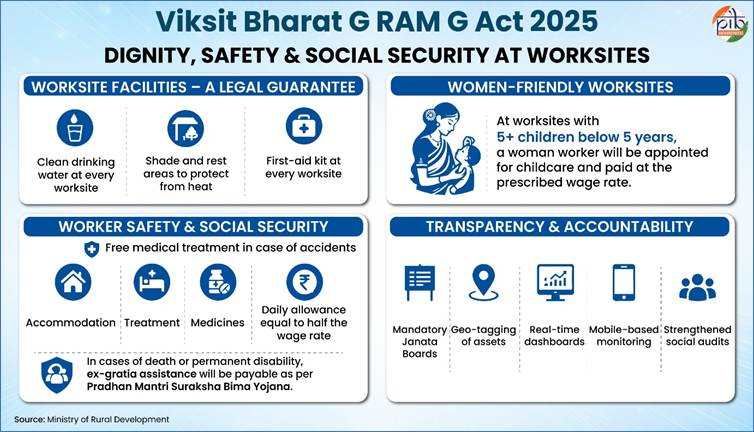
- Gramin Rozgar Guarantee Card to replace job cards: The Act of VB-G RAM G maintains continuity to the existing MGNREGS workers by keeping their e-KYC verified job cards valid till the time the states issue new Gramin Rozgar Guarantee Cards.
- It also provides for giving these cards to rural households willing to do unskilled work, through Gram Panchayats, with special coloured cards for vulnerable groups like women, elderly, disabled persons, bonded labourers, PVTGs and transgender persons. All cards will be good for 3 years, renewable after verification.
- Prompt Payments & Penalties: Wages must be paid weekly or within 15 days from closure of muster rolls and delays incur a daily compensation rate of 0.05% of unpaid wages.
- Normative allocation to states : Under the Draft Objective Parameters for Normative Allocation Rules, 2026, the Union Government will decide annual fund allocations for each state based on specified objective criteria, using the Sixteenth Finance Commission’s horizontal devolution formula as the basis for distributing funds among states.
- New Wage rates for Unskilled Manual Workers: Under the VB-G RAM G Act, 2025, the Centre is empowered to fix wage rates for unskilled manual work and may set different rates for different regions, ensuring they are not lower than MGNREGA wages.
- The Union government has fixed a floor wage of ₹300 per day under the Viksit Bharat-Guarantee for Rozgar and Ajeevika Mission (Gramin) (VB-GRAM G) Act, 2025,
- Daily wages have been notified in the range of ₹300–₹409 across states, with up to ₹450 in parts of Sikkim. While northern and northeastern states have seen wage increases of over 15%, southern states like Karnataka, Tamil Nadu, Andhra Pradesh, and Telangana have recorded relatively lower hikes of up to 3%.
- Unemployment Allowance: If employment not provided within 15 days, mandates an allowance at one-fourth of the notified wage for the first 30 days, and one-half thereafter.
Relevance of VB-G RAM G
- It improves guaranteed employment that reduces seasonal unemployment and income insecurity.
- It addresses wage gaps between states and promotes equitable wages for rural employees.
- It connects employment to water use and disaster planning, creating environmental resilience.
- It helps in participation of women and marginalised communities in rural development works.
- The emphasis on building lasting infrastructure enhances long-term rural productivity and development.
- It Supports broader development goals, including the vision of making India a developed country by 2047.
Criticism and Challenges
- Centralisation may dilute bottom-up planning which is the basis of effectiveness of MGNREGA.
- The proposed centralised methodology for classifying Village Panchayats and distribution within the State normative allocations introduces micromanagement.
- Under MGNREGA, the Centre bore almost the entire labour cost, while material costs were shared in a 60:40 ratio. Under VB-G RAM G, however, the combined labour and material expenditure is now subject to the 60:40 ratio putting states in financial strain.
- Over-reliance on biometric and digital systems could alienate vulnerable and rural populations with limited access.
- The proposed changes raise concerns about weakening or replacing a successful rights-based employment guarantee framework.
Conclusion and Way Forward
- The VB-G RAM G Act is a major reform in rural employment policy which links livelihood security with sustainable development and extends job guarantee.
- However, its success depends on overcoming the challenges of funding, inclusion and governance through adequate fiscal support, autonomy of Gram Panchayat, inclusive digital systems, stronger social audits, climate resilient planning and capacity building for effective implementation towards Viksit Bharat @2047.
Source :IE
Previous article
News In Short 01-07-2026
Next article
eSARAS: Expanding Markets, Empowering Rural Women
