


Garba Dance
Syllabus: GS1/Culture
Context
- The Navratri festival features traditional outdoor Garba dances dedicated to Goddess Ambe Maa.
About Garba
- Garba is a traditional Gujarati folk dance performed during the nine-day festival of Navratri, celebrating the victory of good over evil.
- The name is derived from the Sanskrit word for womb, symbolising life and creation. The dance celebrates fertility, womanhood and devotion to the Mother Goddess.
- It is performed in a circle around a lamp or an image of Goddess Shakti, representing the feminine energy of the universe.
- Accompanied by rhythmic music, singing and clapping, Garba is open to people of all ages, genders and social backgrounds.
- Modern Garba has been influenced by Dandiya Raas, traditionally performed by men, giving it its energetic and contemporary form.
- In December 2023, it was inscribed on UNESCO’s Representative List of the Intangible Cultural Heritage of Humanity.
- Its different forms include Mataji Garba, Krishna Garba and Lok Garba.
Source: IE
President Appointed Governors for 6 States
Syllabus: GS2/Polity and Governance
Context
- President Droupadi Murmu has appointed governors for six states.
About Office of Governor
- Constitutional Provisions: The office of the Governor is defined in Articles 153 to 162 of the Indian Constitution,
- Eligibility: Citizen of India and has completed the age of thirty-five years.
- Not a member of the Parliament and State Legislature.
- Shall not hold any other office of profit.
- Appointment of Governor: The Governor of a State shall be appointed by the President.
- Term of office of Governor: Five years.
- Executive Role: The Governor is the head of the state executive, he/she appoints the Chief Minister and other ministers, who are responsible to the state legislature.
- Legislative Role: The Governor summons, and dissolves the state legislature and can address the state legislature at the beginning of its sessions.
- He has the power to reserve certain bills passed by the state legislature for the President’s approval.
- Judicial Role: The Governor can grant pardons, reprieves, respites, or remissions of punishment in some cases. They also have the authority to commute sentences in certain circumstances.
- The Governor is involved in the appointment of judges to the state’s High Court.
- Discretionary Powers: In cases where the Chief Minister or the council of ministers cannot command a majority in the legislature, the Governor may exercise discretionary powers to invite a different person to form the government.
Source: IE
Lakshadweep Becomes a Fully Literate Union Territory
Syllabus: GS2/Education
Context
- Lakshadweep has achieved full literacy status under the ULLAS – Nav Bharat Saaksharta Karyakram.
ULLAS – Nav Bharat Saaksharta Karyakram (New India Literacy Programme)
- It is a centrally sponsored scheme implemented from 2022-2027.
- The scheme, aligned with NEP 2020, targets adults (aged 15 years and above) who can’t go to school.
- It has five components: Foundational Literacy and Numeracy, Critical Life Skills, Basic Education, Vocational Skills and Continuing Education.
- The vision of the ULLAS Scheme is to make India Jan Jan Saakshar and is based on the spirit of Kartavya Bodh and is being implemented on volunteerism.
About Literacy
- As per the Office of the Registrar General of India, a literate person is someone aged 7 or above who can read and write with understanding in any language.
- The Department of School Education and Literacy has introduced a refined definition of literacy aligned with NEP 2020 and SDG 4.6 goals.
- Literacy is now defined as the ability to read, write, and compute with comprehension, along with critical life skills such as digital and financial literacy. This expanded definition aims to ensure full societal participation and economic progress.
- A state/UT achieving 95% literacy is considered fully literate.
Source: TH
Jantar Mantar No Longer a Site of Protest
Syllabus: GS2/Polity and Governance
Context
- The Delhi Police have notified that Jantar Mantar is no longer a protest site and named three other alternatives (Ramlila Maidan, Burari Ground, and CBD Ground).
- The move followed a recommendation by a committee constituted by the Ministry of Home Affairs (MHA), with a revised SOP for the new venues to be issued separately.
Constitutional Provisions
- Article 19(1)(a) guarantees the right to freedom of speech and expression which includes the right to protest peacefully.
- Article 19(1)(b): Ensures the right to gather peacefully and without arms, subject to reasonable limits under Article 19(3) in the interests of the sovereignty and integrity of India and public order.
Judicial Intervention
- Amit Sahni v. Commissioner of Police (2020): SC ruled that public roads and places can’t be taken indefinitely and protests & rallies have to be weighed against the rights of other citizens.
- Mazdoor Kisan Shakti Sangathan v. Union of India (2018): The SC highlighted the necessity of balancing the freedom to protest against the rights of residents and public order.
About Jantar Mantar
- Jantar Mantar refers to a group of astronomical observatories built by Maharaja Sawai Jai Singh II in the 18th century to measure time, track celestial movements and study astronomical phenomena.
- Locations: Delhi, Jaipur, Ujjain, Mathura and Varanasi.
- Jantar Mantar, Delhi, was built in 1724. It is situated near Connaught Place and contains masonry instruments such as the Samrat Yantra, used to measure time and observe celestial movements.
- Jantar Mantar in Jaipur was included in the UNESCO World Heritage List in 2010.
Source: TH
Pradhan Mantri Dhan-Dhaanya Krishi Yojana
Syllabus: GS3/ Agriculture
Context
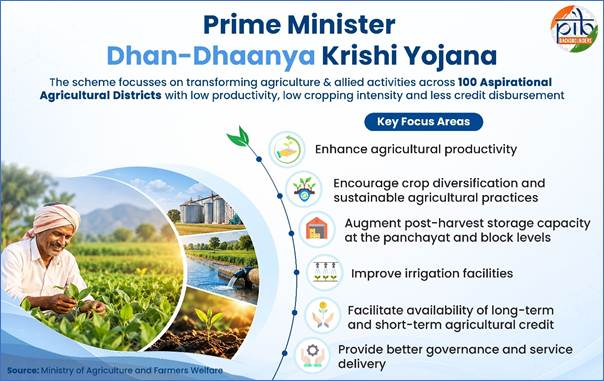
- Pradhan Mantri Dhan-Dhaanya Krishi Yojana has completed one year of implementation on 11th October 2026.
PM Dhan-Dhaanya Krishi Yojana
- It is a coordinated initiative involving 36 sub-schemes across 11 ministries, designed to accelerate agricultural progress in aspirational districts.
- The scheme targets 100 low-performing agri-districts with an annual outlay of ₹24,000 crore for 6 years (starting from 2025-26).
- It will be identified on the basis of three key indicators- low productivity , low cropping intensity and low credit disbursement.
- Targeted beneficiaries: 1.7 crore farmers.
- A digital dashboard, farmer app, and district ranking system will ensure transparency, access, and accountability.
- Administrative Structure for Implementation:
- District Level: The District Dhan Dhaanya Krishi Yojana Samiti, headed by the District Collector/DM, prepares and implements the District Action Plan.
- State Level: The State Dhan Dhaanya Krishi Yojana Samiti, headed by the Chief Secretary of the State, reviews and monitors the District Plans.
- National Level: Two committees oversee the scheme. The National Executive Committee is headed by the Union Minister for Agriculture and Farmers Welfare. The National Monitoring Committee is headed by the Secretary, DA&FW.
Source: PIB
INS Mangrol
Syllabus: GS3/Defence
Context
- The Indian Navy commissioned the ‘Mangrol’, the third Anti-Submarine Warfare Shallow Water Craft.
About
- Ten ships had been commissioned in 2026, with another eight expected to be commissioned soon.
- By 2034, around 60% of the Navy’s platforms are expected to have an average age of less than ten years.
About INS Mangrol
- Mangrol derives its name from the coastal town and minor port of ‘Mangrol’, located in Gujarat, which is a prominent harbour for the marine fishing industry.
- The ship also encapsulates the legacy of erstwhile INS Mangrol, an Indian Naval Minesweeper which remained in service till 2004.
- The ship comprises over 80% indigenous content and is equipped for underwater surveillance, Anti-Submarine Warfare (ASW) operations in coastal waters, Low-Intensity Maritime Operations (LIMO), along with mine warfare capabilities.
- The ship is propelled by waterjets and equipped with state-of-the-art Torpedoes, Anti-Submarine rockets, along with advanced radars and sonars.
- The commissioning of Mangrol is yet another milestone in the Indian Navy’s indigenous shipbuilding journey and a reaffirmation of the Government’s vision of ‘Aatmanirbhar Bharat’.
Source: AIR
Sarus Cranes
Syllabus: GS3/Environment
Context
- The Bombay Natural History Society (BNHS) has announced a nationwide survey to estimate the population of Sarus Cranes.
About the Sarus Crane
- Scientific Name: Antigone antigone.
- Features: The world’s tallest flying bird, it stands approximately 1.5 metres tall. It is also the only resident breeding crane species in India.
- Habitat: It inhabits wetlands, marshes and agricultural fields, often near human settlements.
- Distribution: Found across the Indian subcontinent, Southeast Asia and northern Australia. In India, major populations occur in Uttar Pradesh, Gujarat, Rajasthan, Madhya Pradesh and Haryana.
- Conservation Status:
- IUCN Red List: Vulnerable.
- CITES: Appendix II.
- Wild Life (Protection) Act, 1972: Schedule I.
- Cultural Significance: Revered in Indian culture as a symbol of lifelong devotion and marital fidelity.
Source: DTE
Previous article
Insurance Reforms: Need for a Balanced Approach
Next article
News In Short 13-10-2026
