


Syllabus: GS2/Governance
Context
- The Right to Information (RTI) Act, 2005, has completed 21 years, drawing attention to persistent gaps in proactive disclosure despite improvements in transparency audits and public access to information.
About the Right to Information Act, 2005
- The RTI Act was enacted to promote transparency, accountability and informed citizen participation in governance.
- It empowers Indian citizens to access information held by public authorities, subject to statutory exemptions.
- It gives practical effect to the right to information as an integral part of the freedom of speech and expression under Article 19(1)(a) of the Constitution, as recognised by the Supreme Court.
Key Provisions
- Section 3: Guarantees the right to information to Indian citizens, subject to the Act.
- Section 4: Requires public authorities to maintain records and proactively disclose prescribed information.
- Section 6: Specifies the procedure for filing RTI applications.
- Section 7: Generally requires information to be provided within 30 days. Where a request concerns the life or liberty of a person, the time limit is 48 hours.
- Section 8: Lists exemptions from disclosure, including certain information affecting national security and personal privacy.
- Sections 12 and 15: Provide for the constitution of the Central Information Commission (CIC) and State Information Commissions, respectively.
- Section 19: Provides for appeals against decisions concerning access to information.
- Section 20: Provides for penalties against Public Information Officers (PIOs) in specified cases of non-compliance.
Section 4: Foundation of Proactive Transparency
- Section 4 is central to the RTI framework because it requires public authorities to disclose important information on their own initiative, reducing the need for citizens to file individual applications.
- What Must Be Disclosed: Section 4(1)(b) specifies 17 categories of information, including:
- The organisation, functions and duties of public authorities.
- Powers and responsibilities of officers and employees.
- Decision-making procedures and applicable rules.
- Regulations, manuals, instructions and records used in administration.
- Directories of officers and employees and their remuneration.
- Budget allocations, expenditure and details of subsidy programmes.
- Information about concessions, permits and their beneficiaries.
- Details of information available electronically.
- Facilities available to citizens for obtaining information.
- Names and contact details of Public Information Officers.
- The Act requires Public Authorities (PAs) to publish relevant facts while formulating important policies and to provide reasons for administrative or quasi-judicial decisions affecting individuals.
- In addition, the Department of Personnel and Training (DoPT) has issued guidelines recommending wider disclosures under eight broad categories, including procurement, public-private partnerships and RTI applications received by departments.
Related Concerns and Issues
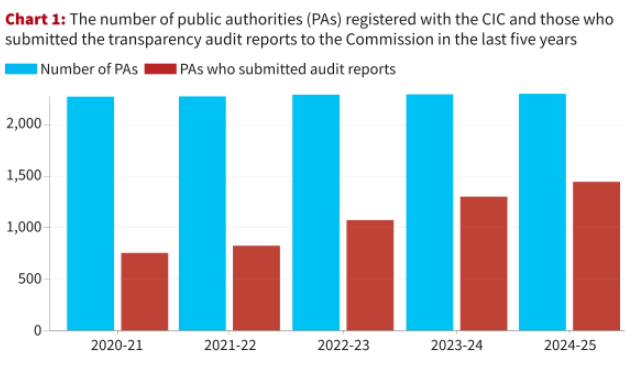
- Weak Implementation of Section 4: Many departments fail to publish mandatory information regularly.
- Websites contain outdated, incomplete or inaccessible information.
- Transparency audits are not conducted or published consistently.
- Citizens need to file applications even to obtain routine administrative information.
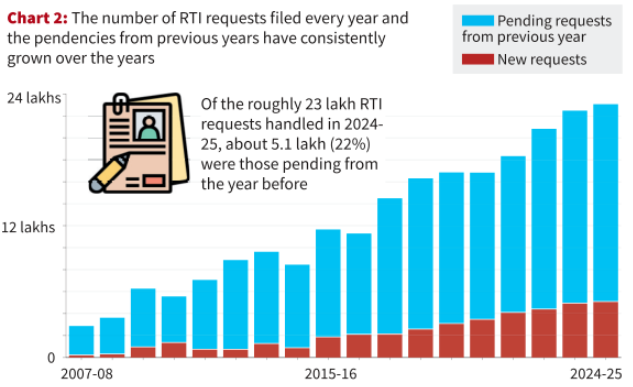
- Pendency of Appeals and Complaints: Delays in deciding cases can make information irrelevant, particularly when it concerns public recruitment, welfare benefits or ongoing administrative decisions.
- Delayed disposal weakens the deterrent effect of penalties against officials who violate the Act.
- Vacancies and Institutional Weaknesses: Delays in appointments and inadequate institutional capacity; and shortages of staff and technological infrastructure.
- Concerns about the independence of Information Commissions from the authorities whose decisions they review.
- Threats to RTI Activists and Information Seekers: Limited protection for individuals seeking sensitive public information.
- Fear of retaliation discourages citizens from raising questions about powerful individuals or institutions.
- Concerns Regarding the RTI Amendment Act, 2019: Under the amended framework, the Central Government is empowered to prescribe tenure of CIC, ICs and State-level commissioners, salaries, allowances and other service conditions through rules.
- Greater executive control over these conditions could affect the perceived independence of Information Commissions.
- Digital Divide and Accessibility: Limited internet connectivity in some rural and remote areas; and low digital literacy among certain sections of society.
- Difficulty navigating departmental websites and online filing systems.
- Information published in formats that are difficult to search or understand.
- Accessibility barriers for persons with disabilities and linguistic minorities.
- Poor Record Management: Missing, incomplete or poorly indexed records; delayed digitisation of government documents; and inconsistent record-retention practices.
- Limited coordination between departments responsible for maintaining information.
- Inadequate Deterrence and Accountability: Delays in initiating or concluding penalty proceedings; inconsistent enforcement of statutory penalties; limited accountability for persistent failures in proactive disclosure; and insufficient follow-up on deficiencies identified during transparency audits.
- Privacy Versus Transparency: An overly restrictive approach to disclosure could limit legitimate public scrutiny, while indiscriminate disclosure could violate personal privacy.
- Limited Awareness and Administrative Resistance: Resistance to sharing information that may expose administrative shortcomings.
- Poor coordination between departments and their designated information officers.
- Concerns About Misuse and Frivolous Applications: Some RTI applications may be repetitive, excessively broad or motivated by personal disputes rather than public-interest concerns.
- However, the possibility of misuse should not be used to weaken the fundamental purpose of the Act. A request that appears inconvenient to a public authority is not necessarily frivolous.
Why Does Section 4 Matter?
- Strengthening Accountability: Public access to information about expenditure, policies and administrative decisions makes it easier to scrutinise the functioning of government departments.
- Curbing Corruption: Greater openness reduces opportunities for arbitrary decisions, favouritism and misuse of public funds.
- Empowering Citizens: Access to reliable information enables people to understand government schemes, claim entitlements and participate meaningfully in democratic processes.
- Administrative Efficiency: When routine information is readily available, citizens need not file separate RTI applications for basic details. It can reduce the workload of public authorities and Information Commissions.
- The Supreme Court of India has recognised the importance of the right to know in democratic governance.
- In the State of U.P. v. Raj Narain (1975), it affirmed the public’s legitimate interest in knowing how public affairs are conducted, subject to permissible restrictions.
- The constitutional foundation of the RTI framework is closely associated with Article 19(1)(a), which guarantees freedom of speech and expression, and the broader democratic values underlying the Constitution.
Why Does Proactive Disclosure Remain Weak?
- Weak Enforcement: Non-compliance may not lead to timely corrective action.
- Poor Record Management: Incomplete or outdated records make regular disclosure difficult.
- Limited Awareness: Officials may lack adequate understanding of their disclosure responsibilities.
- Insufficient Monitoring: Audit findings do not always translate into measurable improvements.
- Administrative Resistance: A culture of secrecy can discourage openness.
- Inconsistent Digital Practices: Differences in website design and information formats make disclosures difficult to locate and compare.
- Digital Divide: Online publication alone may not adequately serve citizens with limited internet access or digital literacy.
Way Forward
- Strengthen Compliance: Ensure timely Section 4 disclosures and regular transparency audits across public authorities.
- Fix Accountability: Assign responsibility for updating departmental websites and addressing deficiencies identified during audits.
- Standardise Disclosures: Introduce uniform formats, searchable databases and accessible dashboards across government websites.
- Improve Record Management: Digitise records and establish regular updating mechanisms while protecting exempt and sensitive information.
- Promote Citizen Awareness: Use local bodies, educational institutions and civil society organisations to improve RTI literacy.
- Ensure Inclusive Access: Supplement online disclosures with accessible offline channels so that digitally excluded citizens are not left behind.
- Reduce Pendency: Make commonly requested information readily available, allowing Information Commissions to focus on disputes that genuinely require adjudication.
Conclusion
- The RTI Act has strengthened Indian democracy by giving citizens a means to question public authorities and demand accountability.
- However, its effectiveness depends not only on the right to seek information but also on the government’s willingness to disclose it proactively.
- The next phase of RTI reform needs to move beyond procedural compliance towards a culture of openness in which accurate, relevant and regularly updated public information is the norm.
- Effective implementation of Section 4 can strengthen public trust, improve governance and reduce the avoidable burden on Information Commissions.
| Daily Mains Practice Question [Q] The implementation of the Right to Information (RTI) Act, 2005, continues to face several institutional and administrative challenges despite being a landmark legislation for promoting transparency and accountability. Critically examine. |
Previous article
Make in India, Measured Against Wrong Decade
