


Syllabus: GS3/Infrastructure
Context
- PM GatiShakti National Master Plan (PMGS-NMP) has completed five years.
PM GatiShakti National Master Plan (PMGS-NMP)
- It was launched on 13 October 2021 for providing multimodal connectivity infrastructure to various economic zones and improving logistics efficiency across India.
- PM Gati Shakti incorporates infrastructure schemes from various ministries and state governments, such as Bharatmala, Sagarmala, inland waterways, dry/land ports, and UDAN.
- It is not under a single ministry but is coordinated by the Department for Promotion of Industry and Internal Trade (DPIIT) under the Ministry of Commerce and Industry.
- Aim: To provide seamless and efficient connectivity for the movement of people, goods, and services across various modes of transport, thereby enhancing last-mile connectivity and reducing travel time.
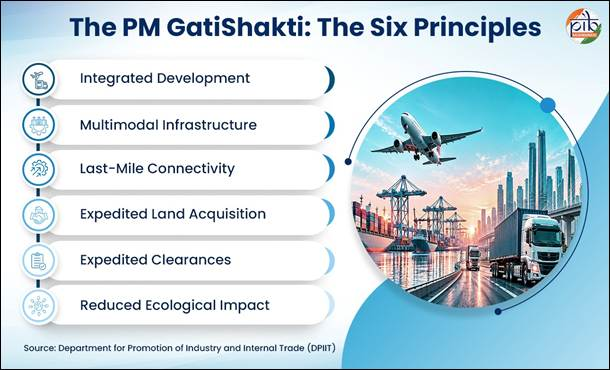
Key features of PM GatiShakti
- Seven Infrastructure Engines: Roads, Railways, Ports, Waterways, Airports, Mass Transport and Logistics Infrastructure form the core sectors of the plan.
- Whole-of-Government Planning: The National Master Plan covers 58 Central Ministries and Departments and all 36 States and Union Territories, enabling infrastructure proposals to be planned and assessed across sectors.
- Integrated Digital Planning: The NMP brings together infrastructure, and geospatial information on a common GIS-based platform, supporting spatial planning and decision-making.
- Wider Data Access: The PM GatiShakti Public platform provides access to 230 approved datasets, enabling site suitability analysis, connectivity mapping, alignment planning and compliance checks.
Institutional Framework of PM GatiShakti
- Empowered Group of Secretaries (EGoS): Chaired by the Cabinet Secretary, the EGoS oversees the implementation of PM GatiShakti and reviews, considers and approves changes in the Master Plan.
- Network Planning Group (NPG): The NPG brings together the Heads of Network Planning Divisions from infrastructure Ministries and Departments.
- It examines infrastructure proposals and ensures unified planning, integration and optimisation.
- It also monitors developments under the National Master Plan for project planning.
- Technical Support Unit (TSU): The TSU comprises domain and subject-matter experts who support the evaluation process. It assists the Logistics Division in performing its role as the PM GatiShakti Secretariat.
Gati Shakti Vishwavidyalaya (GSV)
- GSV is a first-of-its-kind university focused exclusively on the transport and logistics sectors.
- Established in 2022, the university brings together education, executive training and research across transport-related disciplines.
- GSV supports the PM GatiShakti National Master Plan and the National Logistics Policy (2022) through specialised education, training and research.
- As of July 2026, the university had trained more than 2.4 lakh officers through courses designed for PM GatiShakti.
What are the Challenges?
- Interdepartmental Coordination: Different ministries and state governments may have competing priorities, resulting in delays in project planning and execution.
- Data Quality and Integration: Inaccurate, outdated or incompatible datasets can affect the reliability of GIS-based planning and decision-making.
- Land Acquisition: Land disputes, rehabilitation requirements and environmental clearances delay infrastructure projects despite integrated planning.
- Limited Private Sector Access: Restrictions on access to sensitive datasets limit the information available to private investors for project planning and site selection.
Concluding remarks
- PM GatiShakti marks a shift towards integrated, data-driven infrastructure planning in India.
- Strengthening interdepartmental coordination, addressing implementation bottlenecks and ensuring environmental sustainability will be crucial to improving logistics efficiency and achieving the vision of Viksit Bharat.
Source: PIB
Previous article
Nobel Prize in Economics Sciences
Next article
Insurance Reforms: Need for a Balanced Approach
