

Syllabus: GS3/Economy
Context
- India’s textile sector is targeting a $350 billion industry by 2030, making sustainability central to export competitiveness, market access, resource efficiency and responsible employment-led growth.
About India’s Textile Sector
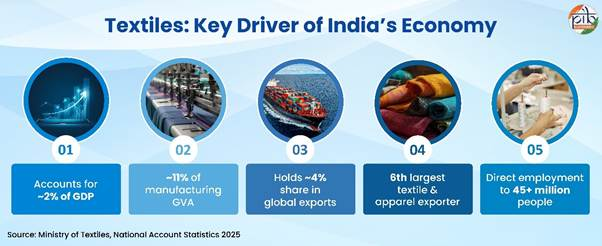
- India’s textile and apparel sector spans fibre, yarn, fabric, processing, apparel, technical textiles and made-ups, directly supporting over 49 million livelihoods.
- Its domestic market is valued at around $196 billion, projected to reach $250 billion by 2030, while textile exports are targeted at $100 billion.
- PM Modi’s vision of ‘Fashion for Environment and Empowerment’ reflects the emerging approach: sustainability is increasingly a component of industrial competitiveness rather than merely an environmental obligation.
- India’s Climate Commitments i.e. 500 GW of non-fossil electricity capacity, 50% of energy requirements from renewables and net-zero emissions by 2070 reinforce the transition towards low-carbon textile production.
Concerns & Issues in India’s Textile Sector
- Sustainability: Textile processing is resource-intensive, particularly in water, energy and chemicals. Global brands increasingly demand sustainable supply chains.
- Export markets are tightening requirements on recycled content, traceability, chemicals, water and energy use.
- Textile Waste: A 2026 Ministry study covering 15 states and more than 250 stakeholder interactions estimated annual textile waste at 70.73 lakh tonnes.
- Post-consumer Waste Gap: Post-consumer textile waste remains inadequately collected, segregated and recycled. While over 70% of textile waste is recovered, and pre-consumer waste recovery exceeds 95%, collection, segregation and economically viable recovery of post-consumer waste remain weaker.
- MSME Constraints: Smaller units often face limited access to green technologies, finance, technical expertise and reliable sustainability data.
- Global Compliance: Export markets increasingly demand traceability, recycled content, chemical safety and lower water, energy and carbon footprints.
- Blended Textiles: Mixed fibres and non-recyclable materials make fibre recovery technologically and economically difficult.
Advantages with India
- India possesses a substantial manufacturing base, diverse raw materials, technical capabilities and an established recycling ecosystem.
- Circularity also has deep cultural roots through practices such as rafugari, kantha, godhadis, chindi durries and khesh weaving.
- The textile recycling market could reach about $3.5 billion by 2030, potentially generating around one lakh green jobs across collection, sorting, recycling, repair and upcycling.
Related Key Efforts & Initiatives
- Circular Economy & Waste Management: Textile Recovery Facilities are being piloted in cities.
- In Navi Mumbai, a pilot diverted more than 3,323 kg of textile waste from landfill/incineration, reaching more than 12,000 families.
- 31 upcyclers have been certified under the Upcycled Textile Mark; 27 categories and 40 products are live on GeM.
- Cleaner Production: A programme with UNIDO, GEF and partners targets reduction of 10,530 tonnes of toxic chemicals directly and 21,000 tonnes indirectly, besides mitigating 147,000 tonnes CO₂ equivalent directly and 294,000 tonnes indirectly.
- It is expected to directly reach 40,000 people, 60% women.
- PM MITRA: The seven PM MITRA parks, with expected investment of about $10 billion, envisage integrated water, wastewater and common-processing infrastructure.
- National Technical Textiles Mission: It supports waste-to-fibre technologies, while IIT Delhi’s Panipat campus researches recycling of materials such as aramid fibre waste.
Other Related Efforts
- The ESG Task Force works on certification, cluster-level handholding, capacity building, sustainable fashion technology, AI and digital traceability.
- EU-India Resource Efficiency & Circular Economy Initiative (EU-I RECEI) has supported textile-waste assessment, a Tamil Nadu circular-economy roadmap, a Panipat MSME toolkit and SOPs for Textile Recovery Facilities.
- Tex-Eco Initiative: It was proposed in Union Budget 2026–27 integrates sustainability into textile growth through four pillars: resource recovery and recycling; water stewardship and decarbonisation; institutional capacity; and innovation and digitalisation.
- It proposes an India Sustainability Mark.
Way Forward
- India needs to move from pilots to scalable, measurable and market-linked solutions.
- Priorities should include stronger post-consumer collection, reverse logistics, recycling of blended fibres, affordable green finance for MSMEs, renewable energy, cleaner chemicals, ZLD systems and credible ESG traceability.
- The objective should be a just transition, combining environmental gains with worker welfare, formalisation and green employment.
- Sustainability, therefore, need not constrain textile growth; it can improve resource productivity, export-market access, innovation and resilience.
| Daily Mains Practice Question [Q] Discuss the major challenges to making India’s textile growth sustainable and examine the role of circular economy, green technologies and MSME-focused policy interventions in enhancing the sector’s global competitiveness. |
