


Syllabus: GS3/Economy
Context
- According to the Reserve Bank of India’s (RBI), India’s software services exports rose 8.2% year-on-year to $221.4 billion in 2025-26.
About Service Sector in India
- The services sector includes trade, transport, communication, financial services, IT and IT-enabled services, professional services, tourism, education and healthcare.
- It is a major contributor to India’s economic growth, employment, foreign exchange earnings and global competitiveness.
- India has emerged as a major global hub for IT services, BPO and digital services.
Current Status
- Software Services Exports:
- India’s software services exports increased 8.2% to $221.4 billion in 2025-26.
- Including services delivered through overseas commercial presence, exports rose 9.5% to $239.3 billion.
- Software services accounted for 53% of India’s total services exports, which stood at $421.29 billion.
- Components included IT services ($147 billion), BPO services ($56 billion) and software product development ($6.4 billion).
- BPO remained the dominant component of IT-enabled services exports.
- Export Destinations:
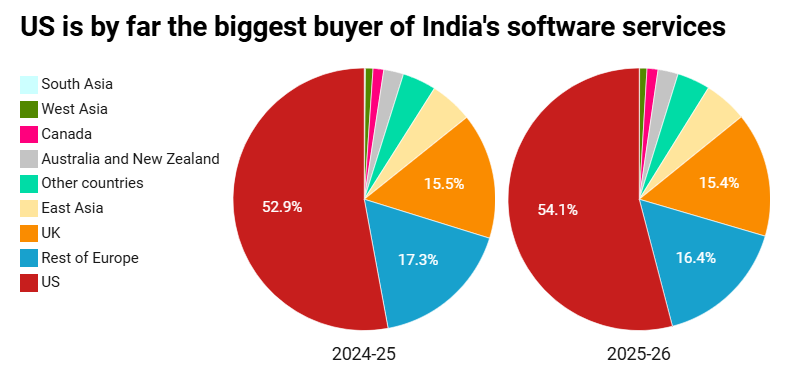
- The US remained the largest market, accounting for 54.1% ($119.7 billion), up from 52.9% in 2024-25.
- Europe accounted for 31.8%, while the UK accounted for 15.4%, marginally down from 15.5%.
- Software exports to the US increased 11% despite the US trade war and tariffs.
- Mode of Delivery:
- 91.7% of software services were delivered through the off-site mode, reflecting the growing importance of remote delivery.
- On-site services declined to $18.4 billion from $19 billion, indicating the impact of tightening visa norms.
- Local software business of foreign affiliates of Indian companies increased to $17.9 billion from $13.9 billion, with the US and UK remaining major destinations.
Key Drivers of India’s Service Sector Growth
- Digital Capability: India’s large pool of skilled IT professionals and established digital infrastructure supports global delivery of IT and BPO services.
- Global Demand: Strong demand from the US and Europe continues to support India’s software exports.
- Remote Delivery: The dominance of off-site delivery reduces dependence on physical mobility and enables Indian firms to serve global clients remotely.
- Overseas Presence: Expansion through foreign affiliates is increasing the global footprint and local revenues of Indian companies.
Issues & Concerns
- Market Concentration: With 54.1% of software exports going to the US, excessive dependence on a single market creates external vulnerability.
- Visa Restrictions: The fall in on-site exports reflects the impact of tighter visa norms on India’s traditional global delivery model.
- Trade Protectionism: The US ‘Liberation Day’ tariffs and continuing attempts to impose duties demonstrate the risks posed by protectionist trade policies.
- Goods–Services Imbalance: Services exports continued to grow faster, highlighting India’s increasing dependence on services for external earnings while goods exports to the US grew only 0.9% to $87.31 billion.
Related Efforts & Initiatives
- Digital and IT Ecosystem: Government programmes promoting Digital India, IT/ITES expansion, digital infrastructure and skill development strengthen the foundations of India’s services economy.
- Global Market Expansion: Diversification of export markets and promotion of Indian IT and professional services can reduce concentration risks.
- Skill Development: Continuous upskilling in AI, cloud computing, cybersecurity, data analytics and emerging technologies is essential to maintain India’s competitiveness.
Way Forward
- Diversify Export Markets: India should deepen services trade with Europe, the UK, Asia-Pacific and emerging markets to reduce excessive dependence on the US.
- Move Up the Value Chain: The focus should shift from conventional IT outsourcing and BPO towards software products, AI, R&D, cybersecurity and high-value digital services.
- Strengthen Global Presence: Greater overseas commercial presence can help Indian companies serve local markets while reducing dependence on cross-border movement of personnel.
- Policy Stability: Predictable trade, taxation, visa and regulatory frameworks are essential for sustaining India’s position as a global services hub.
Source: News On AIR
Previous article
India – Nepal Discussed Ties
