


Rajasthan Shekhawati Havelis enter UNESCO Tentative List
Syllabus: GS1/Culture
Context
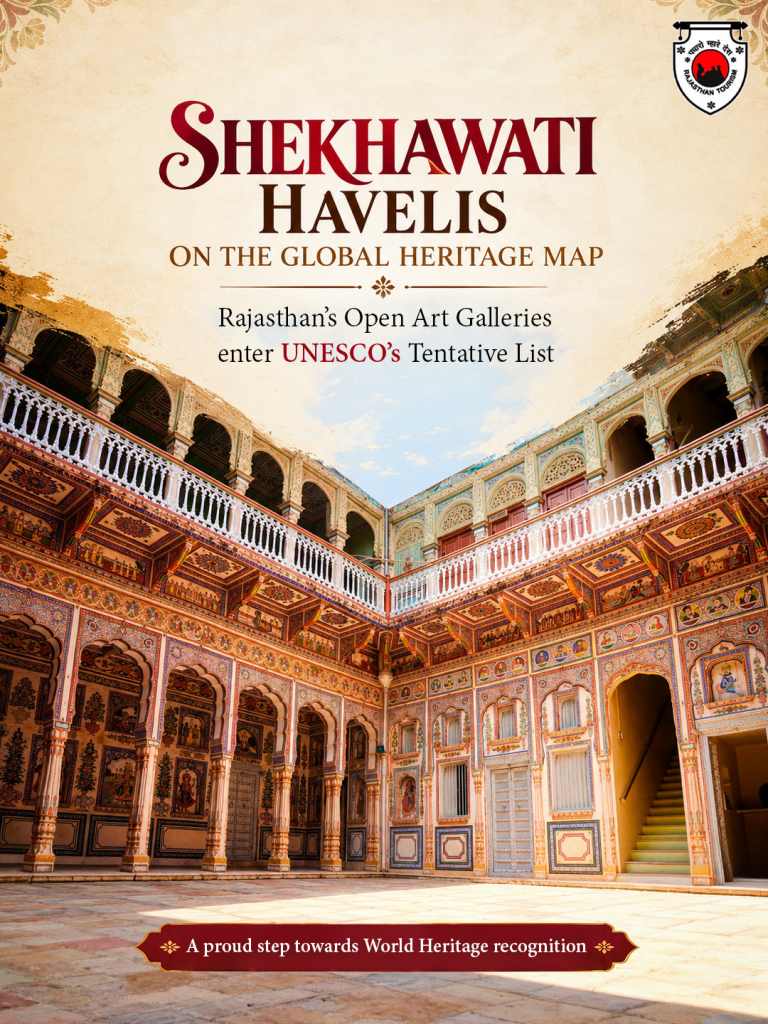
- Rajasthan’s historic Shekhawati havelis have been included in the UNESCO Tentative List, marking a significant step towards their recognition on the UNESCO World Heritage List.
About Shekhawati Havelis
- The proposal covers historic havelis and heritage properties across 14 towns: Alsisar, Bissau, Chirawa, Churu, Dundlod, Fatehpur, Jhunjhunu, Khetri, Laxmangarh, Mandawa, Mahansar, Nawalgarh, Ramgarh and Sikar.
- Located in northeastern Rajasthan, Shekhawati is renowned for its elaborately painted havelis, built largely by merchant families.
- These properties feature ornate façades, courtyards, gateways and detailed frescoes.
- The murals depict religious and mythological themes, portraits, everyday life, flora and fauna, and traditional motifs.
- Several frescoes also document the technological and cultural changes that reached the region during the 19th and early 20th centuries, including new forms of transport, changing lifestyles and external influences.
What is the UNESCO Tentative List?
- The Tentative List is an inventory of natural and cultural heritage sites that a State Party considers to have potential Outstanding Universal Value (OUV) and may nominate for the UNESCO World Heritage List.
- A site must generally be on the Tentative List for at least one year before it can be formally nominated for World Heritage status.
- Inclusion does not automatically confer World Heritage status; it is a preliminary step in the nomination process.
- Sites can be added, removed or updated on the Tentative List.
Source: ET
Dogri Script is Returning to Jammu’s Signboards
Syllabus: GS1/ Culture
Context
- New public signboards in Jammu are displaying place names in Namey Dogra Akhar, alongside Devanagari and the Roman script, as part of efforts to revive Dogri’s traditional writing system.
What is Namey Dogra Akhar?
- Namey Dogra Akhar, meaning “New Dogri Script”, is a modified form of the Takri script historically associated with the Dogri language.
- It developed during the reign of Maharaja Ranbir Singh, when vowel signs from Devanagari were incorporated to make the script more suitable for administrative use.
- Dogri is an Indo-Aryan language, spoken primarily in Jammu and Kashmir’s Jammu division, besides smaller groups in the adjoining states of Punjab and Himachal Pradesh and Pakistan-occupied Kashmir.
- According to the 2011 census, Dogri was the primary language of nearly 2.6 million people in India.
Constitutional and Legal Status of Dogri
- Dogri was included in the Eighth Schedule of the Constitution in 2003 through the 92nd Constitutional Amendment Act.
- It is one of India’s 22 Scheduled Languages.
- Dogri was also recognised as an official language of the Union Territory of Jammu and Kashmir in 2020.
Why did the script fall into disuse?
- Administrative changes: Urdu and later English gained prominence in official communication.
- Shift to Devanagari: In 1944, the Dogri Sanstha, a literary organisation, adopted the Devanagari script to popularise Dogri literature.
- While this helped Dogri gain recognition from the Sahitya Akademi in 1969, it also contributed to the eventual decline of Namey Dogra Akhar.
Source: IE
India’s Regulation on Nicotine Pouches
Syllabus: GS2/Governance
In News
- A new study by ICMR-National Institute of Cancer Prevention and Research has revealed that nicotine pouches are making their way into Indian cities through online platforms, hookah shops, and gig-delivery services.
What are nicotine pouches?
- It is a small, tobacco-free, tea-bag-like sack containing nicotine, flavorings, and plant-based fibers.
- Users tuck the pouch between their lip and gum for up to an hour, allowing nicotine to absorb directly into the bloodstream without smoke, vapour, or spitting.
- Unlike traditional smokeless tobacco like snuff or chewing tobacco, nicotine pouches do not contain tobacco leaf, dust, or stem.
- The nicotine used can be extracted from tobacco plants or created synthetically in a lab.
- In May 2026, WHO issued a Health risk warning linked to nicotine pouches.
Regulation In India
- Marketing, advertising, and sales of cigarettes and other tobacco products are regulated by the Cigarettes and Other Tobacco Products Act, 2003 and the rules (COTPA).
- The definition of cigarettes and tobacco products is very specific and does not include “all products containing nicotine”.
- Nicotine is not mentioned as a drug in any of the schedules of the Drugs & Cosmetics Act, 1940 (Drugs Act).
- Nicotine patches and gums have, however, been approved as drugs by the Drug Controller General of India for therapeutic use in treating nicotine addiction.
- Schedule K under the Drugs and Cosmetics Rules, 1945 lists gums and lozenges and exempts them from licensing and prescription requirements if they contain less than 2 mg of nicotine.
- WHO Guidelines: The World Customs Organization has revised the Harmonised System, and oral nicotine products have been given distinct classifications.
Role of Duty Free Shops
- The scope of Indian law does not completely exclude duty-free outlets at Indian airports.
- Section 58 of the Customs Act provides for their special status, which effectively exempts them from payment of customs duties, levies and taxes on eligible products.
- In the case of Flemingo Duty Free Shop (2024), the Calcutta High Court held that until the time the products maintained in a duty-free shop are purchased by the passengers and transported into the country, they are to be classified as outside India for customs reasons.
- This is not to say that he is totally immune to the laws of India.
- Duty-free shops are likewise bound by restrictions on the import and sale of products, in terms of the Baggage Rules and the quantity of goods that travellers are authorised to carry legally.
Import Rules
- In India, import bans are controlled by the Foreign Trade (Development and Regulation) Act, 1992 and the Customs Act, 1962.
- Together, these allow the government to restrict or completely block certain goods from entering the country.
- The Foreign Trade Act, 1992 gives the Central government the power to prohibit, restrict, or regulate the import of goods.
- The Directorate General of Foreign Trade (DGFT) manages this and publishes the official rules (ITC-HS classification) that specifically list which items are free, restricted, or completely banned.
- Section 11 of the Customs Act, 1962 gives the government the power to issue notifications in the Official Gazette to completely or partially ban goods.
Source: TH
Pictures of the Sun’s Surface Reveal Unseen Whirlpools
Syllabus: GS3/ Science and Technology
Context
- Scientists have captured the highest-resolution images of the Sun’s photosphere, revealing previously unseen small-scale plasma whirlpools (vortices) along the boundaries of solar granules.
- Solar granules are small, bright, cell-like structures on the Sun’s visible surface (photosphere) formed due to the convection of hot plasma.
About the Layers of the Sun
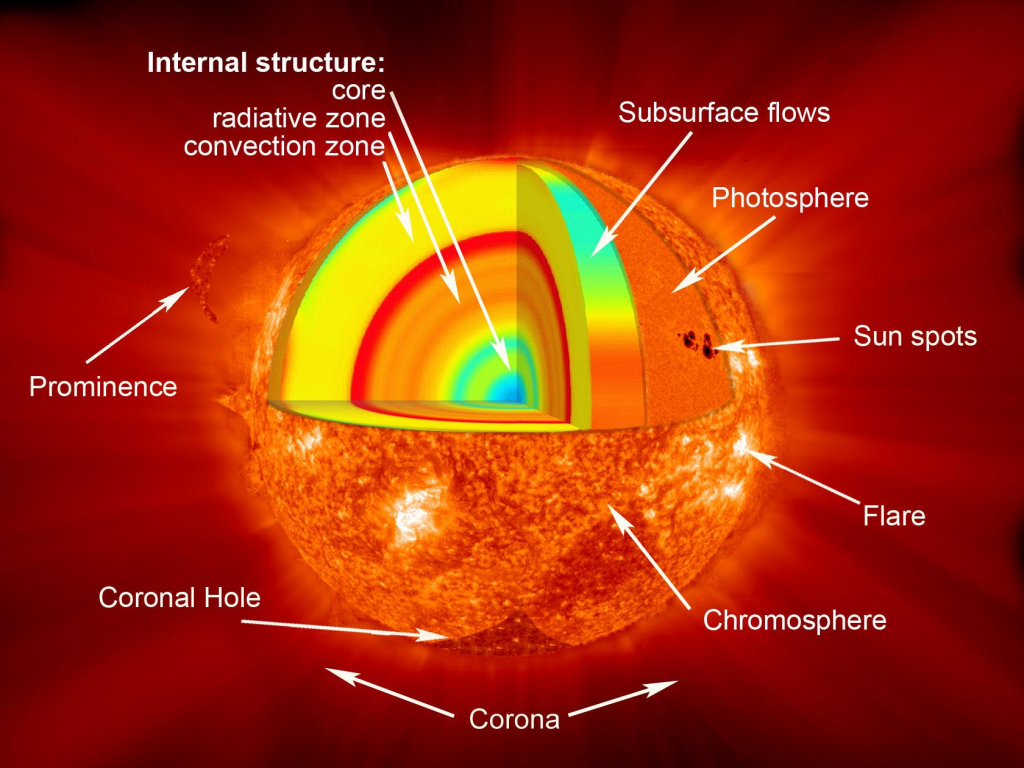
- The Sun and its atmosphere consist of several zones or layers. From the inside out, the solar interior consists of:
- The Core: The central region where nuclear reactions consume hydrogen to form helium. These reactions release the energy that ultimately leaves the surface as visible light.
- The Radiative Zone: It extends outward from the outer edge of the core to the base of the convection zone, characterised by the method of energy transport – radiation.
- The Convection Zone: The outermost layer of the solar interior extending from a depth of about 200,000 km to the visible surface, where its motion is seen as granules and supergranules.
- The solar atmosphere is made up of:
- The Photosphere: The visible surface of the Sun.
- The Chromosphere: An irregular layer above the photosphere where the temperature rises from 6000°C to about 20,000°C.
- A Transition Region: A thin and very irregular layer of the Sun’s atmosphere that separates the hot corona from the much cooler chromosphere.
- The Corona: The Sun’s outer atmosphere.
- Beyond the corona is the solar wind, which is actually an outward flow of coronal gas.
- The Sun’s magnetic fields rise through the convection zone and erupt through the photosphere into the chromosphere and corona.
- The eruptions lead to solar activity, which includes such phenomena as sunspots, flares, prominences, and coronal mass ejections.
Key Solar Missions
- NASA’s Parker Solar Probe is a historic robotic spacecraft on a mission to “touch” the Sun by flying directly through its outer atmosphere, the corona.
- It became the first spacecraft to fly through the corona in 2021.
- Aditya-L1 (ISRO): Aditya-L1 is the first space-based Indian observatory to study the Sun. It was launched on September 2, 2023, by the PSLV-C57.
- The solar observatory is placed at Lagrangian point L1 for “Observing and understanding the chromospheric and coronal dynamics of the Sun” in a continuous manner.
Swachh Vayu Sarvekshan 2026
Syllabus: GS3/Environment
Context
- The Swachh Vayu Sarvekshan 2026 results were released by the Central Pollution Control Board (CPCB).
About Swachh Vayu Sarvekshan
- Swachh Vayu Sarvekshan is an annual assessment of 130 cities under the National Clean Air Programme (NCAP).
- It was launched in 2022–23 and is an initiative of the Ministry of Environment, Forest and Climate Change (MoEFCC).
- It ranks cities based on the measures taken to reduce sources of air pollution, such as road dust, solid waste, construction waste, vehicular and industrial pollution.
- The cities are divided into three categories based on population: million-plus, 3–10 lakh, and below 3 lakh.
Key Highlights
- Lucknow secured the first position among million-plus cities, while national capital Delhi sits much lower at rank 30 with Mumbai & Bengaluru even further down.
- Indore, India’s cleanest city, secured the second spot, while Jabalpur finished third in the million-plus cities category.
- Chennai, Jamshedpur, Kota, Kolkata, and Madurai ranked in the bottom five in this category
- Among cities with 3–10 lakh population, Rourkela topped the list, while Kalinga Nagar secured first position among cities with less than 3 lakh population.
National Clean Air Programme (NCAP)
- It was launched by the Ministry of Environment, Forest and Climate Change (MoEF&CC) in 2019.
- NCAP emphasizes source specific mitigation measures through city, state, and national-level clean air action plans, and it is monitored by various committees constituted at Central, State and District level.
- NCAP aims to achieve up to a 40% reduction in PM10 levels or to meet national standards (60 µg/m³) by 2025-26.
- In FY 2025–26, 108 cities reduced annual PM10 concentrations compared with 2017–18, with 72 cities recording over 20% reduction, 26 over 40%, and 14 meeting NAAQS.
Source: IE
Jhiram Ghati Massacre
Syllabus: GS3/ Internal Security
Context
- A special National Investigation Agency (NIA) court in Chhattisgarh’s Jagdalpur convicted all ten accused in the 2013 Jhiram Valley Maoist attack.
Background
- The attack occurred on May 25, 2013, when armed Maoists ambushed the Congress’s ‘Parivartan Rally’ in Jhiram Valley in Chhattisgarh’s Bastar district.
- The attack highlighted the continuing challenge of Left-Wing Extremism (LWE) and the vulnerability of political and security personnel operating in Maoist-affected regions.
- In 2005 the anti-Maoist campaign Salwa Judum emerged and the Supreme Court later restricted the arming of tribal youth as SPOs.
- By 2013 security forces were advancing a “clear, hold and develop” strategy—pushing camps deeper into Maoist areas and extending roads and services.
Left-Wing Extremism (LWE)
- Left-Wing Extremism (LWE) refers to armed movements inspired by Maoist ideology that seek to overthrow the existing constitutional and democratic system through protracted armed struggle.
- Key Features:
- It is commonly associated with the CPI (Maoist) and its armed wing, the People’s Liberation Guerrilla Army (PLGA).
- Maoist groups primarily operate in remote, forested and tribal-dominated areas. They exploit issues such as poverty, land alienation, displacement, underdevelopment and weak governance to mobilise support.
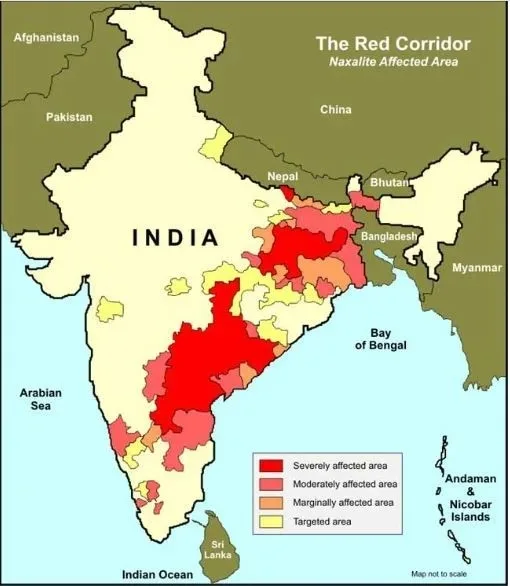
- LWE was historically concentrated in parts of central and eastern India, historically referred to as the Red Corridor.
Source: IE
National Film Awards
Syllabus: Miscellaneous
In News
- The National Film Awards ceremony is going to be organised in Gujarat for the first time, with the 72nd edition scheduled in Ekta Nagar.
National Film Awards
- They were instituted in 1954 to promote cinematic quality and encourage films of high artistic, technical, educational and cultural value.
- The awards were initially called ‘State Awards’, and two President’s Gold Medals, two certificates of merit, and 12 silver medals for regional films were presented in the earlier years.
- The first Best Actor and Best Actress awards were given to Uttam Kumar and Nargis, respectively, in 1968.
- The Best Actress award was initially called ‘Urvashi,’ and the Best Actor award was called ‘Bharat’.
- The Ministry of Information and Broadcasting confers the prestigious National Film Awards along with cinema’s highest honor, the Dadasaheb Phalke Award, each year.
Latest Winners
- The winners of the 72nd National Film Awards include ‘Article 370’ as the best feature film.
- Yami Gautam has been named as the best actress for her performance in the same film.
- Mammootty and Kartik Aaryan will share the best actor award for their performances in ‘Bramayugam’ (Malayalam) and ‘Chandu Champion’ (Hindi), respectively.
- Actor-filmmaker Randeep Hooda has won the best debut director award for ‘Swatantrya Veer Savarkar’, a biographical film on Vinayak Damodar Savarkar.
- ‘Kalki 2898 AD’ has bagged the award for best popular film, providing wholesome entertainment.
Source: TH
MatsyaMetri
Syllabus: Miscellaneous
In News
- The Central Marine Fisheries Research Institute (CMFRI) has claimed to have developed a smartphone application “MatsyaMetri” to measure the length and width of fish without physically handling them.
MatsyaMetri
- It has been designed for fisheries scientists, researchers, and field survey teams.
- It facilitates rapid and systematic collection of biological data to support fisheries assessment and management.
- It was developed by Eldho Varghese, a senior scientist at the institute.
- The application simplified biological data collection by automatically recording measurements and generating length-frequency datasets.
- It allows multiple individuals of the same fish species or aquatic resource to be measured under a single sampling session.
- It automatically generates length-frequency distributions using appropriate class intervals.
- The recorded measurements and the corresponding photographs can be saved along with the sampling session and subsequently exported as a CSV file for further scientific analysis.
Source: TH
Previous article
The International Day of Clean Air for Blue Skies
Next article
News In Short 08-09-2026
