


Syllabus: GS3/Economy
Context
- The renewed focus on skill development as a key driver of Viksit Bharat@2047, coupled with rapid technological change, has brought India’s skilling ecosystem to the fore.
Why Skill Development Matters?
- India’s labour market is undergoing a structural shift due to automation, artificial intelligence (AI), digitalisation, climate action and demographic changes.
- The continuous skilling has therefore become mandatory for employability and economic competitiveness.
- Economic Growth: Development of skills enhances productivity, spurs entrepreneurship, alleviates poverty and builds sustainable economic growth.
- Future Ready Workforce: The IMF’s AI Preparedness Index India scored 49.3, above the average of emerging economies (42.1), indicating preparedness to leverage AI-led opportunities.
- Leveraging Demographic Dividend: More than 54% of India’s population is below 25 years and almost 62% of them are in the working age group, hence skilling is very important to leverage demographic dividend.
- Addressing Global Talent Needs: By 2030, India will produce a surplus of 45 million skilled professionals, and the world could experience a deficit of 85 million workers, creating significant global employment opportunities.
Skilling in India: Current Status
- India Skills Report 2026: Employability rises from 46% (2020) to 56.4% (2026)
- Skill development is embedded at all stages of the education-to-employment life cycle, from school education through vocational training, apprenticeships and digital learning.
- More emphasis is being placed on AI, emerging technologies, entrepreneurship, the involvement of women and training aligned with industry.
- The hiring trend shows increasing demand for skilled professionals in IT, manufacturing, healthcare, tourism and electronics sectors.
Related Efforts & Initiatives
- Early Skilling and Schooling:
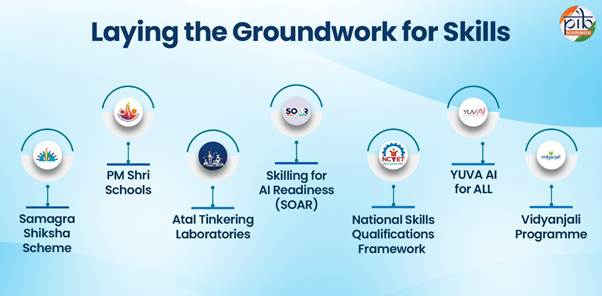
- Samagra Shiksha: Skill education launched in more than 25,000 schools, 35.5 lakh students to benefit in 138 job roles.
- PM SHRI Schools: 21st Century Skills with focus on implementation of NEP 2020 in over 13,000 schools.
- Atal Tinkering Labs (ATL): Over 10,000 innovation labs nurturing creativity and scientific temper.
- AI for ALL (SOAR & YUVA AI): AI literacy programs for school students & citizens under the IndiaAI Mission
- National Skills Qualification Framework (NSQF): It is a competency-based learning that integrates vocational and academic education.
- Workforce Upskilling: Skill India Mission (SIM) by:
- Pradhan Mantri Kaushal Vikas Yojana (PMKVY 4.0): 28 lakh+ candidates trained; new future-skills job roles added.
- Jan Shikshan Sansthan (JSS): Community skilling with more than 82% women beneficiaries.
- National Apprenticeship Promotion Scheme (NAPS): ‘Earn While You Learn’ model of industry-led training.
- Craftsmen Training Scheme (CTS): Modernising Industrial Training Institutes (ITIs).
- PM-SETU: Upgrading 1,000 ITIs into industry-linked centres of excellence.
- Future Skills and Entrepreneurship:
- FutureSkills Prime: Offers more than 2,800 digital courses with over 33 lakh learners.
- PM Vishwakarma: Extends training, credit and market linkages to artisans.
- Startup India, NIESBUD & IIE promotes entrepreneurship and self-employment.
- Skilling focused on women:
- AI Careers for Women, Swavalambini and NAVYA are working to increase women’s participation in AI, entrepreneurship and non-traditional sectors.
- Measures in Budget 2026–27:
- Schools & Colleges: AVGC Content Creator Labs.
- Training of 1.5 lakh caregivers under NSQF.
- Skill development for tourism, sports, Ayurveda, design and university townships linked with industrial corridors.
Key Concerns
- Persistent skill mismatch between education and industry requirements.
- Low participation in formal vocational education compared to international standards.
- Regional inequities in the availability of quality skilling infrastructure.
- Poor placement results and little collaboration between industry and academia.
- Technology is changing so fast that we need to keep relearning new skills.
Way Forward: Toughening the Measures
- Align skilling programmes to emerging sectors like AI, semiconductors, green energy, and Industry 4.0.
- Get industry more involved in the design of the curriculum, apprenticeships and placements.
- Promote quality assurance and outcome based assessment through NSQF.
- Expand digital infrastructure and access to skilling in rural and Tier-II/III locations.
- Encourage continuous learning with regular upskilling and flexible certification paths.
- Strengthen international linkages for mobility of India’s skilled professionals across the world.
Previous article
Cabinet Approves Semicon 2.0
Next article
National Investment Policy (NIP) for Urea-2026
