


Syllabus: GS2/Governance
Context
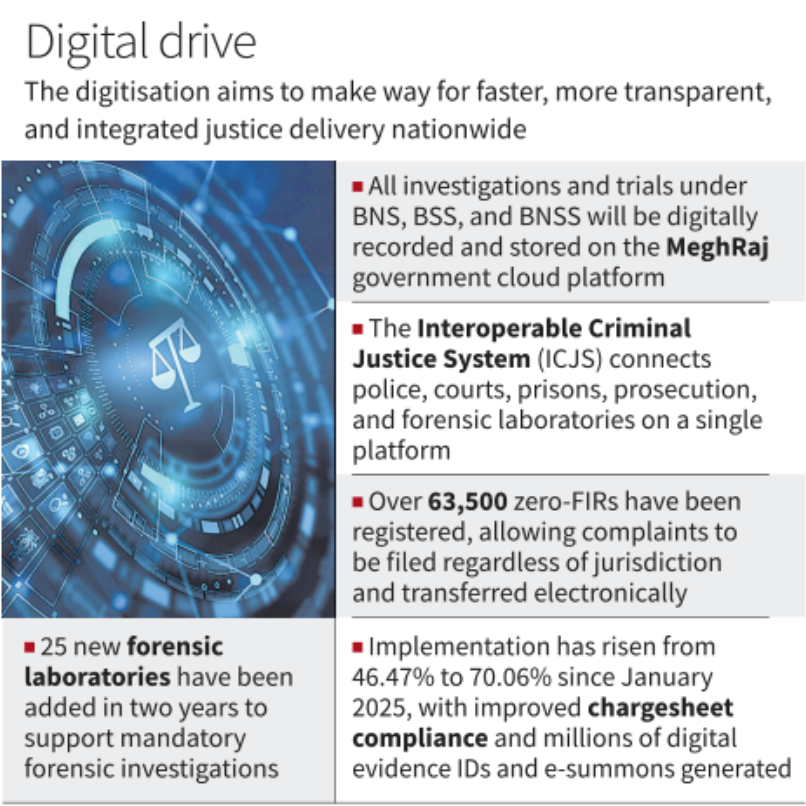
- The Union Government has announced that India aims to achieve a full digital rollout of the criminal justice system by 1 July 2027 through the Interoperable Criminal Justice System (ICJS).
About
- The Inter-Operable Criminal Justice System (ICJS) has been established by integrating the Crime and Criminal Tracking Network & Systems (CCTNS), Courts (e-Courts), Jails (e-Prisons), Forensic Lab (e-Forensic) and Prosecution (e-Prosecution).
- National Crime Records Bureau (NCRB) is the Nodal Agency responsible for implementation of the project in association with National Informatics Centre (NIC), as the Technology Partner.
Criminal Justice System (CJS)
- The criminal justice system comprises the police, courts, prisons, forensics, and prosecution services, and aims at ensuring that individuals who suffer injury or loss at the hand of others can present their cases and seek justice.
- Digital Criminal Justice System: The proposed digital ecosystem seeks to digitise every stage of criminal proceedings, including:
- Registration of First Information Reports (FIRs).
- Investigation and collection of evidence.
- Filing of digital charge sheets.
- Submission of forensic reports.
- Digital presentation of witness testimonies.
- Conduct of trials.
- Final disposal and archival of cases.
Various Digital Systems Developed and being Updated
- Crime and Criminal Tracking Network and Systems (CCTNS) project (2009): Its aim is to inter-link all police stations under a common application software for the purpose of investigation, data analytics, research, policy making and providing Citizen Services.
- e-Prisons: e-Prisons application is a cloud-based product deployed as a unified application for all the states of India where states need to configure state-specific parameters.
- It provides vital information about the inmates lodged in the prisons in a real-time environment to the courts, prison officials, and other entities that are involved in the Criminal Justice System.
- e-Forensics: e-Forensics is an online case registration and tracking system formulated under the project ICJS, which assists the examiners in delivering expeditious, accurate, and reliable forensic reports to the police.
- e-Prosecution: The main purpose of the e-Prosecution application is to digitalize the process followed by the public prosecutor as one of the pillars of the criminal justice system to ensure transparent and speedy trials.
- National Automated Fingerprint Identification System (NAFIS): It is a centralized repository of criminal fingerprints that can be accessed by users of State/UTs and central law enforcement agencies across the country.
- Criminal Procedure (Identification) System: The Government enacted Criminal Procedure (Identification) Act, 2022 which empowers Police and Prison Officers to collect measurements from persons of interest for the purpose of identification and investigation in criminal matters.
- The National Crime Records Bureau (NCRB) has been designated as the modal agency responsible for implementing the CrPI Act Across all States and Union Territories in the country.
Concerns
- Data Privacy and Cybersecurity Risks: Integration of criminal justice databases increases the risk of data breaches, cyberattacks, and misuse of sensitive personal information.
- Digital Divide and Unequal Access: Poor digital infrastructure and low digital literacy especially in rural and remote areas can exclude vulnerable sections from accessing justice.
- Threats to Fair Trial and Due Process: Technical glitches, connectivity issues, and reliance on virtual proceedings may hamper effective legal representation and access to justice.
- Institutional and Infrastructure Challenges: Lack of interoperability, inadequate digital infrastructure, and insufficient training of police, prosecutors, and judicial officers hinder effective implementation.
- Legal and Regulatory Gaps: India lacks a comprehensive legal framework governing AI use, digital evidence, accountability, and data governance in the criminal justice system, creating uncertainty and potential misuse.
Way Ahead
- Strengthen Data Protection and Cybersecurity: Implement robust data protection standards, regular security audits, encryption, and strict access controls for criminal justice databases.
- Build Institutional Capacity: Provide regular training to police, prosecutors, forensic experts, and judicial officers on digital tools, cyber forensics, and electronic evidence.
- Establish a Robust Legal and Ethical Framework: Frame clear guidelines for the use of AI, facial recognition, and digital evidence, with independent oversight to safeguard privacy, transparency, and due process.
Source: TH
Previous article
National Investment Policy (NIP) for Urea-2026
