


Syllabus: GS2/Governance
Context
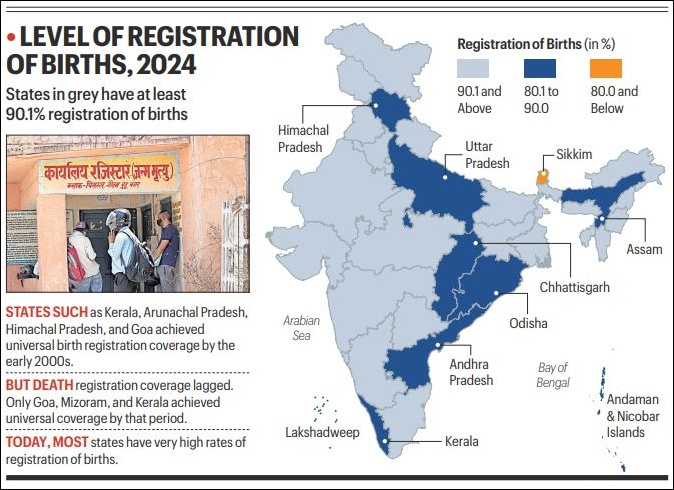
- India officially recorded more than 99% of its estimated births and deaths in 2024, according to the latest official data released by the Civil Registration System (CRS).
Major Findings
Civil Registration System
- Data on births, deaths and stillbirths are recorded under a continuous and compulsory mechanism known as the Civil Registration System (CRS).
- It serves as a foundational source of India’s population data such as estimated births and deaths, for the accurate estimation of mortality, fertility and sex ratio at birth.
- It functions under the Office of the Registrar General and Census Commissioner of India under the Home Ministry.
- The CRS has been legally operational since 1970, though the coverage and completeness of reporting were historically poor.
- The system operates under the Registration of Births and Deaths Act, 1969, which was amended in 2023.
- Births and deaths are ordinarily required to be reported within 21 days.
- In hospitals, the medical officer in charge or an authorised official is responsible for reporting such events.
- For events at home, responsibility generally lies with the head of the household or another prescribed informant.
Data Over the Years
- Until 2000, India registered only 56% of births and 48% of deaths. By 2014, this figure rose to around 86.6% and 72.5%, respectively.
- In 2024, birth registration reached 99.1% and death registration reached 99.4%.
- The improvement is also visible across states, in 2024, 18 states and Union Territories achieved 100% birth registration, while 21 states and UTs achieved 100% death registration.
Reasons for the Rise in Registration of Data in 2024
- Rise in Registration of Birth: The increase in institutional deliveries in hospitals or health facilities incentivised by post-delivery benefits.
- Birth certificates are also now necessary for school admission, identity documents, welfare benefits and other official purposes.
- Rise in Death Registration: More people are accessing formal healthcare through expanded health insurance and public health schemes like PM-JAY.
- Also, families also require death certificates for pensions, insurance, inheritance, property transfer, bank accounts and other administrative processes.
- Amendment in the Act: The Registration of Births and Deaths (Amendment) Act, 2023 made civil registration more complete, timely, and accessible.
Significance of the Data
- Administrative Purpose: Like assessing the impact of health and social policies and understanding trends in fertility, mortality, and population change.
- Real Time Information: Timely registration of births and deaths can provide real-time information on demographic changes and population health.
- CRS is also important for understanding seasonal mortality changes those are driven by high temperatures and pollution.
- Local Planning: A complete CRS can support local planning under decentralised governance since district and sub-district level data are far more useful for programme design than national or state-level estimates alone.
- Individual Identity: Registrations also enable individuals to prove their identity from a legal standpoint.
Concerns
- Regional Disparities: Significant variations in the quality and completeness of Civil Registration System (CRS) implementation persist across states and regions.
- Delayed Registration: Many births and deaths are not registered within the legally prescribed 21-day period, affecting the timeliness and reliability of vital statistics.
- Under-registration of infant deaths: Although 84.2% of registered infant deaths are reported from urban areas and only 15.8% from rural areas, the data suggests possible under-registration.
- Poor quality of mortality data: Registration of deaths does not necessarily include medically certified causes of death, limiting the utility of CRS data for public health planning and disease surveillance.
- Need for better data quality and governance: Greater emphasis is required on timely registration, accurate record-keeping, robust medical certification, and secure, responsible use of digital records.
- Absence of internal migration records: The lack of a mechanism to systematically record internal migration limits the effectiveness of administrative planning and service delivery.
Way Ahead
- Strengthen registration coverage and timeliness by improving awareness, simplifying procedures, and enhancing last-mile service delivery, especially in underserved regions.
- Improve data quality by expanding Medical Certification of Cause of Death (MCCD), conducting regular data audits, and ensuring accurate and timely record-keeping.
- Bridge regional and rural-urban disparities through targeted capacity building, better digital infrastructure, and stronger monitoring of low-performing states and districts.
- Leverage digital governance by ensuring secure use of CRS data, integrating internal migration records, and enhancing inter-agency coordination for evidence-based policymaking.
Source: IE
Previous article
India-Australia Uranium Supplies Agreement
Next article
Viksit Bharat Shiksha Adhishthan (VBSA) Bill, 2025
