


Syllabus: GS2/ IR
Context
- The New Zealand Prime Minister highlighted the need for India and New Zealand to work together to strengthen a rules-based international order amid growing geopolitical uncertainties.
Changing Global Geopolitical Landscape
- New Zealand described the current global situation as an “inflection point”, where the world is shifting from a rules-based system to a power-based system and from a predominantly multilateral framework towards a more multipolar world order.
- There were many key global challenges were highlighted like;
- The increasing strategic influence of China in the Indo-Pacific region.
- The conflict was caused by Russia’s invasion of Ukraine.
- Changing priorities of the United States in global affairs.
- According to New Zealand, smaller countries have benefited from the Post-World War II rules-based order because it ensures that international rules apply equally to both small and large nations.
- He also outlined the defence, security, and people-to-people ties as the three pillars of India and New Zealand ties.
India–New Zealand Relations
- Diplomatic Relations: India and New Zealand established their diplomatic relations in 1952. Both countries are members of the Commonwealth, sharing democratic values and governance principles.
- New Zealand identified India as a priority country in its ‘Opening Doors to India’ policy notified in 2011, which was reiterated in 2015.
- Economic Cooperation: Currently, New Zealand is India’s second-largest trading partner in Oceania.
- In 2024, New Zealand’s imports stood at USD 47 billion, while exports were USD 42 billion.
- Services Trade: India’s services exports to New Zealand grew by 13% in 2024, reaching USD 634 million. Major sectors include travel, IT, and business services.
- In 2024-25, the exports from India to New Zealand were higher than imports from New Zealand, maintaining a positive trade balance with the country.
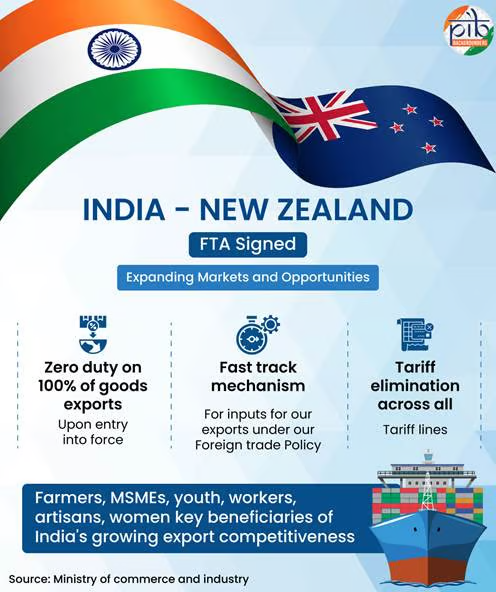
- India and New Zealand signed the India- New Zealand Free Trade Agreement (IN- NZ FTA).
- Customs Cooperation: In 2024, New Zealand and India signed a Customs Cooperative Arrangement, aimed at enhancing trade ties and intensifying collaboration against transnational organized crime.
- Diaspora: There are 292,092 persons of Indian ethnicity in NZ.
- India is the 2nd largest source of international students in NZ. Currently, there are approximately 8,000 Indian students in NZ, pursuing higher education in various disciplines such as IT, hospitality, science, engineering, and architecture.
- Hindi is the fifth most spoken language in NZ.
- Defence Cooperation: Signed in 2025, the Defence Cooperation Memorandum of Understanding provided a formal institutional framework for bilateral defence engagement.
- The inaugural India–New Zealand Defence Strategic Dialogue was held in New Delhi in 2025.
Challenges in Relations
- Immigration and FTA Concerns: Recent debates over New Zealand’s immigration policy have created concerns in India, with allegations that new rules may disproportionately affect Indian migrants.
- Differences over labour mobility remain a key challenge in finalising a comprehensive India–New Zealand Free Trade Agreement (FTA).
- Dairy Market Access Dispute: Dairy remains the most sensitive issue in trade negotiations. New Zealand seeks greater access to India’s dairy market, while India protects the interests of millions of small dairy farmers.
- Khalistan Issue: India has raised concerns over activities of pro-Khalistan groups in New Zealand. Differences exist between India’s security concerns and New Zealand’s approach based on freedom of expression.
Way Ahead
- India and New Zealand, despite being geographically distant, share converging interests in democracy, trade, security and a stable Indo-Pacific.
- At a time when global institutions face challenges, a stronger partnership between the two countries can help promote a more inclusive, equitable and rules-based international order.
Previous article
News In Short 08-07-2026
