


Prambanan Temple complex
Syllabus: GS31/ History and Culture
Context
- PM Modi visited the majestic Prambanan Temple complex, a UNESCO World Heritage Site, in Yogyakarta, Indonesia,
About Prambanan Temple Complex
- Prambanan is the largest Hindu temple compound in Indonesia and is dedicated primarily to Lord Shiva.
- It was built during the 10th century CE during the Mataram Kingdom period in Java.
- The temple complex is located on the border of Yogyakarta and Central Java on the island of Java.
Architectural Features
- The complex follows a three concentric square design, representing the Hindu cosmological concept of the universe.
- The central area consists of towering temples dedicated to the Hindu Trimurti: Shiva, Vishnu and Brahma.
- The walls of the temples contain detailed bas-relief carvings depicting scenes from the Ramayana, reflecting the spread of Indian cultural traditions in Southeast Asia.

Emergency Credit Line Guarantee Scheme (ECLGS) 5.0
Syllabus: GS2/Government Initiatives
Context
- The Emergency Credit Line Guarantee Scheme (ECLGS) 5.0 has facilitated over 4.11 lakh government-guaranteed loans, with the total guaranteed amount exceeding ₹1.55 lakh crore, to improve credit access for eligible sectors.
About ECLGS 5.0
- ECLGS 5.0 is the latest version of the Emergency Credit Line Guarantee Scheme, originally introduced during the COVID-19 pandemic.
- The scheme aims to provide additional working capital support to businesses facing temporary financial stress.
- The scheme launched in 2026 addresses financial stress faced by MSMEs and the aviation sector due to disruptions arising from the ongoing West Asia conflict.
- It allows eligible borrowers to obtain additional loans of up to 20% of their existing working capital limits.
- The scheme has a total credit support envelope of ₹2,55,000 crore (including Rs.5,000 crore for airlines).
Credit Guarantee Structure
- Guarantee coverage: For MSMEs, the government provides a 100% guarantee on the additional credit extended by banks. For non-MSME borrowers as well as the airline sector, the guarantee coverage is 90%.
- Guarantees are provided through the National Credit Guarantee Trustee Company Limited (NCGTC).
- Tenure of Loan:
- For MSMEs/Non MSMEs (except Airline sector): 5 years from the date of first disbursement including a moratorium of 1 year.
- For the airline sector: 7 years from the date of first disbursement including a moratorium of 2 years.
- Tenure of Guarantee Cover: Maximum period of guarantee cover shall be co-terminus with the tenor of the loan.
Source: PIB
Report on Unified District Information System for Education Plus (UDISE+) 2025-26
Syllabus: GS2/Governance
Context
- The Union Ministry of Education released a Report on Unified District Information System for Education Plus (UDISE+) 2025-26 on School Education in India.
Major Highlights
- There is an increase of 8.3% in the number of teachers during the reporting year as compared to 2022-23.
- The Pupil-Teacher Ratio (PTR) at the Foundational, Preparatory, Middle, and Secondary levels are now reported at 10, 12, 17, and 21 respectively, recording a significant improvement as compared to the NEP’s recommended ratio of 30:1.
- Dropout Rate: At the preparatory level, the dropout rate declined from 2.3 percent in 2024-25 to 1.8 percent in 2025-26 and at the secondary level from 8.2 percent to 7 percent.
- Retention rates increased from 82.8% (2024-25) to 83.7% (2025-26) at the middle level and from 47.2% (2024-25) to 51.9% (2025-26) at the secondary level.
- Gross Enrolment Ratio (GER) at the secondary level increased from 68.5% in 2024–25 to 71.7% in 2025-26.
- Improved Female Representation: It witnessed an increase in the representation of female teachers, with women now comprising 54.9% of the total teaching workforce.
- The female representation in schools has also shown a positive trend with girls’ enrolment reaching 48.4% in 2025-26.
- Infrastructure Development: 95.0% of schools are powered with electricity, 98.5% have girls’ toilets, and 97.2% have boys’ toilets.
- There is an increase in the number of schools with computer facilities from 64.7 percent in 2024-25 to 69.9 percent in 2025-26.
Source: PIB
National Academic Depository (NAD)
Syllabus: GS2/Education
Context
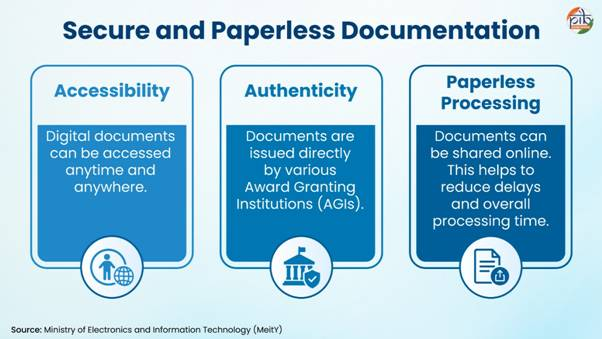
- The Government introduced the National Academic Depository (NAD) in 2017, for the digital storage, verification, and authentication and issuance of academic awards.
About
- The Ministry of Education is the parent ministry responsible for the NAD.
- It has designated the University Grants Commission (UGC) as the nodal agency for implementing the NAD through DigiLocker.
- The Automated Permanent Academic Account Registry (APAAR) and the Academic Bank of Credits (ABC) manage the credit scores of students and facilitate academic mobility.
- NAD registers Central, State, Private, deemed-to-be Universities, CBSE and other school boards, Institutions of National Importance and other higher education institutions.
- The functioning of NAD:
- Academic Award Creation: Educational institutions (schools, universities, boards, and other authorised bodies) generate academic awards such as degrees, diplomas, certificates, and mark sheets after completion of a course or examination.
- Digital Upload to Digi Locker/NAD: The institution securely uploads or issues these verified academic records into the National Academic Depository (NAD) through the DigiLocker platform.
- Students Access via DigiLocker: Once issued, the digital academic documents are automatically linked to the student’s DigiLocker account, where they can be securely accessed anytime.
Significance
Source: PIB
Kamarajar Port
Syllabus: GS3/Infrastructure
Context
- Kamarajar Port has become India’s second major port after Visakhapatnam Port to achieve an 18-metre draft capability following the successful completion of its Capital Dredging Phase VI project.
- Draft capability refers to the maximum depth of water a port can provide for the safe movement and berthing of ships.
About Kamarajar Port
- Formerly known as Ennore Port, it is located about 24 km north of Chennai on the east coast of Tamil Nadu.
- It was declared a Major Port under the Indian Ports Act, 1908 in 1999.
- The ₹440-crore Capital Dredging Phase VI project deepened the navigation channels and berths, making the port Cape Compliant.
- The port can now accommodate fully laden Capesize vessels carrying up to 1,70,000 Deadweight Tonnage (DWT).
Additional Information
- India currently has 14 major ports and approximately 200 non-major ports. The Vadhavan Port (Greenfield Port, Maharashtra) and Galathea Bay Port (Andaman & Nicobar) have been notified as major ports but are not yet operational.
- Major ports: Wholly owned and managed by the Union Government.
- Non-major ports: Respective State Maritime Boards / State Governments.
- 95% of India’s trade by volume and 70% by value is conducted through maritime routes.
- Major ports alone handle 53% of the total maritime cargo traffic in the country.
- 100% FDI is allowed under the automatic route for port construction and maintenance.
Source: PIB
Mizoram’s Natural History Museum notified as India’s 21st Designated Repository
Syllabus: GS3/ Environment and Ecology
Context
- Mizoram’s Natural History Museum has been notified as India’s 21st Designated Repository under Section 39 of the Biological Diversity Act, 2002.
What are Designated Repositories?
- Designated Repositories are an important component of India’s biodiversity governance framework, preserving authenticated biological specimens for scientific research and conservation.
- The repositories are entrusted with maintaining biological materials in safe custody, and any person discovering a new taxon is required to notify the designated repository and deposit the corresponding voucher specimens.
Significance
- The designation advances National Biodiversity Target 4 of India’s National Biodiversity Strategy and Action Plan (2024-2030) by strengthening ex situ conservation.
- It also aligns with Target 4 of the Kunming–Montreal Global Biodiversity Framework, which aims to ensure the conservation and management of threatened species and maintain genetic diversity.
About Mizoram’s Natural History Museum
- Established in 2022 under the aegis of Mizoram University, the Natural History Museum is located within the Indo-Burma Biodiversity Hotspot and has specialised taxonomic expertise.
- The museum’s expertise in pteridophytes, macrofungi, moths, beetles and other lesser-studied taxa fills an important gap in India’s network of Designated Repositories and strengthens the scientific documentation of the region’s rich biodiversity.
White Gut Disease
Syllabus: GS2/ Health
Context
- The Fisheries department sounded an alarm about the outbreak of White Gut Disease (WDG), also known as White Feces Disease (WFD), in shrimp ponds in West Godavari district.
About White Gut Disease
- It is a disease affecting farmed shrimp, particularly Pacific white shrimp (Litopenaeus vannamei), which is widely cultivated in India.
- Symptoms: It is characterized by the appearance of floating white fecal strings in shrimp ponds and discoloration of the shrimp intestine.
- Causes: It is not caused by a single pathogen but is considered a multifactorial disease, resulting from interactions among pathogens, poor water quality, environmental stress, and management practices.
- Microsporidian parasite: Enterocytozoon hepatopenaei (EHP) (commonly associated).
- Bacterial infections: Mainly Vibrio species.
- Poor pond hygiene and accumulation of organic waste.
- Deterioration in water quality (high ammonia, nitrite, low dissolved oxygen).
Source: TH
Finerenone
Syllabus: GS2/ Health, Miscellaneous
In News
- Researchers found that patients having kidney disease and taking finerenone lost kidney function more slowly.
About
- Finerenone (sold as Kerendia and Lyvelsa) is a nonsteroidal mineralocorticoid receptor antagonist (MRA) primarily prescribed to reduce the risk of kidney function decline, kidney failure and heart failure hospitalization in patients.
- Overactive mineralocorticoid receptors (MR) in the body can trigger inflammation and fibrosis (scarring) in the heart, kidneys, and blood vessels. Finerenone blocks these receptors, protecting the organs from these harmful, progressive processes.
- The most common side effect is hyperkalemia, which means increased potassium levels in the blood.
Source: TH
Scientist Won Coller Dolittle Challenge Award on Zebra Finches Communication
Syllabus: GS3/Species in News
Context
- An American scientist, Dr Julie Elie at the University of California has won the the Coller Dolittle Challenge award for her work on how zebra finches communicate with each other.
About Zebra Finches
- The Zebra Finch is a small, colorful songbird native to Australia.
- They can also be found natively in parts of Indonesia and East Timor.
- It is one of the most widely studied bird species in the world because of its simple care requirements, social behavior, and vocal learning abilities.
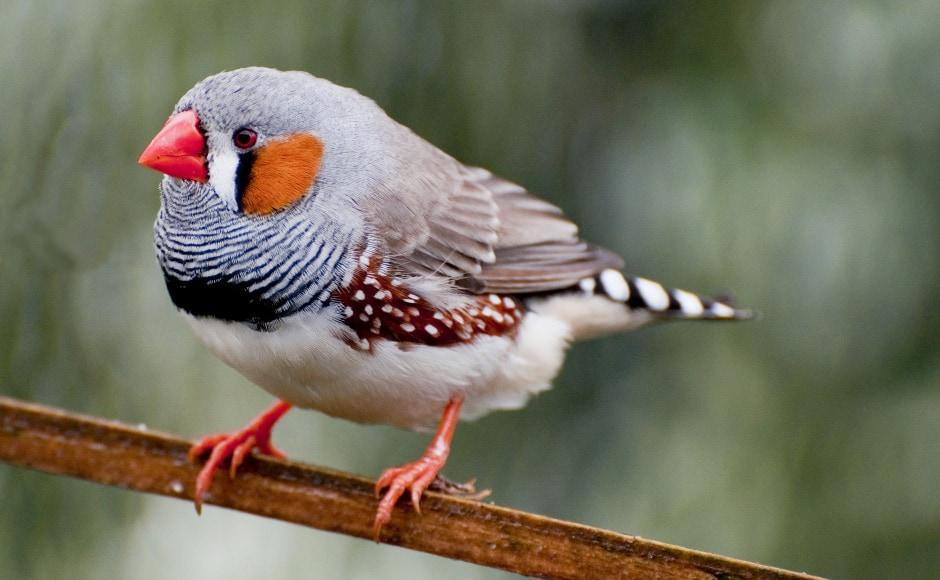
- Scientific Name: Taeniopygia guttata.
- Family: Estrildidae (Waxbills and Grass Finches).
- Habitat: Grasslands, scrublands, and areas near water sources.
- IUCN Status: Least Concern (LC).
Source: IE
Previous article
India Lifted the Energy Curbs Imposed during the West Asia Crisis
Next article
India–New Zealand Relations
