

Indira Point
Syllabus: GS1/ Geography
Context
- The Directorate of Lighthouses and Lightships at Sri Vijaya Puram (Port Blair) has approached the Andaman and Nicobar Coastal Zone Management Authority and the Environment Ministry seeking approval for protection and development work at Indira Point.
What is Indira Point?
- Indira Point is India’s southernmost point, located on Great Nicobar Island in the Andaman and Nicobar Islands.
- It lies south of Galathea Bay, where the proposed Great Nicobar mega infrastructure project is being developed.
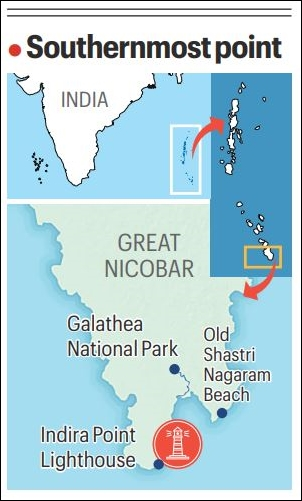
- The Indira Point lighthouse, built in 1972 on 11.5 hectares of land, stands 35 metres tall and is made of cast iron.
- The 2004 tsunami caused the southern shoreline of Great Nicobar Island to subside by roughly 4.25 metres, pushing the sea closer to the lighthouse.
Why Does the Proposal Require Environmental Clearance?
- The project site falls within ecologically sensitive Island Coastal Regulation Zone (ICRZ) categories.
- ICRZ-1A rules bar most development activity, with limited exceptions for eco-tourism, roads (including those built on stilts) and — in exceptional circumstances — defence, strategic, or public utility projects, provided a detailed impact assessment is carried out.
- ICRZ-IV, on the other hand, permits and regulates certain activities such as land reclamation, bunding and erosion control.
Source: IE
Indiahandmade
Syllabus: GS2/Governance
Context
- Indiahandmade is a dedicated digital marketplace that brings India’s handloom and handicraft traditions into the online economy.
About
- India currently has an estimated 64.66 lakh handloom and handicraft artisans.
- Women form a major part of this workforce, accounting for 71% of handloom weavers and 64% of total artisans as of 2025.
- Indiahandmade was launched in 2023, to strengthen the visibility of handmade products and open wider market opportunities for sellers.
- Developed By: Digital India Corporation under the Ministry of Textiles.
- Salient Features:
- Specialised Online Marketplace: It enables weavers and artisans to sell their handloom and handicraft products online.
- Direct Buyer Access: Artisans and weavers are directly connected with buyers, helping reduce intermediaries and support fair compensation.
- Digital Empowerment: Artisans and weavers are provided with digital tools and visibility to participate more effectively in online commerce.
- It offers a wide range of products, including apparel, home décor, furnishings, paintings, furniture, religious items, stationery, musical instruments, jewellery, bags and footwear.
- It also highlights special product categories such as GI-tagged and ODOP products.
Source: PIB
Record Flow of FPIs into Indian Bonds
Syllabus: GS3/Economy
Context
- Foreign Portfolio Investment under general limit debt securities came in at ₹55,518 crore in June 2026.
About
- Foreign Portfolio Investment (FPI) refers to investments made by foreign individuals, institutional investors, or funds in financial instruments such as stocks, bonds, mutual funds, and government securities.
- FPIs do not participate in the management or decision-making of the companies in which they invest and are generally considered passive investors.
- Foreign Institutional Investment (FII) is a category of FPI that refers specifically to investments made by foreign institutional investors such as mutual funds, pension funds, insurance companies, and hedge funds.
- These institutions invest pooled funds in financial markets and typically play a more active role in investment research and decision-making.
- Government Securities (G-Secs), are tradeable debt instruments issued by the central/ state governments to fund public projects, manage fiscal deficits, control market liquidity.
- Foreign investors can invest in Indian G-Secs through routes such as the General Route and the Fully Accessible Route (FAR).
- Classification of Capital Gains
- Long-Term Capital Gains (LTCG) arise when a Government Security is held beyond the prescribed holding period.
- Listed G-Secs: More than 12 months.
- Unlisted G-Secs: More than 24 months.
- Short-Term Capital Gains (STCG) arise when a Government Security is held for less than the prescribed holding period.
- Listed G-Secs: Up to 12 months.
- Unlisted G-Secs: Up to 24 months.
- Long-Term Capital Gains (LTCG) arise when a Government Security is held beyond the prescribed holding period.
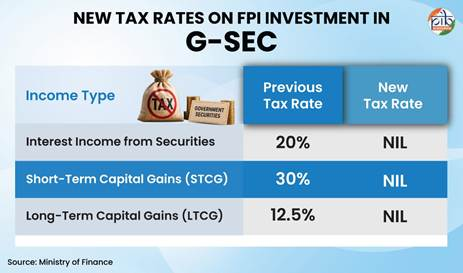
- Recognising the importance of a competitive tax framework in attracting global capital, the Government has introduced a tax exemption for FPIs/FIIs investing in G-Secs.
Source: TH
Vikram-1 to Showcase India’s Space Innovation
Syllabus: GS3/ Science and Technology
Context
- Skyroot Aerospace has announced that Vikram-1, will carry six payloads during Mission Aagaman.
What is Vikram-1?
- Vikram-1 is a four-stage orbital launch vehicle developed by Skyroot Aerospace, an Indian space-tech start-up.
- The first three stages are solid-fuelled, providing robust initial thrust, while a hypergolic liquid upper stage allows for precise orbital manoeuvres.
- It is India’s first privately developed orbital-class rocket.
- Vikram-I can deploy up to 350 kg into low Earth orbit (LEO) and 260 kg into a sun-synchronous orbit (SSO).
Payloads to be launched by Vikram
- Payloads celebrating creativity and India’s scientific heritage:
- Cosmic Bloom, developed by Cosmos Diamonds, featuring a diamond jewellery creation mounted on an aluminium base plate.
- Microart: An 18K gold rocket holding micro-sculptures of Sir C.V. Raman, Dr. Vikram Sarabhai, and Dr. A.P.J. Abdul Kalam — each smaller than a grain of rice.
- Technology Demonstration Payloads:
- Robotic Arms by Cosmoserve
- SOLARAS by Grahaa Space
- SCOPE by Skyroot Aerospace
- One international payload — uD3PP and mD3RN — developed by Dcubed GmbH, Germany.
FDA Approves the First PROTAC Drug
Syllabus: GS3/ Science and technology
Context
- The U.S. Food and Drug Administration (FDA), approved the drug Vepdegestrant for patients with ESR1-mutated, ER-positive, and HER2-negative advanced breast cancer.
About
- It is the world’s first therapy that the FDA has approved that is based on PROTAC (Proteolysis-Targeting Chimera) technology.
- The approval paves the way for drugs designed to remove harmful proteins from cells, rather than simply block them.
How Do PROTACs Work?
- ‘PROTAC’ stands for proteolysis-targeting chimaera, which is a kind of molecule designed to remove specific proteins from a cell.
- A PROTAC has two ends: one binds to the target protein and the other binds to an E3 ligase, an enzyme involved in the cell’s protein degradation process.
- By bringing these components together, the PROTAC causes the target protein to be degraded by the cell. This is called targeted protein degradation.
Significance
- Conventional drugs work by binding to a protein in a way that prevents it from performing certain roles in the body. Hence the drugs need to be present for long periods in the body.
- PROTACs however act like catalysts, while the proteins they target end up being degraded, they themselves are not degraded.
- After triggering one degradation process, the PROTAC can detach itself and repeat it with another instance of the same protein. This mechanism allows a single PROTAC molecule to act multiple times.
Source: TH
Oldest Quasars Found
Syllabus: GS3/Space
Context
- The Euclid space telescope has spotted the oldest quasars ever discovered, deepening a cosmic mystery that has been puzzling scientists.
About
- A quasar is the intensely luminous core of a distant galaxy powered by a supermassive black hole.
- As gas spirals into the black hole, extreme amounts of gravitational energy are converted into radiation, making quasars shine with the light of a trillion suns.
- They provide valuable insights into the early evolution of galaxies and black holes.
- The light from the oldest pair comes from when the universe was roughly 670 million years old, just five percent of its current age of 13.8 billion years.
- This beats the previous record for oldest and therefore most distant quasar announced in 2021 by around 20 million years.
Black Hole
- A black hole is an extremely dense object whose gravity is so strong that nothing, not even light, can escape it.
- It does not have a surface, like a planet or star. Instead, it is a region of space where matter has collapsed in on itself.
- This catastrophic collapse results in a huge amount of mass being concentrated in an incredibly small area.
- Formation: A black hole is formed when a really massive star runs out of fuel to fuse, blows up, leaving its core to implode under its weight to form a black hole.
- The centre of a black hole is a gravitational singularity, a point where the general theory of relativity breaks down, i.e. where its predictions don’t apply.
- A black hole’s great gravitational pull emerges as if from the singularity.
Do You Know?
- Known black holes fall into two classes:
- Stellar mass: 5 to tens of times the Sun’s mass;
- Supermassive: 100,000 to billions of times the Sun’s mass;
- Middleweight black holes may exist between these classes, but none have been found to date.
- Spaghettification: As objects approach the event horizon of a black hole, they’re horizontally compressed and vertically stretched, like a noodle.
- The nearest known black hole, called Gaia BH1, is about 1,500 light-years away.
- Sagittarius A*: Sagittarius A* is more than 25,000 light years from Earth – nearest supermassive black hole, with an estimated mass millions of times that of the Sun.
- Often abbreviated by researchers to Sgr A* (pronounced “Sagittarius A star”), it sits in the constellation of Sagittarius at the heart of the Milky Way.
Source: TH
INS Mahendragiri
Syllabus: GS3/Defence
Context
- The Indian Navy is set to commission INS Mahendragiri (F38), the sixth indigenous stealth frigate under Project 17A, at Visakhapatnam.
About
- Named after the majestic Mahendragiri mountain range in the Eastern Ghats, the stealth frigate was designed by the Indian Navy’s Warship Design Bureau and built by Mazagon Dock Shipbuilders Limited, Mumbai.
- The frigate is powered by a modern Combined Diesel or Gas (CODOG) propulsion system, enabling high-speed operations with exceptional endurance across the full spectrum of maritime missions.
- The frigate is equipped with an advanced suite of indigenous and state-of-the-art weapons and sensors, including surface-to-surface and surface-to-air missile systems, sophisticated electronic warfare capabilities, comprehensive anti-submarine warfare systems, and an integrated Combat Management System.
- With over 75 per cent indigenous content, Mahendragiri exemplifies the Government’s Aatmanirbhar Bharat initiative.
Project 17A (Nilgiri-class Programme)
- Project 17A is the follow-on class to the Project 17 (Shivalik-class) frigates.
- It includes 7 stealth frigates:
- 4 being built by Mazagon Dock Shipbuilders Limited (MDL), Mumbai;
- 3 by Garden Reach Shipbuilders & Engineers (GRSE), Kolkata.
- The warships have a displacement of 6,670 tonnes, are 149 metres long, can reach a top speed of 28 knots, and carry 225 personnel.
Source: PIB
Previous article
Should Voting Be a Fundamental Right in India?
Next article
Prime Minister’s Visit to Indonesia
