


Syllabus: GS2/eGovernance
Context
- The Government recently emphasized the role of eSARAS (SARAS Aajeevika) in digitally empowering women-led Self-Help Groups (SHGs) by linking rural artisans to national markets and promoting inclusive growth under the Digital India mission.
About eSARAS (SARAS Aajeevika)
- It is a digital marketplace for products created by women SHGs, rural artisans and producer collectives across India.
- It is developed by the Ministry of Rural Development under the Deendayal Antyodaya Yojana–National Rural Livelihoods Mission (DAY-NRLM).
- Its objective is to provide SHG members with direct market access, eliminate middlemen, ensure fair remuneration and promote indigenous crafts and rural entrepreneurship.
- Every product on eSARAS carries a story, and every purchase is a direct connection to the artisan behind it. It includes examples like:
- Chanderi sarees from Madhya Pradesh
- Marble artisans in Rajasthan
- Pashmina producers in the hills of Jammu & Kashmir
Key Milestones: From Portal to e-Commerce Ecosystem
- eSARAS Portal: e-Commerce portal launched for better and more effective marketing of Saras products
- eSARAS Mobile App: Mobile app launched alongside the eSARAS Fulfilment Centre. It is used for processing, packaging and shipping of products.
- ONDC: SHG products made available across more than 11 buyer apps (more than 20 crore buyers on ONDC platform) with more than 800 handcrafted products listed.
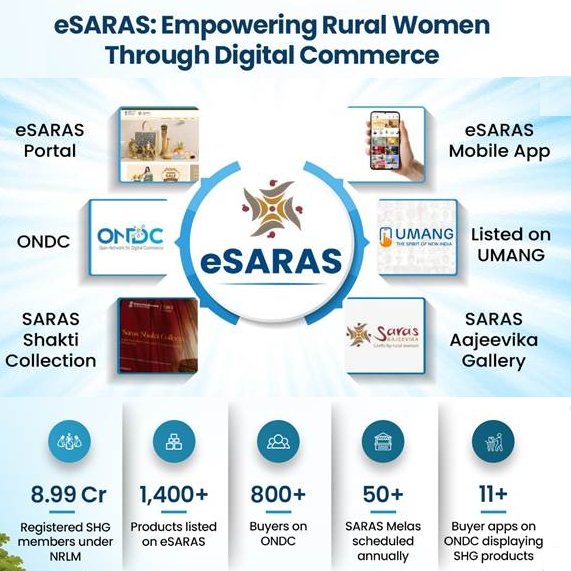
- UMANG: eSARAS listed on UMANG; platform now serves 2,572 services with 796.69 crore transactions (June 2026)
- SARAS Shakti Collection: Premium curated gift collection launched at Rashtriya Gramin Vikas Sammelan 2026 for institutional and corporate markets.
- SARAS Aajeevika Gallery: It is a permanent retail gallery established for showcasing curated SHG products.
Key Features of eSARAS
- Marketplace for SHGs: It focuses only on the sale of goods produced by SHGs and producer groups run by women.
- Entrepreneurship amongst Rural Women: It is an effort at nurturing entrepreneurship skills in rural women.
- Direct Market Linkages: It offers direct connections between the producers and customers, and minimizes reliance on middlemen, thereby helping increase the income of producers.
- Product Diversification: It has handicrafts, handlooms, natural & organic foods, home décor, textile products, traditional artefacts etc. It helps promote the rich cultural and artisanal tradition of India.
- Digital Empowerment: It enables online registration, cataloging, digital payments and order management, and digital literacy and financial inclusion amongst rural women.
- National Market Access: It enables rural products to reach the customers throughout the country irrespective of the geographical constraints.
- It contributes to the ‘Vocal for Local’ and Atmanirbhar Bharat agenda.
- Inclusiveness: It gives livelihood options to the women, especially those belonging to marginalized communities and remote areas.
- It supports the community institutions formed under DAY-NRLM.
Way Forward
- Capacity Building: Continuous training in digital marketing, packaging, branding and quality standards.
- Logistics Infrastructure: Need for a well-structured supply chain and delivery system for order fulfillment.
- Technological Innovations: AI-based recommendation, multi-language interface, analytics and other such technologies for enhanced user experience.
- Brand Creation: Creating region-wise brands and leveraging the GI-based product promotion to strengthen competitiveness.
- Integration with Other Marketplaces: Convergence with ONDC, GeM and other major e-commerce platforms to enlarge market access.
- Financial Assistance: Providing easy credit, working capital and insurance assistance to SHGs.
- Export Initiatives: Explore export options for the premium handicrafts and artisanal products.
Previous article
VB-G RAM G Act Come Into Force
Next article
130th Constitution Amendment Bill
