


Syllabus: GS3/Agriculture
Context
- The Pradhan Mantri Krishi Sinchayee Yojana (PMKSY) has completed more than 10 years of advancing irrigation-led agricultural transformation through sustainable water management and the expansion of irrigation coverage.
About Pradhan Mantri Krishi Sinchayee Yojana (PMKSY)
- It is a flagship irrigation scheme launched in 2015 under the vision of ‘Har Khet Ko Pani’ (Water to Every Field) and ‘Per Drop More Crop’.
- It aims to provide for the integrated development and efficient management of water resources from source creation to its application at the farm level.
- It follows the convergence approach which involves ministries of Jal Shakti, Agriculture & Farmers Welfare and Rural Development.
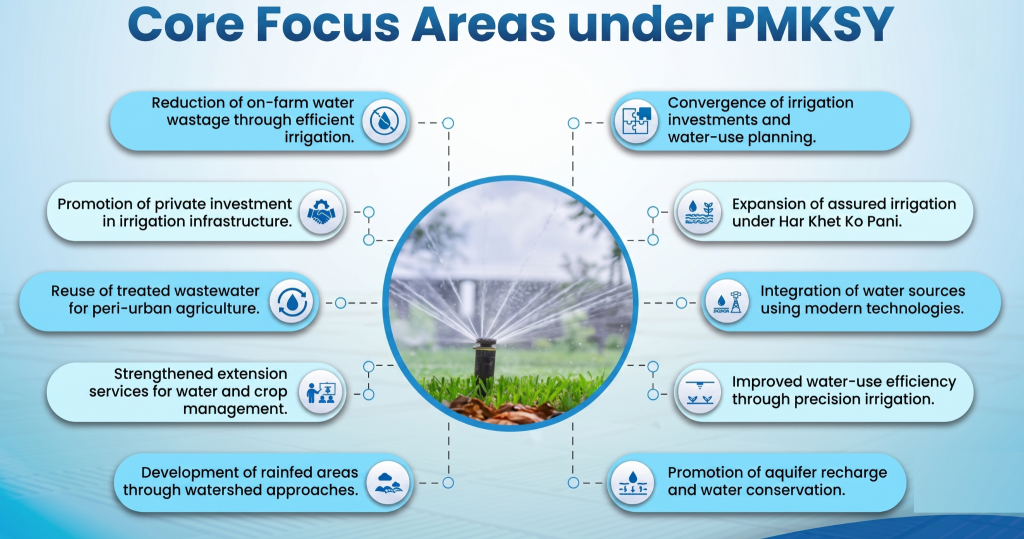
Components of PMKSY
- Accelerated Irrigation Benefit Programme (AIBP): It ensures the timely completion of major and medium irrigation projects.
- It improves irrigation infrastructure and availability of water.
- It has received more than ₹21,023 crore of central assistance since 2016-17. It benefitted nearly 17.3 million farmers.
- The newly approved Modernization of Command Area Development and Water Management (M-CADWM) aims to provide water through pressurized piped network and micro-irrigation systems.
- Har Khet Ko Pani (HKKP): It expands assured irrigation through minor irrigation and groundwater development.
- It aims for the repair, renovation and restoration (RRR) of traditional water bodies.
- More than 3,462 Surface Minor Irrigation and RRR schemes have been implemented.
- Watershed Development Component: It promotes integrated watershed management in rainfed and degraded areas.
- It improves soil moisture conservation, groundwater recharge and climate resilience.
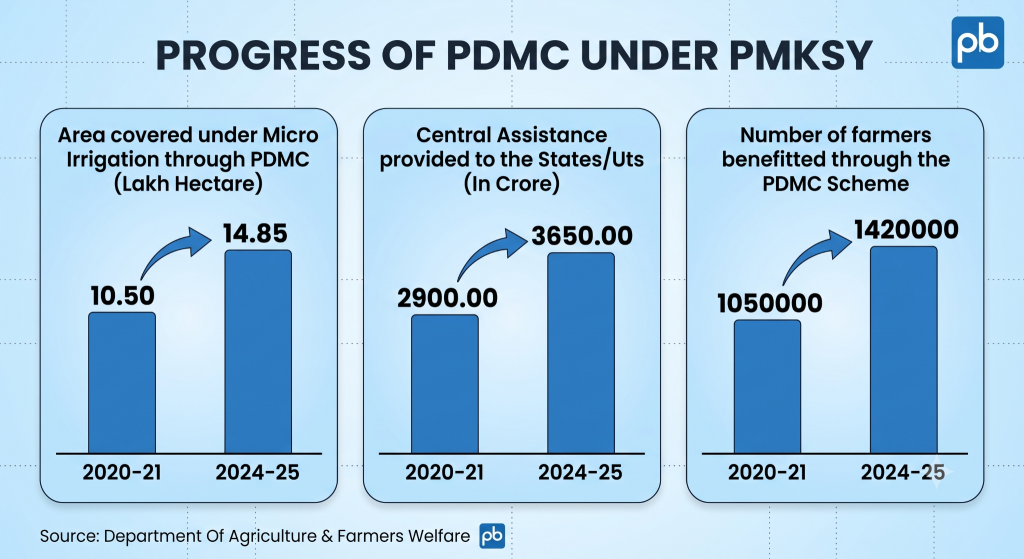
- Per Drop More Crop (PDMC): It promotes micro-irrigation technologies like drip and sprinkler irrigation.
- PDMC has been subsumed under PM-RKVY since 2022-23.
- It provides financial assistance:
- 55% subsidy for small and marginal farmers.
- 45% subsidy for other farmers.
Issues in India’s Irrigation Infrastructure
- Monsoon Dependency: Almost half of India’s net sown area is rainfed, making agriculture highly dependent on monsoon.
- Inefficient Water Usage: Flood irrigation dominates Indian agriculture which causes loss of water through evaporation, runoff, and seepage.
- Regional Disparities: States like Punjab and Haryana have high irrigation coverage, while eastern and central India are still facing irrigation deficits.
- Groundwater Degradation: Unplanned exploitation has led to depleting water tables in many regions.
- Incomplete irrigation projects: Many major and medium irrigation projects remain stalled for decades due to lack of funding and administration.
- Climate Change: Increased frequency of droughts, irregular rains and extreme weather events threaten the sustainability of agriculture.
How Can PMKSY Be a Solution?
- Integrated Water Resource Management: PMKSY takes care of the whole irrigation value chain- from water source creation to efficient use at the farm level.
- Promotion of Micro-Irrigation: Drip and sprinkler systems cause minimal loss of water and increase irrigation efficiency.
- Expanding Assured Irrigation: Irrigation infrastructure is expanded in un-covered areas through AIBP and HKKP.
- Watershed Based Development: Rainwater harvesting, groundwater recharge and soil conservation help in building resilience in rainfed regions.
- Convergence and Decentralized Planning: The scheme helps in promoting convergence among ministries/states for better resource utilisation.
- Climate Resilience: Efficient management of water helps farmers adapt to climate change and droughts.
Achievements of PMKSY in Last 10 Years
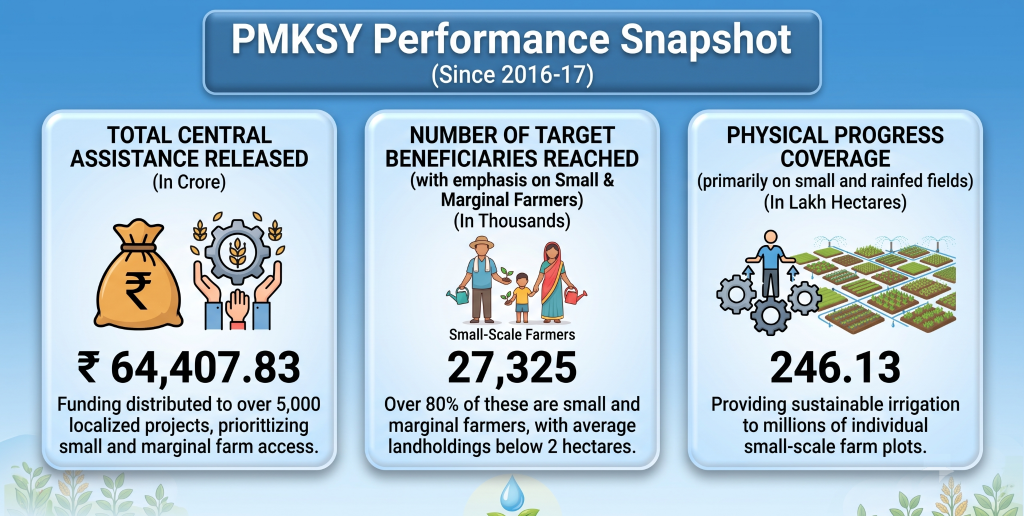
- Expansion of Irrigation Coverage: PMKSY is continued till 2021-26 with an outlay of ₹93,068.56 crore.
- By Aug 2025, more than 27 million farmers will benefitted.
- Over 24.61 million hectares have been covered or developed through various interventions.
- Increasing Irrigation Potential: HKKP interventions have helped in creating almost 5.93 lakh hectares of irrigation potential.
- Groundwater interventions have helped in adding around 88.55 thousand hectares.
- Adoption of Micro-Irrigation: Around 110.92 lakh hectares have been brought under micro-irrigation.
- Almost 9.3 lakh farmers are supported annually.
- Increasing Water-Use Efficiency: Sprinkler and drip irrigation have significantly decreased the use of water, fertilizer, electricity and labor.
- Increasing Income of Farmers: Experience of farmers of Barabanki, Uttar Pradesh shows that:
- There has been an increase in yield of 25-30%.
- There is a 50% decrease in use of water and inputs.
- Farmers earn profits of around ₹60,000-70,000 per hectare.
- Sustainable Natural Resources Management: Watershed interventions have improved soil health, groundwater recharge and ecological sustainability.
What More Needs To Be Done?
- Universalization of Micro-Irrigation: Micro-irrigation covers only a small portion of net sown area of India and its greater adoption is needed.
- Strengthening Participatory Irrigation Management: Water Users Association (WUAs) needs to be strengthened for better distribution and maintenance.
- Completion of Incomplete Projects: Timely execution and monitoring of irrigation projects is required.
- Promoting Crop Diversification: Water-intensive crops in stressed regions need to be replaced with less water-intensive crops.
- Usage of Technology: Scaling up remote sensing, GIS, AI based irrigation advisories and IoT enabled precision farming can prove beneficial.
- Improvement in Groundwater Governance: Need of scientific groundwater budgeting and management of aquifers is required for long term water security.
- Greater Convergence: PMKSY should be converged with MGNREGS, PMKSN, Atal Bhujal Yojana etc.
Previous article
Rise in Gulf Remittances
Next article
Fiscal Tightrope for State Governments
