


Syllabus: GS2/ Governance
Context
- The Digital India Programme completes 11 years as on 1 July 2026.
India’s Digital Leadership
- Over the last decade, Digital India has become the foundation of India’s digital economy and Digital Public Infrastructure.
- It accelerated innovation, startup growth, and technology adoption across the various sectors.
- India is now leads global real-time digital payments with UPI handling nearly 49% of worldwide transaction volume.
- The digital economy contributes nearly 12–14% of India’s GDP and expected to contribute around one-fifth over the next decade.
- India also launched India Stack Global and the Global DPI Repository during its G20 Presidency in 2023 which help in expanding global access to Indian digital solutions.
- As of February 2026, India has signed MoUs with 24 countries for cooperation on India Stack and DPI systems, covering digital identity, payments and service delivery.
What are the Nine Pillars of Digital India?
- Broadband Access: Reliable broadband is essential for digital governance and inclusive economic growth.
- For example: The broadband Internet subscriber base increased to 106.58 Cr. at the end of March 2026.
- Universal Access to Mobile Connectivity: As of Jan 2026, around 2.15 lakh Gram Panchayats i.e. nearly 97% have been connected with close to 7 lakh Km of optical fiber cable under the under BharatNet-1 and BharatNet-2.
- Public Internet Access Programme: Accessible digital centres help citizens access services near their homes. Like more than 6.5 lakh Common Service Centres and 1.6 lakh post offices now deliver digital services.
- e-Governance: It promotes paperless, integrated, and public-centric administration.
- Platforms such as DigiLocker and the National Single Sign-On ecosystem enable seamless access to certificates, applications, payments, and public services, reducing paperwork while improving ease of living.
- e-Kranti: As the service delivery pillar of Digital India, e-Kranti has accelerated the shift from physical to digital governance.
- Integrated platforms such as e-Hospital, e-Sanjeevani, and e-Courts have simplified access to certificates, healthcare and justice services.
- Information for All: This pillar strengthens transparent and participatory governance by making government information easily accessible and encouraging citizen engagement through digital platforms.
- Initiatives such as MyGov and Open Government Data enable citizens to access information.
- Electronics Manufacturing: Electronics production has increased from ₹1.9 lakh crore in FY 2014-15 to about ₹12 lakh crore as of March 2026.
- Today, India is the world’s second-largest mobile phone manufacturer, reflecting its growing role in global electronics value chains.
- IT for Jobs: The IT and ITeS industry is estimated to have generated USD 283 billion in revenue in FY25, according to NASSCOM.
- India’s 2,100+ Global Capability Centres (GCCs) employ around 26 lakh professionals across engineering, analytics, cyber security, and AI-driven roles.
- Early Harvest Programmes: Quick-impact initiatives such as biometric attendance, secure government email, public Wi-Fi hotspots, eBooks, SMS-based weather alerts, and digital communication platforms demonstrated the immediate benefits of technology-led governance.
Flagship Initiatives That Powered an Inclusive Decade
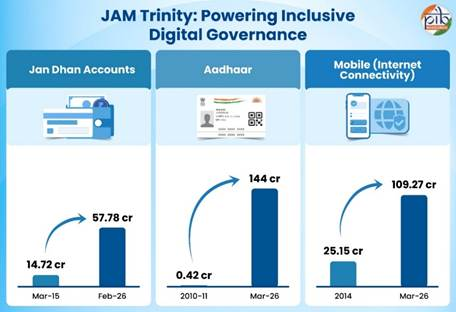
- JAM Trinity: The Foundation of Digital India has revolutionised financial inclusion and welfare delivery in India. It brought millions into the formal banking system and enabled seamless access to government services.
- DigiLocker: DigiLocker is replacing physical documents with a secure digital wallet, and transforming document storage and verification across India.
- As of March 2026, the platform has registered over 70.69 crore users and issued more than 850+ Cr documents.
- Unified Payments Interface (UPI): Completing ten years in 2026, UPI is transforming digital payments through instant and secure transactions for citizens and businesses.
- UPI’s global footprint now extends to nine countries, with Cambodia becoming the latest to adopt it.
- Digital Platforms Powering Public Health:
- The Online Registration System (ORS) enables patients to book appointments digitally while reducing queues and paperwork. The cloud-based eHospital platform is digitising hospital operations, while eBloodBank is improving blood availability and management across healthcare institutions.
- eSanjeevani: The telemedicine platform is connecting patients with doctors remotely, especially in rural and underserved regions.
- Tele MANAS provides free tele-counselling and mental health support nationwide.
- Empowering Commerce Through Technology:
- Government e-Marketplace (GeM) has transformed public procurement by making it transparent, efficient and paperless.
- Open Network for Digital Commerce (ONDC) is creating an open and interoperable digital commerce ecosystem that connects buyers and sellers across platforms.
- AgriStack: Empowering Farmers Through Technology
- Developed under the Digital Agriculture Mission, AgriStack is a farmer-centric DPI powering services such as e-NAM for online agricultural trading and Kisan e-Mitra, an AI-powered chatbot providing instant farming information and government scheme support.
- Digital Platforms Driving Educational Access:
- DIKSHA (Digital Infrastructure for Knowledge Sharing) is transforming school education through curriculum-linked digital learning resources and teacher training.
- SWAYAM (Study Webs of Active Learning for Young Aspiring Minds) and SWAYAM Prabha are expanding access to quality education beyond classrooms.
- Powering India’s Digital Workforce:
- PMGDISHA bridged the rural digital divide by training citizens in smartphone usage, internet access, digital payments and online services.
- FutureSkills Prime is preparing learners for emerging technologies such as AI, cloud computing, cybersecurity and data analytics.
- Skill India Digital Hub (SIDH) is a unified platform for skilling, certification and employment services.
- IndiaAI Mission is strengthening AI education, infrastructure and responsible AI adoption.
Way Ahead
- Strengthen digital infrastructure: Complete universal broadband connectivity, particularly in remote and Left Wing Extremism (LWE)-affected areas.
- Bridge the digital divide: Enhance digital literacy programmes to ensure that rural populations, women, senior citizens, and other vulnerable groups are not excluded from the digital economy.
- Boost manufacturing ecosystem: Strengthen domestic value addition through the Semiconductor Mission, encourage research and development, and integrate India more deeply into global technology supply chains.
Source: PIB
Previous article
Hamburg Sustainability Conference 2026
Next article
News In Short 30-06-2026
