


Syllabus: GS3/Science and Technology
Context
- The rise of advanced robotics and AI-powered “embodied intelligence” could fundamentally change India’s economic advantage.
India’s Traditional Advantage
- For decades, India has benefited from an abundant supply of low-cost labour.
- Many industries chose India because wages were lower than in developed countries.
- However, if factories increasingly rely on robots rather than human workers, labour-cost advantages become less important.
What is Robotics?
- Robotic technology encompasses the design, construction, operation, and use of robots.
- Advances in artificial intelligence (AI) and machine learning have led to the development of more advanced robots that can perform tasks that were previously thought to be exclusive to humans, such as visual perception, speech recognition, and decision-making.
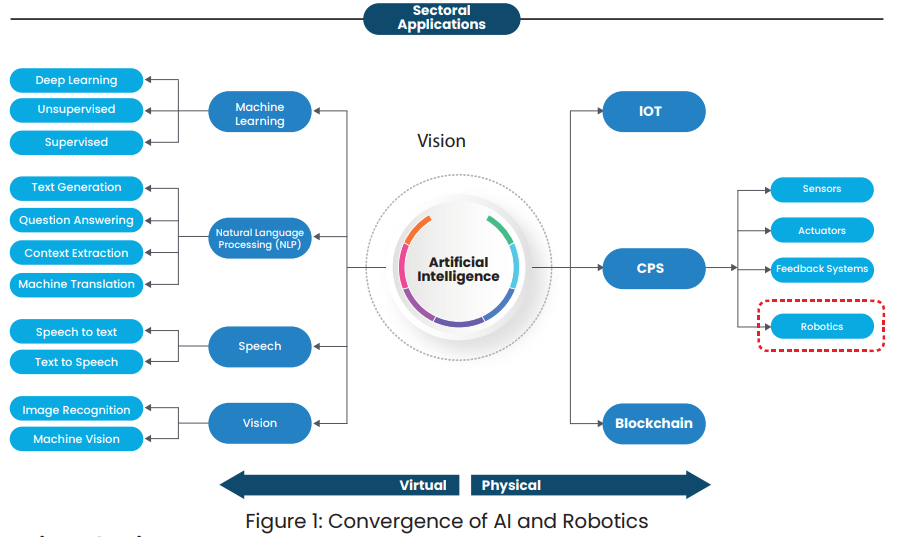
Global Scenario in Robotics
- China dominates the global humanoid robot market, producing roughly 85 per cent of all humanoids worldwide.
- China has built an industrial ecosystem to mass-produce the body.
- According to the International Federation of Robotics, China accounted for 54% of all industrial robot installations worldwide in 2024.
- China is fast becoming a leader in robotics as it is already leading in solar panels, batteries, and rare-earth processing.
- The U.S. leads in frontier artificial intelligence, advanced chip design, and the software architecture that will eventually serve as the brain of any humanoid robot.
India’s Position:
- India installed 9,100 industrial robots in 2024, a 7% rise on the previous year.
- It places it only sixth in the world by annual installations, well behind the United States, Japan, China, South Korea and Germany.
- India’s overall robot density of around 10 continues to trail the global average of 132 robots per 10,000 manufacturing workers.
- SSI Mantra is India’s first indigenous surgical robotic system, it has already conducted telesurgeries across thousands of kilometres.
- Several other companies, like GreyOrange, are pressing ahead with robotics development. The challenge lies in building industrial-scale robotics.
- As per the Draft National Policy on Robotics 2023, India aims to Position itself as a global leader in robotics for manufacturing, healthcare, agriculture, and national security sectors, by 2030.
Challenges Faced by India
- Inadequate Skilled Human Resources: India faces a shortage of engineers, technicians, and robotics specialists.
- There is a weak industry-ready training infrastructure in ITIs and polytechnics.
- Heavy Reliance on Imports: Dependence on imported sensors, chipsets, magnets, batteries, actuators, and motors.
- The domestic robotics supply chain remains underdeveloped and there is a lack of economies of scale compared to countries like China and Japan.
- High Costs: The high cost of imported components increases robot prices.
- Robotics solutions often require customization, limiting mass production.
- Installation, integration, maintenance, and servicing are expensive.
- Low affordability discourages adoption, especially among MSMEs.
- Technological Limitations: Foundational research in core robotics technologies is still nascent.
- There is a lack of advanced manufacturing, prototyping, and testing facilities.
- Limited Governance Mechanisms: Absence of a comprehensive robotics-specific regulatory framework. There are concerns regarding privacy, cybersecurity, safety, and liability.
- Ethical and Social Concerns: Fear of job displacement due to automation.
- Concerns over transparency in autonomous decision-making.
Government Initiatives
- FutureSkills Prime: Under this initiative, a robust online platform has been created to encourage remote and self-paced learning in the field of emerging technologies.
- This program aims to offer subsidised access to certified courses to interested participants in any of the 10 identified emerging technologies.
- Atal Innovation Mission is establishing Atal Tinkering Laboratories (ATLs) in schools across India.
- ATLs have dedicated innovation workspaces where Do-It-Yourself (DIY) kits on emerging technologies like robotics, IoT, etc. have been installed to enable students to get hands-on exposure to these technologies.
- e-YANTRA: It is a robotics outreach program funded by the Ministry of Education and hosted at IIT Bombay.
- The goal is to harness the talent of young engineers to solve problems using technology across a variety of domains.
- Make-in-India Robots: Defence Research and Development Organisation (DRDO), under the Ministry of Defence, developed the remotely operated vehicle (ROV) – ‘Daksha’, an automated mobile platform for multi-purpose payloads.
- Vyommitra is a spacefaring humanoid robot developed by the Indian Space Research Organisation (ISRO) to function onboard the Gaganyaan, a crewed orbital spacecraft.
- Manav is India’s first 3D-printed humanoid robot. It has an inbuilt vision and sound processing capability which allows it to walk, talk and dance just in response to human commands.
Way Ahead
- Strengthen Human Capital: Expand robotics, AI, and automation training through ITIs, polytechnics, engineering institutions, and industry-led skilling programs.
- Promote Indigenous Manufacturing: Develop domestic production of critical robotics components such as sensors, semiconductors, motors, and batteries to reduce import dependence.
- Boost R&D and Innovation: Increase investment in robotics research, support startups, and foster industry-academia collaboration for cutting-edge technological development.
- Create an Enabling Ecosystem: Establish robust regulatory frameworks, technical standards, reliable digital infrastructure, and ethical guidelines for safe and responsible deployment of robotics.
Conclusion
- India’s robotics ecosystem faces challenges related to skills, imports, costs, technology, governance, and infrastructure.
- A combination of skilled manpower, indigenous innovation, supportive policies, and strong infrastructure can help India emerge as a global leader in robotics and automation.
Source: IE
Previous article
Tourism-Led Growth in India
Next article
News In Short 26-06-2026
