


Syllabus: GS2/IR
Context
- The Iranian government extended a formal invitation to Prime Minister Narendra Modi for the funeral of Supreme Leader Ayatollah Ali Khamenei next month.
Brief on India-Iran Ties
- Civilisational Roots: The civilisational bond between India and Iran is among the oldest in the world.
- The Indus Valley and Mesopotamian civilisations traded across the Persian Gulf 4,000 years ago.
- Persian was the court language of Mughal India across the subcontinent for centuries.
- Around 15% of India’s Muslim population is Shia, a community with direct theological and cultural ties to Iran.
- Formal diplomatic relations were established with Iran in 1950 and were institutionalised through the Friendship Treaty of 1950, the Tehran Declaration of 2001, the New Delhi Declaration of 2003, and a series of subsequent agreements.
- Connectivity: India and Iran signed a MoU in 2015 to jointly cooperate on the development of the Shahid Beheshti Port at Chabahar, Iran.
- India continues to cooperate closely with Iran in realizing the vision of Chabahar Port.
- Energy Partnership: Between 1990-2018, Iran was either the second or third largest supplier of crude oil to India.
- Iran offered freight discounts, favourable payment terms, and crucially, settlement in rupees rather than dollars.
- Trade Relations: At its peak, bilateral trade reached approximately $17 billion annually when oil was included.
- Even after sanctions reduced the oil component, the non-oil trade remained significant – $2.33 billion in 2022-23, with India maintaining a trade surplus.
- The Joint Commission on Bilateral Trade (established in 1983) met annually or biannually to review and expand cooperation.
- A Double Taxation Avoidance Agreement was in force.
- Support to India: In 1994, Iran refused to back a Pakistan-driven OIC resolution on Kashmir that was reportedly supported by several Western countries at the UN Human Rights Commission.
- Iran choosing to shield India from Pakistan’s pan-Islamic diplomatic offensive was a direct demonstration of the relationship’s strategic depth.
Significance of Iran for India
- Gateway to Central Asia: Iran is the only country that gives India a land route to Afghanistan, Central Asia, and from there to Russia and Europe, which does not pass through Pakistani territory.
- Iran, positioned between Pakistan and the Central Asian landmass, is the key to India’s continental reach.
- Energy Security: Iran possesses the world’s second-largest natural gas reserves and among the largest crude oil reserves.
- Before sanctions, Iran was one of India’s major crude oil suppliers, contributing to diversification of India’s energy imports.
- Chabahar Port: It is located on Iran’s south eastern coast along the Gulf of Oman, about 170 kms from the Gwadar Port in Pakistan, developed under the China-Pakistan Economic Corridor.
- More significant than the port itself was the International North-South Transport Corridor (INSTC) of which Chabahar was the anchoring southern terminal.
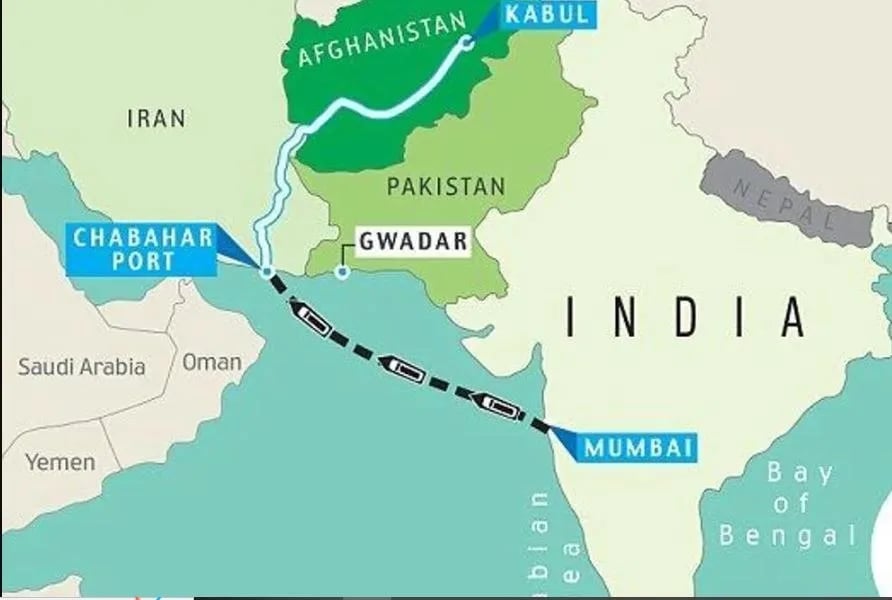
International North-South Transport Corridor (INSTC)
- The INSTC is a 7,200-km multi-modal network connecting Mumbai with Moscow via Tehran and Baku, combining sea, rail and road routes.
- It was conceived in 2000 and signed by India, Iran and Russia.
- Fully operationalised, it would reduce cargo transit time between India and Russia from 40 days to approximately 20, and cut transport costs by 30%.
- Regional Security and Stability: Iran plays a pivotal role in the stability of West Asia, the Persian Gulf, and Afghanistan.
- Cooperation with Iran helps India address challenges related to terrorism, extremism, maritime security, and regional conflicts.
- Strategic Autonomy: Engagement with Iran enables India to pursue its policy of strategic autonomy by maintaining balanced relations with all major powers in West Asia, including Israel, Iran, and the Gulf countries.
Concerns in Relations
- U.S. Sanctions on Iran: Sanctions have disrupted bilateral trade, investment, banking channels, and compelled India to stop importing Iranian crude oil.
- Example: India ended crude oil imports from Iran in May 2019 after the U.S. withdrew waivers under its “maximum pressure” policy.
- Declining Energy Cooperation: India’s crude oil imports from Iran have fallen significantly due to sanctions and diversification of energy sources.
- Before sanctions, Iran was India’s third-largest crude oil supplier.
- Slow Progress of Connectivity Projects: Implementation of Chabahar Port and the International North-South Transport Corridor has been delayed by geopolitical and financial constraints.
- Balancing Competing Partnerships: India’s closer strategic ties with Israel, the United States, and Gulf countries require careful balancing with its relations with Iran.
- Example: India is a member of I2U2 (India-Israel-UAE-USA) while simultaneously maintaining engagement with Iran on connectivity and regional issues.
- Regional Instability: Conflicts and tensions in West Asia, including around the Strait of Hormuz, threaten India’s energy security, trade routes, and diaspora interests.
- Low Bilateral Trade Potential: Financial restrictions, logistical bottlenecks, and geopolitical uncertainties continue to keep India–Iran trade below its potential.
Way Ahead
- Adopt Calibrated Diplomacy: Maintain high-level political engagement with Iran through appropriate diplomatic representation and regular dialogue, while carefully managing sensitivities arising from regional conflicts and great-power rivalries.
- Promote Regional Peace and Stability: Support dialogue, de-escalation, freedom of navigation, and respect for sovereignty in West Asia to safeguard India’s energy security, diaspora interests, and long-term strategic presence in the region.
- Fast-track Connectivity Projects: Expedite the development of Chabahar Port and the International North-South Transport Corridor to strengthen India’s access to Central Asia and Eurasia.
Conclusion
- The invitation to Prime Minister Modi for the funeral of Supreme Leader Ayatollah Ali Khamenei underscores the diplomatic tightrope India must walk in West Asia.
- India must balance its deep civilizational ties with Iran while safeguarding its expanding partnerships with Israel, the Gulf countries, and the United States.
Source: IE
Previous article
News In Short 25-06-2026
