


Syllabus: GS1/Geography; GS3/Environment; Agriculture
Context
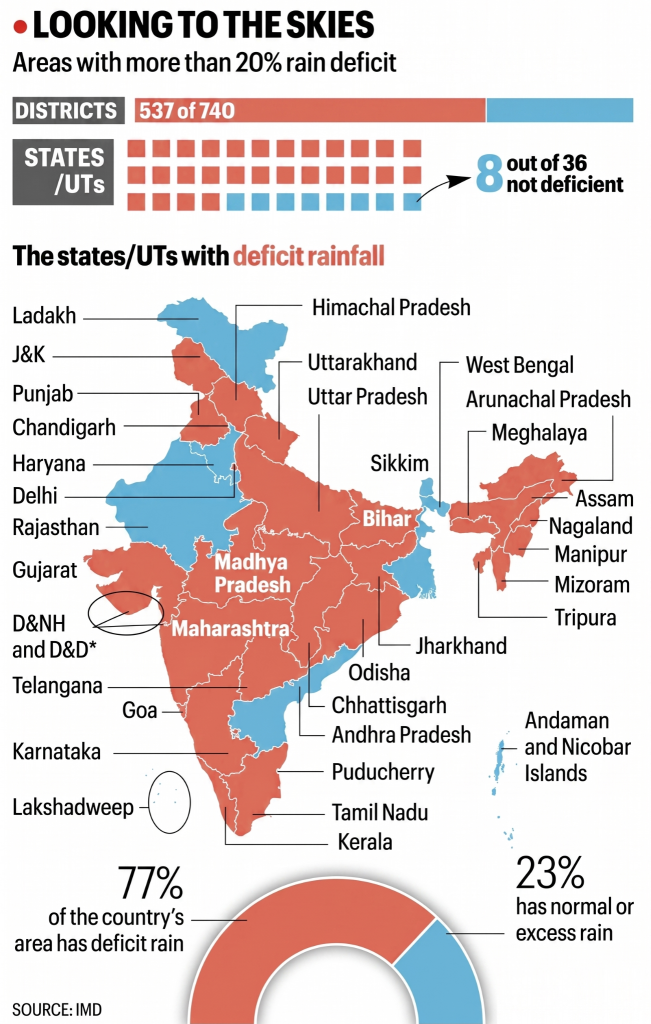
- Recently, IMD forecasts below-normal precipitation (about 43% below normal) that have intensified due to delayed rainfall and emerging El Niño conditions.
About Indian Monsoon
- It is the seasonal reversal of winds.
- It is primarily caused due to the difference between land an
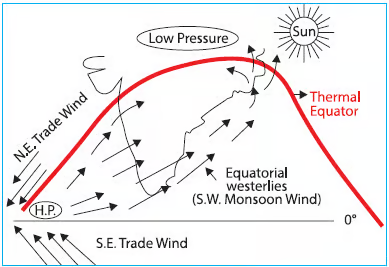
- There are two types of monsoons in India:
- Southwest Monsoon: It accounts for about 75% of total precipitation in India.
- Northeast or Retreating Monsoon: It occurs in the southeastern part of India including Tamil Nadu.
- It is very important for the farming, water supply, and economy of the country.
- Long Period Average (LPA) serves as the standard parameter for IMD to evaluate monsoon.
| Classification of Monsoon Performance (IMD) | |
| Category | Rainfall (% of Long Period Average – LPA) |
| Normal Monsoon | 96–104% of LPA |
| Below Normal / Weak Monsoon | < 90% of LPA |
| Deficient Monsoon | < 90% with significant regional deficits |
| Surplus Monsoon | > 110% of LPA |
Key Reasons Behind the Weak Monsoon
- Limited Impact of El Niño Before Early June: El Niño phenomenon developed in the equatorial Pacific Ocean.
- According to IMD, the effect of El Niño on the Indian monsoon shows a lag of roughly one month.
- El Niño reduces the strength of Walker Circulation.
- It inhibits moisture transport and convection over the Indian subcontinent.
- However, the deficit rainfall in June could not have been caused mainly by El Niño.
- Favorable Madden-Julian Oscillation (MJO): MJO is an active system of cloudiness, rainfall and wind movement along the equator.
- The favorable phase of MJO was not present over India through most of June.
- While over India, it suppressed convection and rainfall.
- It reduced monsoon activity over much of the country.
- Weak Monsoon Circulation System: It is because of:
- Weak cross-equatorial flow from the Indian Ocean.
- Ineffective moisture transport from the Arabian Sea and Bay of Bengal.
- Weak progression of monsoon over northern and western India.
- No Significant Low-Pressure Areas: Monsoon rains over India are strongly influenced by:
- Low-pressure areas and depressions developing over the Bay of Bengal.
- During June, such systems were either missing or weak, producing poor rainfall distribution.
- Increased Climate Variability: Climate change has increased intraseasonal climate variability; occurrence of droughts and excessive rainfall; and uneven distribution of rainfall across regions.
- Therefore, even the years having near-normal total rainfall experience localized shortages.
Implications of a Weak Monsoon Over India
- Agricultural Stress: Agriculture remains highly dependent on monsoon rainfall despite expansion of irrigation.
- A weak monsoon may lead to reduced kharif sowing; lower crop yields, especially rice, pulses and oilseeds; and increased input costs for farmers due to dependence on irrigation.
- Threat to Food Security and Inflation: Lower agricultural output can push food prices upward; increase inflationary pressures; and affect nutritional security, particularly among vulnerable populations.
- Water Shortage: Poor rains reduce the groundwater level; fill the reservoirs; and decrease the availability of drinking water.
- Past experience shows that dry years require water to be transported to drought-prone areas.
- Economic Impact on Rural Areas: Weak monsoon affects farm income; demand from rural sector; and job prospects in agriculture-based regions.
- It would hamper the economic growth of the country.
- Hydropower Production: Low reservoir water level affects hydropower production; and availability of water for irrigation and consumption in cities.
- Environmental Impacts: Lack of rain increases the risk of forest fires; soil erosion; and pressure on wetlands and waterways.
India’s Preparedness For Weak Monsoon
- Weather Forecasting By IMD: IMD provides extended-range and district-level forecasts.
- Early warnings enable governments and farmers to plan crop choices and irrigation schedules.
- Assessing Districts Vulnerability: Around 315 districts have been identified as potentially affected by weak monsoon conditions.
- 111 districts (high priority) have irrigation coverage below 25%.
- 76 districts (medium-priority) have irrigation coverage between 25% to 50%.
- 128 districts (low priority) have relatively better irrigation facilities through dams and other sources.
- Contingency Crop Planning: The ICAR prepares district-specific contingency plans involving drought-tolerant crop varieties; alternate cropping systems; and short-duration seed varieties.
- The Centre and state governments are preparing region-specific strategies for vulnerable farm areas as seen in the recent contingency planning exercises.
- Water Conservation: MGNREGS focuses on farm ponds, check dams, rainwater harvesting structures, and watershed development. These initiatives enhance local water security.
- Expansion of Irrigation Infrastructure: Schemes such as Pradhan Mantri Krishi Sinchai Yojana (PMKSY) aim to improve irrigation efficiency through micro-irrigation; ‘Per Drop More Crop’ initiatives; and command area development.
- Diversification of Energy Sources: Rapid expansion of solar power, wind energy, and other renewables has reduced dependence on hydropower during drought years.
- Crop Insurance: The Pradhan Mantri Fasal Bima Yojana (PMFBY) provides risk coverage against weather-induced crop losses.
Way Forward
- Strengthen climate-resilient agriculture by using drought-resistant seeds and diversified farming.
- Increase micro-irrigation and water conservation to make less use of rains.
- Build up better watersheds and management of groundwaters locally, and advocate river basin and reservoir management.
- Improve climate forecasting and dissemination systems for timely decision-making.
- Incorporate climate change adaptation into rural development policies.
- Encourage community-led water conservation and sustainable agricultural practices.
Conclusion
- India’s experience underscores that a weak monsoon is no longer merely a meteorological concern but a multidimensional developmental challenge.
- While improved forecasting, water conservation measures and renewable energy expansion have enhanced resilience, increasing climate variability necessitates sustained adaptation and long-term preparedness.
| Daily Mains Practice Question [Q] Examine the causes behind poor monsoons in India. Discuss their implications and evaluate India’s preparedness to deal with weak monsoon conditions. |
