


Syllabus: GS3/Environment; Climate Change
Context
- The National Oceanic and Atmospheric Administration (NOAA) has forecast a high probability of El Niño in 2026, while IMD projects a below-normal monsoon, raising concerns over agriculture, inflation and livelihoods.
About El Niño and Its 2026 Forecast
- El Niño is a climate phenomenon characterised by the abnormal warming of sea surface temperatures in the central and eastern equatorial Pacific Ocean.
- It is one phase of the El Niño–Southern Oscillation (ENSO) cycle and significantly influences global weather patterns, including India’s monsoon.
El Niño–Southern Oscillation (ENSO)
- It is a naturally occurring climate phenomenon involving periodic changes in sea surface temperatures and atmospheric pressure over the tropical Pacific Ocean.
- It is one of the most important drivers of global weather and climate variability.
Components of ENSO
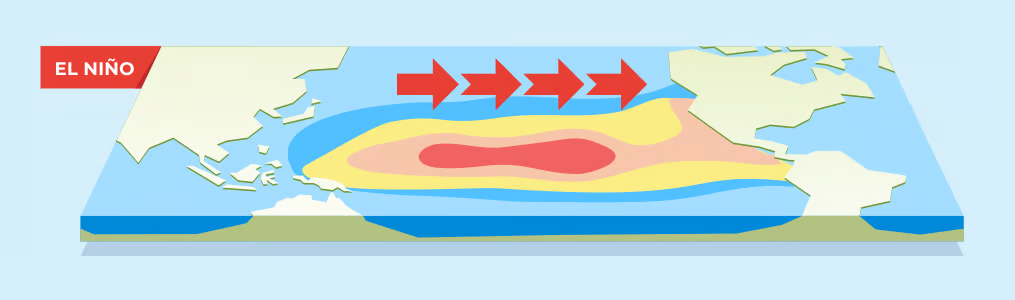
- El Niño (Warm Phase): It is characterised by warmer-than-normal sea surface temperatures in the central and eastern equatorial Pacific Ocean.
- It weakens the trade winds.
- It is often associated with below-normal monsoon rainfall in India, droughts in parts of Asia and Australia, and increased global temperatures.
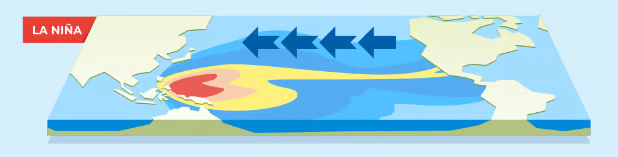
- La Niña (Cool Phase): It is characterised by cooler-than-normal sea surface temperatures in the same region.
- It strengthens the trade winds, and is often associated with above-normal monsoon rainfall in India, increased flooding in some regions, and slightly cooler global temperatures.
- Southern Oscillation: It refers to the periodic fluctuation in atmospheric pressure between Tahiti (Eastern Pacific), and Darwin, Australia (Western Pacific).
- It is measured through the Southern Oscillation Index (SOI).
- Changes in pressure influence trade winds and ocean temperatures.
ENSO Mechanism
- Under normal conditions, trade winds blow from east to west across the Pacific, warm water accumulates near Indonesia and Australia, and cooler, nutrient-rich water rises along the South American coast (upwelling).
- During El Niño, trade winds weaken, warm water shifts eastward, upwelling decreases, and rainfall patterns change globally.
- During La Niña, trade winds strengthen, more warm water accumulates in the western Pacific, upwelling intensifies, and opposite climatic impacts occur.
Impact of El Niño
- Heat Economy (Productivity Losses and Informal Workers): India’s large informal workforce, comprising construction workers, street vendors, delivery personnel and agricultural labourers remains highly vulnerable to extreme heat.
- Higher temperatures lead to reduced working hours due to heat exposure, lower labour productivity, increased health risks and heat-related illnesses, and income insecurity for daily wage earners.
- Agricultural Stress and Rural Distress: Agriculture remains the most climate-sensitive sector of the Indian economy.
- The Southwest Monsoon provides nearly 70% of the rainfall required for crops and replenishes reservoirs and aquifers.
- A weaker monsoon can result in delayed or reduced sowing, lower crop yields, increased irrigation costs, greater dependence on groundwater extraction, and higher risks for small and marginal farmers.
- Food Inflation and Macroeconomic Risks: Climate shocks often become visible first through rising food prices.
- The Consumer Price Index (CPI) data released by MOSPI in 2026 showed food inflation at 4.2% in April 2026. A deficient monsoon could intensify price pressures on pulses, vegetables, cereals, and edible oils.
- Water Security Challenges: Reduced rainfall directly affects reservoir storage levels, groundwater recharge, drinking water availability, and hydropower generation.
- A weak monsoon can worsen these stresses, particularly in drought-prone regions of peninsular and western India.
- Urban Vulnerability and Rising Inequality: Indian cities are increasingly becoming urban heat islands due to rapid concretisation, shrinking green cover, and loss of water bodies.
- Public Health Concerns: El Niño-induced heatwaves and water stress can contribute to heat strokes and dehydration, spread of vector-borne diseases, reduced nutritional security due to food inflation, and greater health expenditure among vulnerable households.
- Public health systems may face increased pressure, especially in densely populated urban areas.
Way Forward: Building Climate Resilience
- Strengthen Heat Action Plans: Expand city-level heat action plans; establish cooling shelters and early warning systems; and ensure occupational safety standards for outdoor workers.
- Climate-Resilient Agriculture: Promote drought-resistant crop varieties; expand micro-irrigation and precision farming; and strengthen crop insurance and weather-based advisories.
- Water Resource Management: Improve rainwater harvesting; encourage watershed development; and enhance groundwater governance and recharge initiatives.
- Urban Climate Resilience: Increase urban green spaces; protect wetlands and water bodies; and promote heat-resilient urban planning.
- Social Protection for Vulnerable Groups: Strengthen MGNREGA and livelihood support programmes, expand social security for informal workers, and improve access to affordable cooling and healthcare.
| Daily Mains Practice Question [Q] Examine the socio-economic implications of El Niño on India’s agriculture, labour market, food security, and urban resilience. |
