


Syllabus: GS3/Defence
Context
- The wars in Ukraine, Lebanon and West Asia have shown how drones have become central to modern warfare.
What is Drone Warfare?
- Drone warfare refers to a mode of warfare employing unmanned or remotely controlled devices.
- Such drones have the capability of staying in the air, on land, at sea level, or underwater.
- The drones may be operated by manual control, and others may utilise auto-pilot systems on their missions.
- Remotely Piloted Aircraft System: It refers to a set of components that include the drone, its ground-based control system.
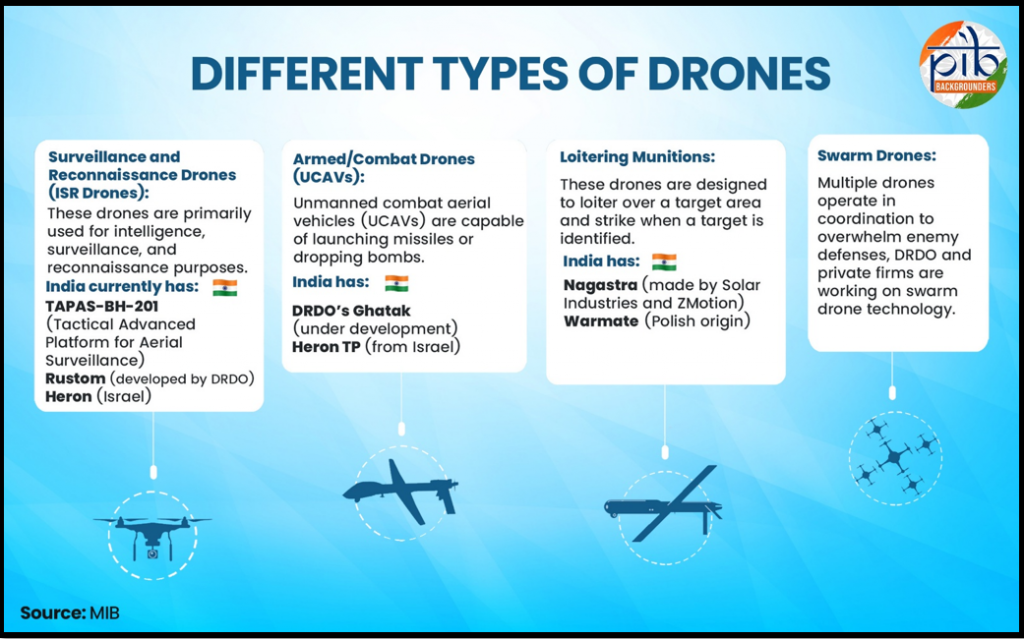
- The US, UK, Israel, China, India, Russia, and Turkey, have produced combat drones, or UCAVs (Unmanned Combat Aerial Vehicles).
- These are employed in targeted attacks, frequently in locations difficult to access by conventional forces.
- AI: The second stage of drone application is artificial intelligence. AI drones can navigate on their own, detect targets, and even operate in “swarm” groups.
Recent Use of Drones
- In the early years of the 21st century, most drone strikes were carried out by the US military in countries such as Afghanistan, Pakistan, Syria, Somalia, Yemen, and Libya, using air-to-surface missiles against ground targets.
- Drone warfare has since been adopted by countries like Russia, Ukraine, Turkey, Azerbaijan, and Iran, as well as by non-state actors such as the Houthis.
- India, too, has employed drones in recent operations, including the Operation Sindoor and retaliatory strikes against Pakistan.
Evolution of UCAVs
- In the 1960s, British Commonwealth artillery regiments started developing drones for target identification and extending their range.
- The past two decades saw the US set the trend world-wide with using drones for its counterterrorism action in Iraq, Syria, Afghanistan, and Yemen with precision attacks minimising personnel risks.
- It was the Ukraine war that saw a turning point.
- Russian and Ukrainian forces both used small drones on a massive scale for real-time intelligence and direct attacks.
- By 2023, small drones had evolved to accommodate multiple payloads – from infrared detectors to electronic warfare equipment.
Significance of Use of Drones in Warfare
- Targeted Strikes: Drones allow militaries to carry out highly targeted attacks, minimizing collateral damage.
- Lower Risk to Personnel: Since drones are unmanned, they eliminate the risk to pilots and reduce the need for boots on the ground.
- Cost-Effectiveness: Drones are cheaper to manufacture, operate, and maintain compared to manned aircraft.
- Real-Time Surveillance and Intelligence: Drones provide continuous, real-time imagery and intelligence gathering, essential for both offensive and defensive operations.
- Strategic Advantage in Asymmetric Warfare: Drones are especially useful against non-state actors and terrorist groups, who may not be reachable by conventional military means.
India’s Institutional and Strategic Response
- Integrated Drone Detection and Interdiction System (IDD&IS) is developed by Defence Research and Development Organisation and Bharat Electronics Limited, provides a comprehensive counter-drone solution.
- It is capable of detecting drones at ranges of 5–8 km, jamming communication signals within 2–5 km and neutralising threats using laser-based directed energy weapons at close ranges.
- Bhargavastra” Anti-Swarm System: Developed by Solar Defence and Aerospace Limited (SDAL), it is a low-cost, homegrown counter-drone system that uses micro-rockets to destroy drone swarms in hard-kill mode.
- The Indian Army has initiated large-scale procurement of surveillance and kamikaze drones to enhance both defensive and offensive capabilities.
Way Ahead
- Modern warfare demands a shift from platform-centric approaches to capability-based, technology-driven force planning. India must accelerate AI adoption, cyber resilience, space security, and jointness reforms.
- Sustained investment in human capital, defence innovation, and strategic partnerships will be crucial to maintain credible deterrence.
- Adapting to the evolving character of warfare is essential for safeguarding India’s sovereignty, stability, and strategic autonomy in a rapidly changing global order.
Source: TH
Previous article
India’s Exports Rise
Next article
NCERT Dancing Girl Row
