


Syllabus: GS1/Ancient History
Context
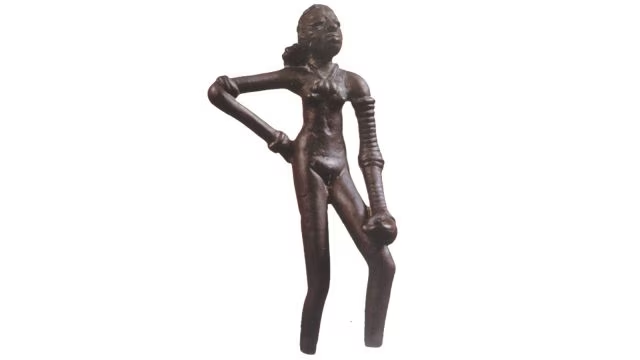
- After facing backlash, NCERT has decided to restore the original image of the Indus Valley Civilization’s iconic Dancing Girl in its Class 9 textbook, reversing its earlier decision to depict the figurine with a covered torso.
About the Dancing Girl
- The “Dancing Girl” is a 4,500-year-old bronze statuette unearthed in 1926 by archaeologist Ernest Mackay at Mohenjo-daro (present-day Pakistan), a major urban centre of the Indus Valley Civilization.
- The statue is around 10.5 centimetres tall and is adorned with a necklace and a large number of bangles stacked on her arms.
- Material and Technique: The bronze sculpture was created using the lost-wax technique, a metal-casting method that continues to be practiced in parts of India, including West Bengal, Jharkhand, and Chhattisgarh.
- Today, the original artefact is housed in the National Museum, New Delhi.
Indus Valley Civilization
- The Indus Valley Civilization (IVC), also known as the Harappan Civilization, is believed to be one of the oldest world civilizations that flourished roughly between 2600 and 1900 BC.
- It developed primarily along the Indus River system and covered large parts of present-day Pakistan and north-western India.
- The civilization is known for its well-planned cities, drainage systems, standardized weights and measures, craft production, and long-distance trade networks.
- It is considered a Bronze Age Civilization due to the widespread use of copper-based alloys.
Major Sites of the Indus Valley Civilization
| Site | Present Day |
| Harappa | Punjab, Pakistan |
| Mohenjo-Daro | Sindh, Pakistan |
| Dholavira | Kutch district of Gujarat, |
| Kalibangan | Rajasthan |
| Lothal | Gujarat |
| Rakhigarhi | Haryana |
| Chanhudaro | Sindh, Pakistan |
| Ganweriwala | Punjab, Pakistan |
| Sutkagendor | Baluchistan Province, Pakistan |
| Alamgirpur | Uttar Pradesh |
Significance of the Controversy
- The episode has reignited the debate over the balance between historical authenticity and educational sensitivity in school textbooks.
- It raises questions about whether historical artefacts should be reproduced exactly as they are or modified to suit contemporary notions of what is considered age-appropriate.
- The controversy highlights the role of textbooks in shaping students’ understanding of India’s cultural and civilizational heritage.
- It also underscores the importance of preserving the integrity of archaeological evidence while ensuring effective pedagogy.
Similar Debates in India and Abroad
- In India, the Khajuraho Group of Monuments feature intricate sculptures depicting love, human relationships, and sensuality. Despite occasional debates over their explicit imagery, these UNESCO-recognized monuments are preserved and presented in their original form as important expressions of India’s cultural and artistic heritage.
- In Europe and North America, students routinely encounter images of ancient Greek and Roman sculptures, many of which depict the human body in ways that modern audiences might consider explicit. Yet these works are generally presented in their original form, accompanied by historical and artistic explanations.
Source: IE
Previous article
Drone Revolution and Modern Warfare
Next article
News In Short 16-06-2026
