


Syllabus: GS3/Economy
Context
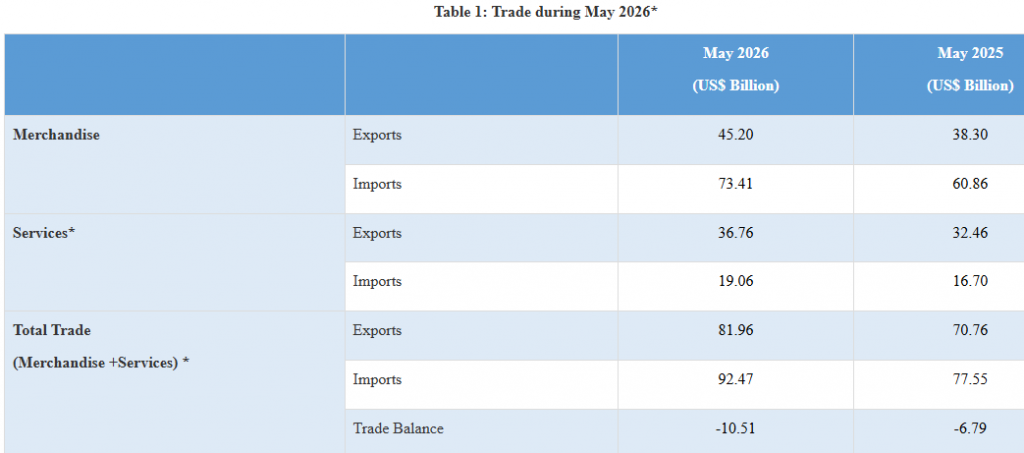
- As per the data released by the Ministry of Commerce and Industry, India’s merchandise exports jumped to a record high of $45.2 billion in May 2026, 18% higher than in May last year.
About
- India’s overall trade deficit widened to $10.5 billion due to a sharper growth in imports of both goods and services.
- Top 5 export destinations are Singapore (68.96%), South Africa (116.21%), Tanzania Rep (196.89%), Italy (87.54%), and Sri Lanka Dsr (150.29%).
Reasons for Increase in India’s Exports
- Rise in Petroleum and Commodity Prices: Higher international petroleum prices increased the value of India’s petroleum exports, particularly diesel, petrol, and aviation turbine fuel.
- Rising global commodity prices contributed to the overall increase in export earnings.
- Strong Performance of Manufacturing Sectors: Engineering goods exports remained robust due to strong global demand for manufactured products and machinery.
- Electronics exports recorded rapid growth because of expanding domestic manufacturing under Production-Linked Incentive (PLI) schemes.
- Diversification of Export Markets: Indian exporters expanded into emerging markets such as Tanzania, Sri Lanka, Bangladesh, and Vietnam.
- Diversification reduced dependence on traditional export destinations and improved resilience against regional disruptions.
- Improved Competitiveness: Depreciation of the Indian rupee improved the price competitiveness of Indian goods in global markets.
- Stable supply chains and improved logistics enabled industries to maintain export momentum despite global uncertainties.
Significance for India’s Economy
- Strengthening External Sector Stability: Strong export growth supports India’s foreign exchange reserves and external stability.
- Diversification of export sectors reduces dependence on any single commodity or market.
- Growth of Manufacturing Exports: Rising engineering and electronics exports indicate improvements in India’s manufacturing ecosystem. Export growth supports employment generation and industrial expansion.
- Strategic Importance of Services and Trade Agreements: Services exports continue to provide stability to India’s external trade balance. FTAs can improve market access, reduce tariff barriers, and integrate India more deeply into global value chains.
Main Challenges in India’s Export Sector
- Global Economic Uncertainty: Geopolitical tensions in West Asia and other regions disrupt trade routes, shipping networks, and supply chains.
- Heavy dependence on imported crude oil exposes India to global energy price shocks. Rising imports of gold and petroleum products contribute to widening trade deficits.
- Infrastructure Constraints: High logistics and transportation costs reduce the competitiveness of Indian exports.
- Global Competition: Indian exporters face intense competition from countries such as China, Vietnam, and Bangladesh.
- Protectionist trade policies and non-tariff barriers imposed by developed countries restrict market access.
- Structural Weaknesses in Manufacturing: India’s manufacturing sector faces challenges related to scale, productivity, and technological competitiveness.
- Limited diversification into high-value and technology-intensive exports constrains long-term export potential.
Recent Government Initiatives
- Export Promotion Mission: In the Union Budget for 2025-26, the Finance Minister announced an Export Promotion Mission.
- It would facilitate easy access to export credit, cross-border factoring support, and support to MSMEs to tackle non-tariff measures in overseas markets.
- EPM will span six years covering FY 2025-26 to FY 2030-31.
- Under EPM, priority support will be extended to sectors impacted by recent global tariff escalations, such as textiles, leather, gems & jewellery, engineering goods, and marine products.
- Export Support Package: The government announced a Rs 7,295-crore export support package, comprising a Rs 5,181-crore interest subvention scheme along with a Rs 2,114-crore collateral support, to improve exporters’ access to credit.
- Free Trade Agreements (FTA) Negotiations: India is aggressively pushing for newer markets and has signed as many as three free trade agreements, with Oman, New Zealand, and UK, in 2025. India also signed an FTA with the EU in 2026.
- Digital Transformation: The Department of Commerce has advanced its Digital Transformation agenda to strengthen trade facilitation and intelligence through data-driven solutions.
- Initiatives such as Trade eConnect and Trade Intelligence & Analytics (TIA) portal lay a strong foundation for evidence-based decision-making.
Way Ahead
- Diversify Export Markets: India should expand exports to emerging markets and reduce dependence on a few traditional destinations.
- Improve Logistics Infrastructure: India should modernize ports, transport networks, and customs systems to reduce export costs and delays.
- Support MSMEs and Exporters: India should improve access to finance, technology, and export incentives for small exporters.
- Build Resilient Supply Chains: India should develop resilient supply chains and alternative trade routes to tackle geopolitical disruptions.
Source: TH
Previous article
Ease of Living: India’s Journey of Inclusive Progress
Next article
Drone Revolution and Modern Warfare
