

Syllabus :GS 3/Economy
In Context
- India’s cruise tourism is rapidly developing by leveraging its extensive rivers, coastlines, and ports to offer unique leisure and cultural experiences.
Cruise Tourism
- It offers nature-driven travel along rivers, seas, and canals, providing safe and inclusive access to diverse destinations while boosting connectivity and local economies through job creation.
Indian Scenario
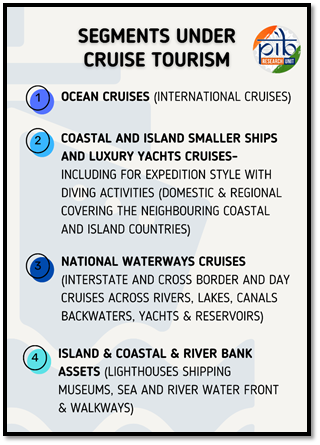
- India is well-positioned for cruise tourism with its extensive infrastructure, including 12 major and 200 minor ports along a 7,500 km coastline, over 20,000 km of navigable waterways connecting around 400 rivers, and numerous coastal states, union territories, and 1,300 islands.
- From Kerala’s backwaters to major rivers like the Ganga and Brahmaputra, cruise tourism is driving economic growth, creating jobs, and supporting local communities.
Importance of Cruise Tourism
- Cruise tourism has a market size of US $7.1 billion, and is projected to grow at a CAGR of 12.1% over the next 10 years.
- Cruise tourism stimulates local economies through port services, hospitality, retail, and cultural excursions.
- The cruise industry is generating jobs across various sectors — hospitality, aviation, agriculture, retail, entertainment, manufacturing, information services, and healthcare.
- Cruises offer immersive experiences in India’s heritage, fostering global cultural exchange.
- River cruises promote tourism in hinterland regions, supporting inclusive growth.
- Development of cruise terminals and navigational aids enhances overall maritime capacity.
Challenges
- Infrastructure Gaps: Limited number of modern cruise terminals and inadequate last-mile connectivity.
- Complex clearance procedures and fragmented jurisdiction across agencies.
- Monsoons and cyclonic risks affect cruise schedules and safety.
- Domestic tourists often lack exposure to cruise travel as a leisure option.
- Waste management and emissions from cruise vessels require stringent oversight.
Steps Taken By the Indian Government to Boost Cruise Tourism
- In June 2025, the Ministry of Ports, Shipping & Waterways hosted the first-ever ASEAN-India Cruise Dialogue in Chennai to enhance India’s cruise connectivity with a focus on heritage-led cruise tourism.
- The ASEAN-India Cruise Dialogue was very significant. ASEAN countries have over 25 major seaports and a combined coastline of over 1,00,000 km.
- The Cruise Bharat Mission : It was launched in 2024, at Mumbai port, aims to double India’s cruise passenger traffic to boost the country’s cruise tourism industry by 2029.
- The mission promotes a coordinated inter-ministerial approach involving agencies like Customs, Immigration, and State Tourism to streamline regulations and operations.
- The Maritime India Vision 2030 aims to position India as a major player in the global ocean and river cruise market, with the potential for the cruise industry to grow eightfold in the next decade due to rising demand and incomes.
Conclusion and Way Forward
- Government initiatives like the Cruise Bharat Mission and Maritime India Vision 2030 are building a strong foundation to establish India as a global cruise destination.
- With improving infrastructure and rising awareness, cruise tourism is poised to become a key part of India’s travel industry, attracting global travelers to explore the country.
- To compete globally, India must strengthen infrastructure, identify lucrative routes, improve regulations, and invest in quality operations.
- Although the ASEAN partnership is strategic, significant capacity building is required to fully realise India’s cruise tourism potential.
- Identifying lucrative cruise routes and creating an enabling regulatory environment will enhance state-of-the-art cruising experience for international travellers.
Source :TH
Previous article
India’s Unique Dairying Model and Its Challenges
