

Mount Denali
Syllabus :GS1/Geography
In News
- Sheikh Hasan Khan, mountaineer from Kerala is stranded at 17,000 ft on Mount Denali in North America due to a severe snowstorm.
- He is on a mission to complete the Seven Summits Challenge — scaling the highest peaks on each continent — and to honor the Indian Army’s Operation Sindoor.
Mount Denali
- The name “Denali” stems from “deenaalee,” which is from the Koyukon language traditionally spoken on the north side.
- It is also known as Mount McKinley and it is the highest peak in North America.
- It is located near the center of the Alaska Range, with two summits rising above the Denali Fault, in south-central Alaska, U.S.
Source :TH
Nonia Rebellion
Syllabus: GS1/ History and Culture
Context
- Union Minister for Agriculture paid tributes to freedom fighter Buddhu Nonia at his centenary celebrations in Patna and acknowledged the Nonia community’s contributions in Nonia Rebellion.
About the Nonia Rebellion
- The Nonias were traditional salt makers, and they also had expertise in producing Shora (saltpetre) — an essential ingredient in making gunpowder.
- The Nonia Rebellion refers to a series of uprisings by the Nonia community between 1778 and 1800 in Bihar, particularly in the districts of Saran, Vaishali, and Purnia.
- It was a grassroots movement against the British East India Company’s exploitative revenue policies, and oppression by local zamindars.
About Buddhu Nonia
- Buddhu Nonia was a freedom fighter from the Nonia community in Bihar.
- He actively participated in the Salt Satyagraha movement led by Mahatma Gandhi.
- He began making salt as an act of civil disobedience and was deceitfully arrested and thrown into a boiling salt cauldron—an act that turned him into a martyr of the freedom movement.
Source: PIB
Proposed Legal Metrology (Indian Standard Time) Rules
Syllabus: GS 2/Governance
In News
The government will mandate the use of Indian Standard Time (IST) for all legal, commercial, digital, and administrative activities.
| Indian Standard Time (IST) – The Indian Standard Time is calculated from 82°30’E meridian passing through Mirzapur. 1. Therefore, IST is plus 5.30 hours from the GMT ((82°30’ x 4) (60 minutes=5 hours 30 minutes). – Countries select a standard meridian within their territory to define official time, while those with wide east-west spans, like Russia, Canada, and the USA, may adopt multiple time zones. |
Proposed Legal Metrology (Indian Standard Time) Rules
- The Union Consumer Affairs Ministry announced that the proposed Legal Metrology (Indian Standard Time) Rules will make synchronising all legal, administrative, and commercial activities with IST mandatory.
- The initiative aims to provide highly accurate Indian Standard Time (IST) using five Regional Reference Standard Laboratories with atomic clocks and secure protocols like NTP (Network Time Protocol) and PTP (Precision Time Protocol), promoting digital and administrative efficiency under the ‘One Nation, One Time’ vision.
Importance
- There is strategic importance of uniform IST usage across sectors like finance, telecom, power, and transport, prohibiting unauthorised time references.
- The move aims to enhance digital security, ensure accurate utility billing, reduce cybercrime risks, and synchronise timekeeping across sectors.
- Currently, many systems depend on foreign time sources.
Source :TH
Performance Grading Index (PGI) 2.0 Report
Syllabus: GS2/Education
Context
- The Ministry of Education released the latest assessment of the Performance Grading Index (PGI) 2.0 report for 2023-24.
About
- The PGI was introduced in 2017, and the ministry revamped it as PGI 2.0 in 2021.
- It is an assessment of school education along six domains – learning outcome and quality, access, infrastructure and facilities, equity, governance processes, teacher education, and training.
- The latest report, covering the years 2022-23 and 2023-24, draws data from the National Achievement Survey 2021, the Unified District Information System for Education Plus (UDISE+), and information on the mid-day meal programme (PM-POSHAN).
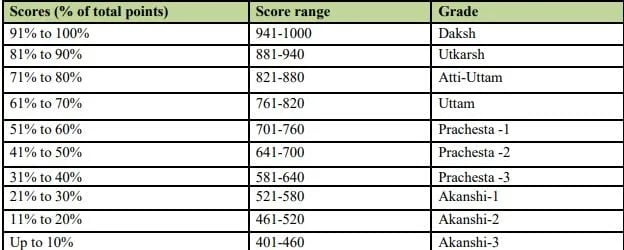
- PGI grades the districts into ten grades viz., Highest achievable Grade is Daksh, which is for Districts scoring more than 90% of the total points in that category or overall.
- The lowest grade in PGI-D is called Akanshi-3 which is for scores upto 10% of the total points.
Findings
- The highest scorer was Chandigarh, followed by Punjab, and Delhi.
- Kerala, Gujarat, Odisha, Haryana, Goa, Maharashtra, and Rajasthan also scored in the 581-640 range.
- The state that scored the lowest was Meghalaya (417.9).
- Just above it were Arunachal Pradesh (461.4), Mizoram (464.2), Nagaland (468.6), and Bihar (471.9).
Source: IE
Barak Magen
Syllabus :GS3/Defence
In News
- The Israeli Navy achieved a major defense milestone by successfully intercepting eight Iranian UAVs using the ‘Barak Magen’ aerial defense system.
Barak Magen
- The Barak Magen system is the naval variant of the Barak MX family developed by Israel Aerospace Industries (IAI).

- It integrates advanced radar with vertical missile launchers and multiple interceptor types: MRAD (short/medium range), LRAD (mid/long range), and ER (extended range).
- Barak Magen complements Israel’s existing systems (Iron Dome, David’s Sling, Arrow, plus future laser Iron Beam), adding a powerful naval tier to national defense.
- It is engineered to provide full-spectrum protection against a variety of modern airborne threats including unmanned aerial vehicles (UAVs), cruise missiles, shore-to-sea projectiles and even certain classes of ballistic munitions.
Source :LM
50 years of Crocodile Conservation Programme
Syllabus: GS3/Species in News
Context
- India began its Crocodile Conservation programme in 1975, and this year marks 50 years of this initiative.
About
- As per the survey conducted in 1974 (H.R. Bustard), Crocodile populations were on the brink of extinction.
- Scientific conservation efforts were launched with the assistance of the Food and Agriculture Organization of the United Nations.
- In 1975, three conservation projects were launched in Odisha for as many species – salt-water crocodiles in Bhitarkanika, gharials in Satkosia and muggar in Similipal.
- Odisha is uniquely positioned by hosting wild populations of all three crocodile species.
- Objective: To protect their natural habitats and rebuild the population quickly through captive breeding.
Crocodiles Species in India
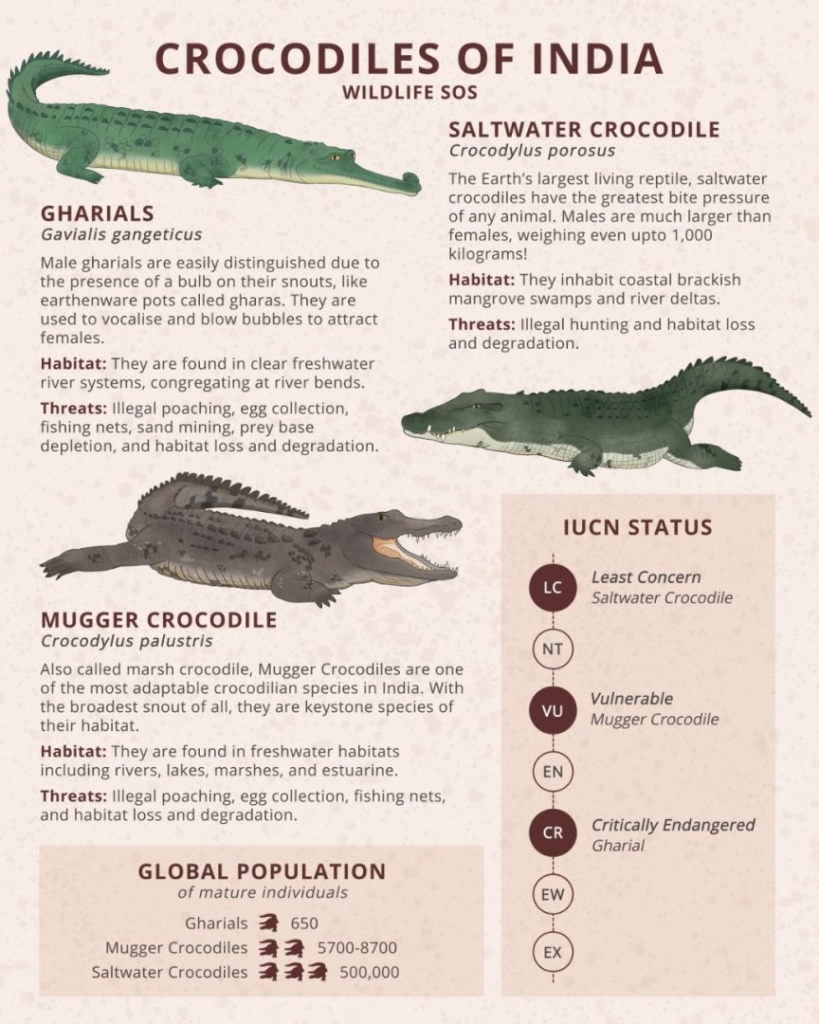
- India is home to three main kinds of crocodile species – the gharial (gavialis gangeticus), the saltwater crocodile (crocodylus porosus), and the mugger (crocodylus palustris).
Conservation Success
- The saltwater crocodile population has recovered to approximately 2,500 individuals in the wild, with Bhitarkanika in Odisha holding the largest share, followed by the Andaman and Nicobar Islands and the Sundarbans in West Bengal.
- The mugger crocodile, once severely depleted in numbers, has now reclaimed most of its historical range, with its numbers in the wild estimated at 8,000 to 10,000.
- India holds nearly 80% of the global wild gharial population—an estimated 3,000 individuals.
Source: TH
FASTag-based Annual Pass
Syllabus: GS3/Infrastructure
Context
- The Minister of Road Transport and Highways announced a FASTag-based annual pass priced at Rs 3,000 for “hassle-free-highway travel”.
About
- The FASTag-based passes will be effective from August 15 and valid for one year or 200 trips, whichever comes earlier.
- Passing through one toll plaza will be counted as one Trip.
- By reducing wait times, easing congestion, and minimizing disputes at toll plazas, the Annual Pass aims to deliver a faster and smoother travel experience for private vehicle owners.
FASTag
- FASTag is an electronic toll collection system managed by the National Payments Corporation of India (NPCI) and the National Highways Authority of India (NHAI).
- A FASTag sticker is usually pasted on the windscreen of a car.
- It uses Radio Frequency Identification (RFID) technology to communicate with scanners installed at toll plazas.
- Once the car crosses a toll plaza, the requisite toll amount is automatically deducted from a bank account or a prepaid wallet linked to the FASTag.
Source: IE
Sahitya Akademi Yuva and Bal Puraskar
Syllabus: Miscellaneous
Context
- The Sahitya Akademi has announced the names of 23 writers for its Yuva Puraskar and 24 for the Bal Puraskar for 2024.
About Sahitya Akademi
- Sahitya Akademi, India’s National Academy of Letters, is the Central institution for literary dialogue, publication and promotion in the country and the only institution that undertakes literary activities in 24 Indian languages, including English.
- It was inaugurated by the Government of India on 12 March 1954.
- Status: Set up by the Government of India, it functions as an autonomous organization, registered as a society on 7 January 1956 under the Societies Registration Act, 1860.
- Each winner receives: A casket with an engraved copper plaque and ₹50,000 cash prize.
Source: TH
Previous article
Third United Nations Oceans Conference (UNOC)-2025
Next article
Magna Carta
