


Syllabus: GS3/Environment
Context
- Recently, the third United Nations Oceans Conference (UNOC), held in Nice, France, concluded with commitments aimed at safeguarding the planet’s marine ecosystems.
| Background: United Nations Oceans Conference (UNOC) – 1st UNOC (2017): In New York, Co-hosted by Sweden and Fiji; To support SDG 14: Life Below Water. – 2nd UNOC (2022): In Lisbon, Co-hosted by Portugal and Kenya; To emphasize the need for science-based solutions and innovative partnerships. – 3rd UNOC (2025): In Nice, France, and co-hosted by Costa Rica 1. Theme: Accelerating action and mobilizing all actors to conserve and sustainably use the ocean. |
Key Outcomes of the Conference (2025)
- High Seas Treaty Nears Enforcement: Fifty-six of the required sixty countries have ratified the Biodiversity Beyond National Jurisdiction (BBNJ) Agreement (aka High Seas Treaty).
- It enables the creation of marine protected areas (MPAs) in international waters, regulate marine genetic resources, and mandate environmental impact assessments.
- Voluntary Commitments and Financial Pledges: The European Commission pledged 1 Billion Euro to support ocean conservation and sustainable fishing.
- French Polynesia announced plans to establish the world’s largest marine protected area, covering its entire exclusive economic zone—about five million square kilometers.
- Global Political Declaration: Over 170 countries adopted the Nice Ocean Action Plan, a political declaration paired with more than 800 voluntary commitments.
- These range from youth advocacy to deep-sea ecosystem literacy and capacity-building in marine science.
- Pushback Against Deep-Sea Mining: A growing coalition of nations called for a precautionary pause on deep-sea mining, citing its potential to irreversibly damage fragile marine ecosystems.
- India’s Role and Roadmap: India pledged to ratify the High Seas Treaty and proposed a 10-point roadmap for sustainable ocean governance. It includes:
- Expand Marine Protected Areas (MPAs)
- Scale Up the Blue Economy
- Reduce Marine Pollution
- Promote Offshore Renewable Energy
- Support the Global Plastics Treaty
- Invest in Ocean Science and Technology
- Strengthen Coastal Resilience
- Ensure Equitable Access to Marine Resources
- Pause Deep-Sea Mining
- Foster Global Partnerships
About High Seas
- The high seas refer to areas of the ocean that lie beyond the jurisdiction of any single country — specifically, beyond 200 nautical miles (about 370 kilometers) from a nation’s coastline (United Nations Convention on the Law of the Sea-UNCLOS).
- These waters are considered part of the global commons.
- The high seas make up nearly two-thirds of the ocean’s surface and are vital for regulating Earth’s climate, supporting marine biodiversity, and sustaining global fisheries.
Importance of Oceans
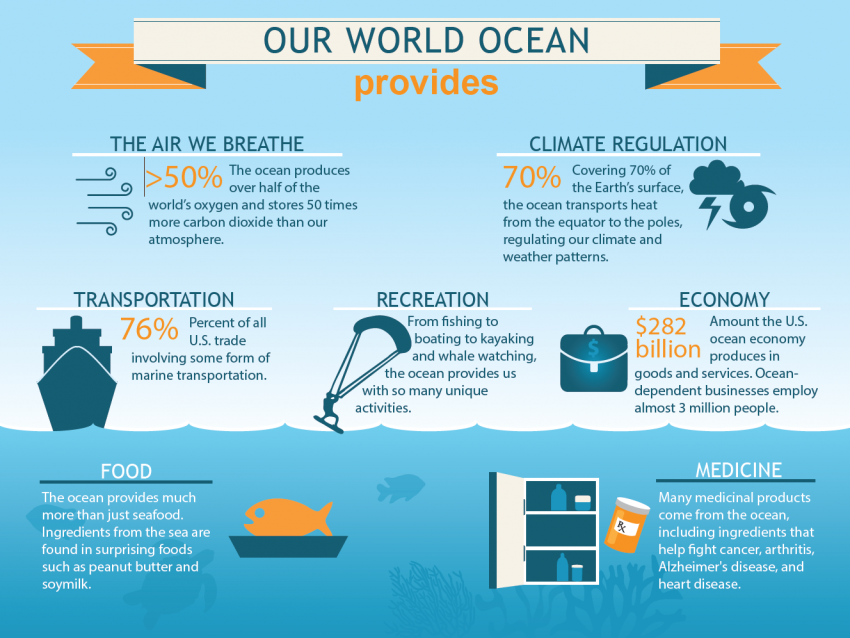
- Climate Regulation: Oceans absorb over 25% of global carbon emissions and generate 50% of the oxygen.
- They act as Earth’s largest carbon sink and heat buffer, helping stabilize the climate.
- Food Security: Oceans provide 15% of the animal protein consumed globally.
- In some developing nations, seafood is the primary protein source for over half the population.
- Livelihoods and Economy: More than 3 billion people depend on marine and coastal resources for their livelihoods.
- The ocean economy is valued at $3–5 trillion annually, supporting industries like fisheries, tourism, and shipping.
- Biodiversity Reservoir: Oceans host an immense variety of life—from coral reefs to deep-sea ecosystems that are essential for ecological balance and future scientific discoveries.
Key Concerns
- Ocean Pollutions: An estimated 75 to 199 million tonnes of plastic. Each year, 8 to 12 million metric tons more are added.
- Asia largest (81%) contributors of ocean plastic pollution (largely due to inadequate waste management systems).
- About 92% of microplastics have been found in 60% of fish consumed by humans annually.
- Five major ocean garbage patches, with the Great Pacific Garbage Patch containing an estimated 1.8 trillion pieces of trash.
- About 14 million metric tons of ocean garbage rest on the seafloor.
- By 2050, plastic in the ocean is projected to outweigh all fish if current trends continue.
- Currently, the ocean’s average pH is 8.1 which is about 30% more acidic than in pre- industrial times.
- Other Concerns:
- Overfishing, threatening marine species and food chains.
- Climate change, causing acidification, sea-level rise, and coral bleaching.
- Deep-sea mining, which risks irreversible damage to fragile ecosystems.
Ocean Conservation Efforts
- Early Foundations (Pre-1970s): International Whaling Commission (1946), one of the first global marine conservation agreements.
- Institutionalization (1970s–1990s): The US passed the Marine Protection, Research, and Sanctuaries Act (1972), and the Law of the Sea Convention (1982) laid the groundwork for international maritime law.
- Scientific & Global Expansion (2000s–2010s):
- Marine Protected Areas (MPAs): Countries began designating MPAs to safeguard biodiversity. However, only about 2.7% of the oceans were highly protected till 2020.
- Data-Driven Conservation: Initiatives like MegaMove used satellite tracking to identify critical habitats for marine megafauna, helping shape smarter conservation strategies.
- Modern Era (2020s–Present):
- High Seas Treaty (2023): It allows for the creation of MPAs in international waters—covering nearly two-thirds of the ocean.
- 30×30 Goal: At COP15 in 2022, nations committed to protecting 30% of oceans by 2030.
- Indigenous Knowledge Integration: Pacific Islander traditions are increasingly recognized as vital to conservation, blending ancestral wisdom with modern science.
Previous article
Global Drought Outlook
Next article
News In Short-19-06-2025
