The Delhi Sultanate was a series of five ruling dynasties that governed significant parts of India from the early 13th to the 16th century, marking a critical era of Muslim rule in the Indian subcontinent. Its significance lies in its role in shaping India’s cultural, architectural, and political landscape, leading to the eventual rise of the Mughal Empire. This article aims to study in detail the history, impact, and legacy of the Delhi Sultanate and its ruling dynasties.
About Delhi Sultanate
- The Delhi Sultanate was a series of five ruling dynasties that governed parts of India from the early 13th to the 16th century, marking a significant period in Indian history.
- Established in 1206 AD by the Mamluk dynasty, it laid the foundations for Muslim rule in the Indian subcontinent.
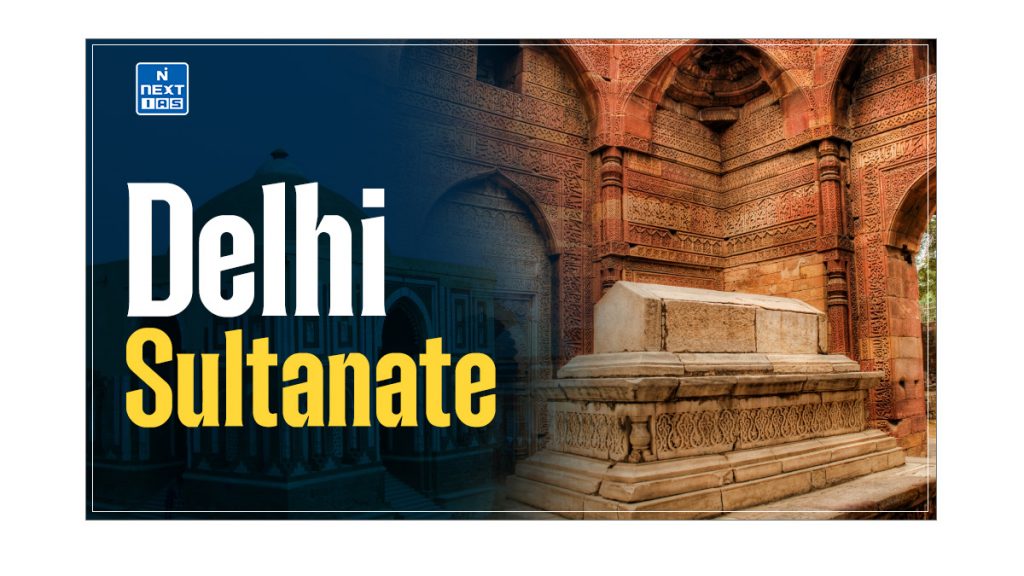
- The Sultanate is notable for its cultural and architectural achievements, including constructing iconic monuments like the Qutub Minar and Lodi Gardens.
- The Khalji and Tughlaq dynasties expanded the empire through military conquests, while the Sayyid and Lodi dynasties faced challenges from regional powers.
- The period also witnessed a fusion of Persian and Indian cultures, leading to literature, art, and architecture advancements.
- The Delhi Sultanate ended in 1526 with the rise of the Mughal Empire, which inherited and expanded upon its rich legacy.
Five Ruling Dynasties of Delhi Sultanate
The five ruling dynasties of the Delhi Sultanate are as follows:
Mamluk or Slave Dynasty (1206 – 1290 AD)
- The Mamluk dynasty was founded by Qutb al-Din Aibak, a former slave who rose to power.
- This dynasty marked the beginning of the Delhi Sultanate and is notable for its military conquests and the establishment of administrative frameworks.
- The construction of the Qutub Minar and other monuments was initiated during this period.
Read our detailed article on Mamluk Dynasty.
Khaljis Dynasty (1290 – 1320 AD)
- The Khalji dynasty, founded by Jalal ud-Din Khalji, is known for its expansionist policies and economic reforms.
- Alauddin Khalji, a prominent ruler of this dynasty, implemented price controls and enhanced agricultural production.
- The Khaljis also expanded the empire through military campaigns, notably into southern India.
Read our detailed article on Khaljis Dynasty.
Tughlaqs Dynasty (1320 – 1412 AD)
- Founded by Ghiyath al-Din Tughlaq, this dynasty is recognized for its ambitious projects and administrative innovations.
- Muhammad bin Tughlaq, a significant ruler, is known for his attempts at administrative reforms, including currency changes and the shifting of the capital to Daulatabad.
- However, his reign also faced challenges and instability due to overambitious policies.
Read our detailed article on the Tughlaq Dynasty.
Sayyids Dynasty (1412 – 1451 AD)
- The Sayyid dynasty emerged after the decline of the Tughlaqs and is characterized by its weak rule and regional fragmentation.
- The Sayyids attempted to stabilize the region but faced challenges from powerful regional governors and rival factions.
- Their rule marked a transitional phase leading to the rise of the Lodis.
Read our detailed article on the Sayyid Dynasty.
Lodis Dynasty (1451 – 1526 AD)
- The Lodis were the last dynasty of the Delhi Sultanate, founded by Bahlul Lodi.
- They are known for consolidating power in northern India and fostering cultural developments.
- The Lodis encouraged the arts and architecture, with significant contributions like the construction of the Lodi Gardens in Delhi.
- Their rule ended with the invasion of Babur, marking the establishment of the Mughal Empire.
Read our detailed article on the Lodis Dynasty.
Impact of Arab Rule in Sindh Region
- Conversion of Sindh Population to Islam: The Arab rule led to a limited and temporary conversion of the Sindhi population to Islam, primarily due to the influence of traders and Sufi missionaries. While some embraced the new faith, the majority retained their traditional beliefs, leading to a complex cultural tapestry in the region.
- Laying the Foundation of Islam in India: The establishment of Arab rule in Sindh marked the beginning of Islam’s presence in India. It set the stage for the later expansion of Islamic culture and governance, influencing various aspects of Indian society.
- Introduction of Formal Slavery System: The Arabs introduced a formal slavery system, significantly impacting social structures in India. This system facilitated the movement of slaves, influencing labor dynamics and contributing to the economy.
- Promotion of Arab Trade: Arab rule enhanced trade networks, fostering economic interactions between Sindh and other regions. Arab merchants established vital trade routes, facilitating the exchange of goods and ideas, which contributed to the region’s economic prosperity.
- New Arab Settlements on Sea-Coast: The Arabs established settlements along the Sindh coastline, particularly in port cities like Debal and Alor. These settlements became hubs for trade and cultural exchange, promoting the integration of Arab and local cultures.
List of Delhi Sultanate Rulers Chronology
| Dynasty | Ruler | Reign Period |
|---|---|---|
| Mamluk (Slave) | Qutb-ud-din Aibak | 1206–1210 |
| Aram Shah | 1210–1211 | |
| Shams-ud-din Iltutmish | 1211–1236 | |
| Rukn-ud-din Firuz | 1236 | |
| Razia Sultana | 1236–1240 | |
| Muiz-ud-din Bahram | 1240–1242 | |
| Ala-ud-din Masud | 1242–1246 | |
| Nasir-ud-din Mahmud | 1246–1266 | |
| Ghiyas-ud-din Balban | 1266–1287 | |
| Muiz-ud-din Qaiqabad | 1287–1290 | |
| Khilji | Jalal-ud-din Khilji | 1290–1296 |
| Ala-ud-din Khilji | 1296–1316 | |
| Shihab-ud-din Omar | 1316 | |
| Qutb-ud-din Mubarak Shah | 1316–1320 | |
| Nasir-ud-din Khusrau Khan | 1320 | |
| Tughlaq | Ghiyas-ud-din Tughlaq | 1320–1325 |
| Muhammad bin Tughlaq | 1325–1351 | |
| Firoz Shah Tughlaq | 1351–1388 | |
| Ghiyas-ud-din Tughlaq II | 1388–1389 | |
| Abu Bakr Shah | 1389–1390 | |
| Nasir-ud-din Muhammad Shah III | 1390–1394 | |
| Ala-ud-din Sikandar Shah I | 1394 | |
| Nasir-ud-din Nusrat Shah | 1394–1399 | |
| Nasir-ud-din Mahmud | 1399–1412 | |
| Sayyid | Khizr Khan | 1414–1421 |
| Mubarak Shah | 1421–1434 | |
| Muhammad Shah | 1434–1445 | |
| Ala-ud-din Alam Shah | 1445–1451 | |
| Lodi | Bahlul Lodi | 1451–1489 |
| Sikandar Lodi | 1489–1517 | |
| Ibrahim Lodi | 1517–1526 |
Delhi Sultanate Administration
The government of the Delhi Sultanate was an extremely well-structured system in which the Sultan, the highest power, had military, administrative, and judicial control all at once. The government was organized in such a way that a superior power was given to its top officials and departments:
The Sultan was the supreme ruler supported by the ministry consisting of the Wazir (Prime Minister and Finance Minister), Ariz-i-Mamalik (the military head), and Qazi-ul-Quzat (the chief judge having the power to interpret and apply Islamic law).
The empire was partitioned into districts known as Iqtas or Subas ruled by the officials called Wali or Muqti. These districts were then segmented into Shiqs, headed by Shiqdars, and further into Parganas made up of villages.
The local government consisted of village leaders (Muqaddam or Chaudhri) and clerks (Patwari).
Some of the significant officials in the province were Amils (who collected the revenue), Mushrifs, Hazamdars (who held the treasury), Qazis (who were civil officials), Shiqdars (who were in charge of criminal matters), and Kotwals (who were the police heads).
The government was based on the Persian system and aimed at getting taxes smoothly, keeping the peace, and exercising control over the military.
Thus, the administration of the Delhi Sultanate was both pyramidal and bureaucratic that did not only allow the Sultan to control a vast area effectively by blending central power with local government.
Delhi Sultanate Architecture
Delhi Sultanate architecture was the first step of the Indo-Islamic architectural journey and showed a perfect union of Islamic and Indian styles. The usage of red sandstone and marble was done on a huge scale in combined with the elements of arches, domes, minarets. The whole style of architecture is classified into two: one being the Imperial Style which was supported by the sultans from the center and the other being the Provincial Style that shows the cultural diversity across the regions.
The key dynasties came with their own contributions:
- Slave Dynasty (1206-1290): Famous for the making over Indian temples and building the Quwwat-ul-Islam mosque and tomb of Iltutmish, and to a lesser extent, the imbibition of Indian and Islamic styles.
- Khilji Dynasty (1290-1320): Brought Seljuq types of architecture, actual arches, pointed horseshoe arches, domes, red sandstone and detailed calligraphy. Among other things, the gateway and the Hauz Khas Complex are some major structures.
- Tughlaq Dynasty (1320-1414): Their works were characterized by building very big, strong, and stable structures with sloping (“batter”) walls, the use of stone rubble, the four-centered arch, pointed domes and octagonal plans for tombs. Tughlaqabad Fort is among them.
- Sayyid Dynasty (1414-1451): Concentrated on simple tombs with octagonal shape, eaves, colored tiles for decoration, and plastered medallions of saints.
- Lodi Dynasty (1451-1526): The period saw a decrease in architectural work; the adoption of the double dome, the lowering of arches, and the roofing like Bangla were among the innovations. Mainly brick and mortar were used, while the decoration was done with terracotta tiles depicting motifs that included the lotus.
The Qutub Minar complex, Alai Darwaza, and Tughlaqabad Fort are excellent examples of the Indian and the Muslim world’s merger of building styles as well as the starting point of the Indo-Islamic style in North India.
Conclusion
The Delhi Sultanate significantly influenced Indian history, establishing a blend of Islamic and Indian cultures through the five ruling dynasties: Mamluks, Khaljis, Tughlaqs, Sayyids, and Lodis. The Arab rule in Sindh laid the foundation for Islam in India, facilitating cultural exchange and trade. Though the Sultanate eventually gave way to the Mughal Empire, its legacy of architectural, literary, and administrative advancements continues to resonate in modern India, reflecting its crucial role in shaping the subcontinent’s identity.
Frequently Asked Questions (FAQs)
Who was the founder of Delhi Sultanate?
The founder of the Delhi Sultanate was Qutb al-Din Aibak.
What are the 5 dynasties of Delhi Sultanate?
The five dynasties of the Delhi Sultanate are the Mamluk (Slave) dynasty, Khilji dynasty, Tughlaq dynasty, Sayyid dynasty, and Lodi dynasty.
What was the language of administration under the Delhi Sultans?
The language of administration under the Delhi Sultans was Persian.
Who was the first slave king of Delhi Sultanate?
The first slave king of the Delhi Sultanate was Qutb al-Din Aibak.
Who was the last ruler of Delhi sultanate?
The last ruler of Delhi sultanate was Ibrahim Lodhi.