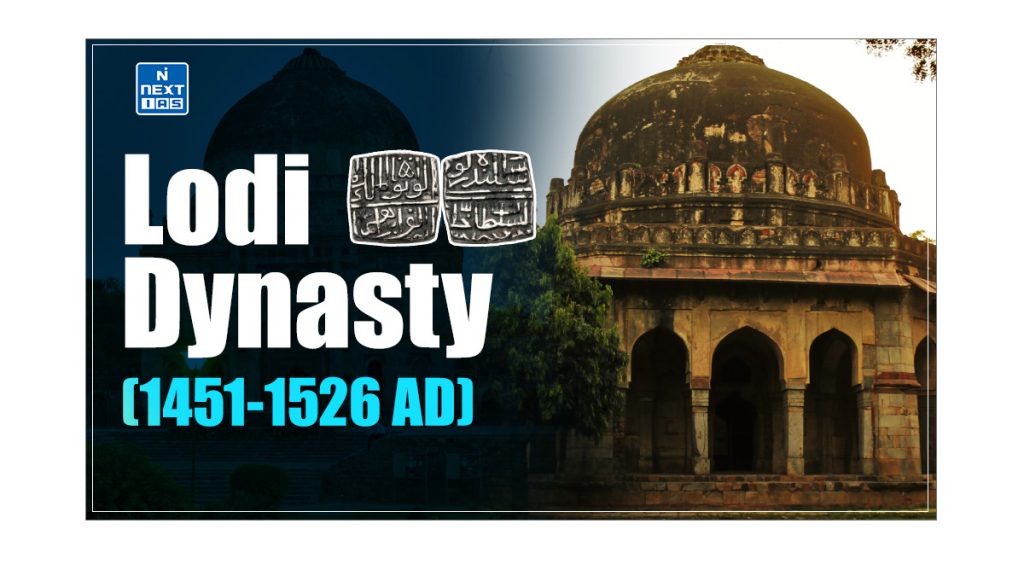
The Lodi Dynasty was the 5th and last ruling family of the Delhi Sultanate, established by Bahlul Khan Lodi in 1451 AD. They replaced the Sayyid dynasty, stretching across North India. This period was very strategic due to marking the shift from Turkish to Afghan rule and setting the platform for the Mughal Empire.
Bahlol Lodi followed the policy of ‘First Among Equals’, he refused to sit on a high throne and treated monarchy as partnership rather than autocracy. One of the greatest kings of this dynasty was Sikandar Lodi who founded the city of Agra and introduced a unit of land measurement Gazz-i-Sikandari. Ibrahim Lodi was the only Sultan of Delhi to have died fighting on the battlefield.
Lodi introduced the Double Dome technique in India that was reflected in Sikandar Lodi’s tomb. Lodi Gardens contains the tombs of Muhammad Shah and Sikandar Lodi. They are often called the living room of Delhi. Lastly in 1526 Lodhi’s faced Babur in The First Battle of Panipat and got defeated.
About Lodi Dynasty
- The Lodis were the last rulers of the Delhi Sultanate and the first to be headed by the Afghans.
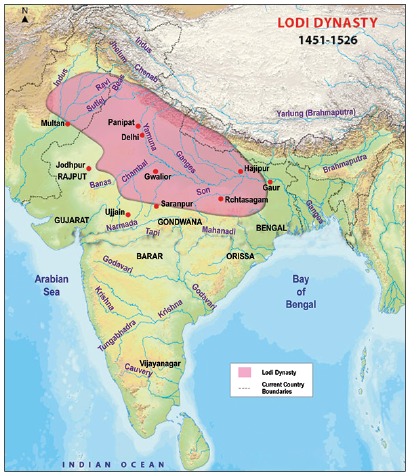
- The Lodi kingdom was larger than that of the Sayyids. They formed a large army in the sultanate.
- The Lodis dominated Punjab and the upper Ganga valley. They were known for their Behluli coins, which continued until Akbar’s tenure.
- Apart from this, the standard of measurement known as gaj-i-sikandari remained in force till the Mughals.
3 Main Rulers of the Lodi Dynasty
The three main rulers of the Lodi dynasty were:
- Bahlul Lodi
- Sikandar Lodi
- Ibrahim Lodi
Bahlul Lodi (1451-89 AD)
- Bahlul Lodi founded the Lodi dynasty in 1451 AD and ruled the Delhi sultanate until 1489 AD.
- Bahlul Lodi was a great soldier and a capable General. He maintained good relations with the nobles.
- The significant achievement of Bahlul Lodi’s reign was the eventual annexation of the Jaunpur kingdom.
- Bahlul Lodi extended his territories over Gwalior, Jaunpur and upper Uttar Pradesh.
- Bahlul Lodi also annexed the entire Sharqi kingdom and was known to issue the Bahluli coins. After the death of Bahlul Lodi, Sikandar Lodi ascended to the throne.
Sikandar Lodi (1489-1517 AD)
- After Bahlul Lodi’s death, Sikandar Lodi ascended the throne. He was the second ruler of the Lodi dynasty from 1489 AD to 1517 AD.
- Sikander Lodi’s real name was Nizam Shah, also called Sultan Sikandar Shah.
- Sikander Lodi was a good administrator who laid roads and encouraged irrigation facilities. During his reign, commodities were very cheap.
- Sikandar Lodi considered the Sultan’s position superior to that of the nobles. Sikander Lodi compelled nobles and amirs to respect the Sultan in Darbar and outside formally and treated them harshly.
- Sikander Lodi re-annexed Bihar, Dholpur, Narwar, and some parts of Gwalior and Nagor to the Delhi Sultanate.
- Sikander Lodi also introduced ‘Sikandar’ for measuring land and abolished Octroi’s duty on grain.
- Sikandar Lodi controlled the Ganga valley as far as western Bengal and moved his capital from Delhi to a new town, which later became famous as the city of Agra.
- Sikander Lodi was indulged in destroying temples. Sikander Lodi showed little tolerance towards non-Muslims and re-imposed Jizya on them. Sikander Lodi was succeeded by his son Ibrahim Lodi in 1517 AD.
- Sikandar Lodi composed poems with the pen name Gulrukhi.
Ibrahim Lodi (1517-26 AD)
- Ibrahim Lodi was the last ruler of the Lodi dynasty. He succeeded his father, Sikandar Lodi, in 1517 AD.
- Ibrahim Lodi’s tenure was dominated by several revolts by his officers and nobles. After his brother Jalal Khan rebelled against him, Ibrahim Lodi murdered Jalal Khan.
- The governor of Bihar declared his independence. The governor of Punjab, Daulat Khan, invited Babur, the ruler of Kabul, to invade India. Babur accepted the proposal and marched towards Delhi.
- Babur defeated Ibrahim Lodi in the battle of Panipat in 1526. With his death, the Lodi kingdom ended, and Babur began establishing a new dynasty, better known as the Mughal Empire.
- Thus, the Sultanate of Delhi, which originated on the battlefield of Tarain in AD 1192, breathed its last in 1526, a few miles away on the battlefield of Panipat.
- Maharana Sanga and Ibrahim Lodi fought the battle of Khatoli in 1518. Maharana Sanga defeated Ibrahim Lodi poorly.
Administration during the Lodi Dynasty
- Wazir headed the Lodi dynasty’s administration and was also called the Chief Minister. Wazir’s office collected revenue, maintained accounts, and regulated expenditures.
- The office of Wazir was also known as Diwan-i-Wizarat. The mushrif-i-mamalik (accountant) assisted the wazir, who maintained a record of the accounts, and the mustauf-i-mamalik (auditor) audited this account.
- During the Lodi dynasty, the provinces were divided into Shiqs under the administration of Shiqdars.
- The provinces were divided into Parganas (groups of hundred villages) headed by Chaudhary. Among all units, the village was the smallest unit of administration.
- Diwan-i-arz (military department) was another significant Lodi dynasty department headed by Ariz-i-Mamalik, who was responsible for inspecting, recruiting, and paying troops.
- The Lodi dynasty managed the royal correspondence headed by Dabir-i-Insha under the office of Diwan-i-Insha.
Literature, Art & Architecture
About Literature
- The rulers of the Lodi dynasty emphasized Literature, which was produced in Persian, Sanskrit, and other religious languages.
- The rulers of the sultanate provided shelter to different scholars who produced historical and religious literature in prose, drama, and poetry.
About Art and Architecture
- The design of the arch and the dome was a unique feature of the Lodi dynasty, and it became predominant in North India.
- The decorations used geometrical and floral designs with verses from the Quran.
- The Lodi dynasty constructed several monuments dedicated to its dead leaders, which is also known as the period of the Macabre.
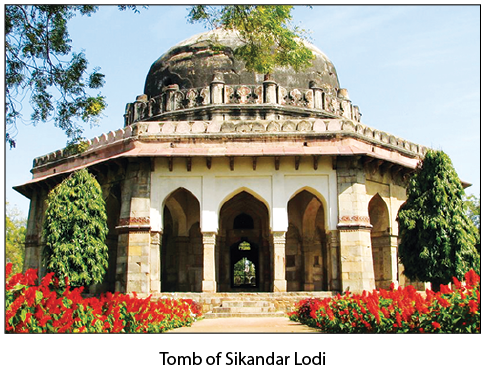
- A large number of tombs and parks were constructed around the capital. Sikandar Lodi’s tomb was built within the Lodhi garden.
- Other famous architecture of the Lodi dynasty include Bade Khan ka Gumbad, Chhote Khan ka Gumbad, Bada Gumbad, the tomb of Shihab-ud-din Taj Khan, and Poli ka Gumbad.
- The tomb of Lalitpur, popularly known as Jama Masjid, was an iconic piece of Islamic architecture of the Lodi dynasty.
Conclusion
The fall of the Lodi Dynasty in 1526, culminating in Ibrahim Lodi’s defeat by Babur at the Battle of Panipat, signified the end of an era and the rise of the Mughal Empire. Despite their eventual decline, the Lodis left a lasting legacy through their contributions to governance, culture, and architecture in India. The remnants of their rule can still be seen in various historical sites and monuments, preserving the rich heritage of a dynasty that once dominated the subcontinent. As the last sultans of Delhi, the Lodi rulers bridged the gap between the medieval period and the dawn of a new imperial age.
FAQs about Lodi Dynasty
Who founded the Lodi Dynasty in 1451?
The Lodi Dynasty was founded in 1451 by Bahlul Lodi.
Who was the founder of the Lodi Dynasty?
The founder of the Lodi Dynasty was Bahlul Lodi, who was a prominent Afghan noble.
Who established the Lodi Dynasty?
Bahlul Lodi established the Lodi Dynasty, marking the beginning of Afghan rule in northern India after the decline of the Sayyid Dynasty.
Who was the last ruler of the Lodi Dynasty?
The last ruler of the Lodi Dynasty was Ibrahim Lodi, who was defeated by Babur in 1526.