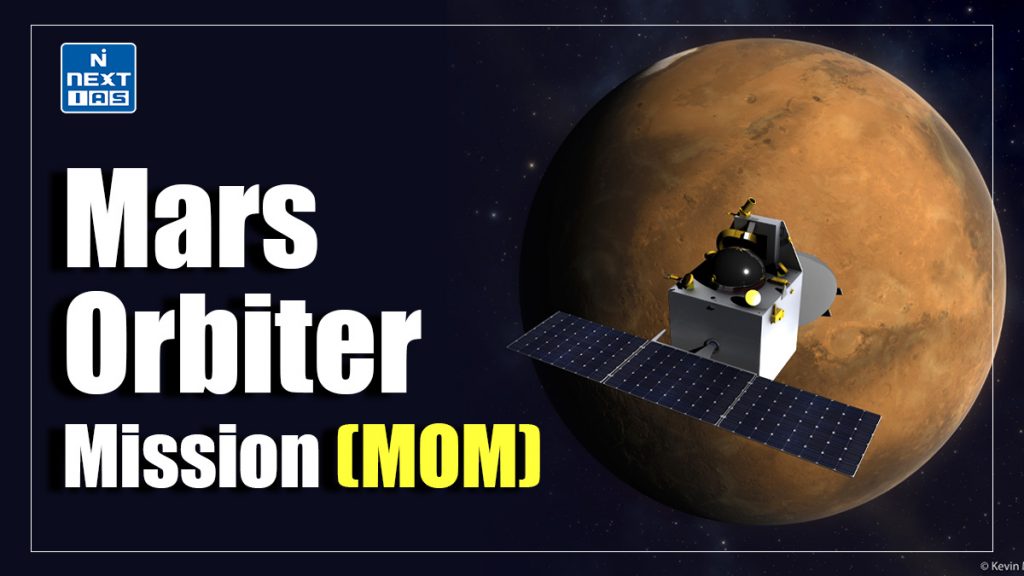
The Mars Orbiter Mission (MOM), also known as Mangalyaan, was India’s first interplanetary mission, launched by the Indian Space Research Organisation (ISRO) in 2013. Its objectives were to study Mars’ surface, atmosphere, and mineral composition, marking a significant achievement for India as the first Asian nation to reach Mars’ orbit. This Article Aims to study about The Mars Orbitor Mission (MOM).
About the Mars Orbiter Mission (MOM)
- The Mangalyaan mission, also called the Mars Orbiter Mission, was the first Indian interplanetary mission.
- It was launched on 5 November 2013 and the space probe that was launched in 2013 is still orbiting Mars.
- This mission made India the first Asian nation to reach Martian orbit and the first nation in the world to do so on its maiden attempt.
- Also, India became the fourth country to do so, after Russia, the USA and Europe. The mission is a “technology demonstrator” project to develop the technologies for designing, planning, management, and operations of an interplanetary mission.
- It carries five scientific instruments. The spacecraft is currently being monitored from the Spacecraft Control Centre at ISRO Telemetry, Tracking and Command Network (ISTRAC) in Bengaluru.
Mission Profile
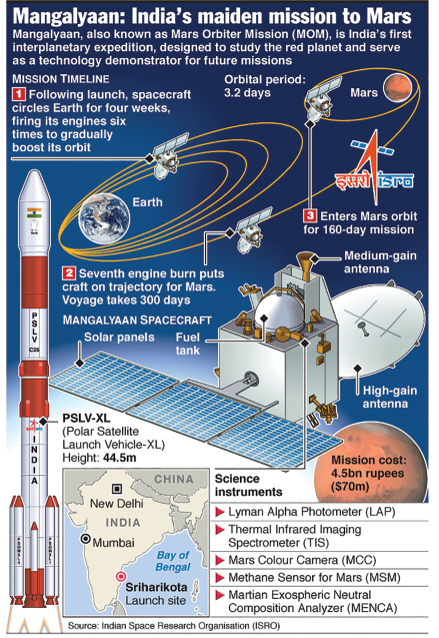
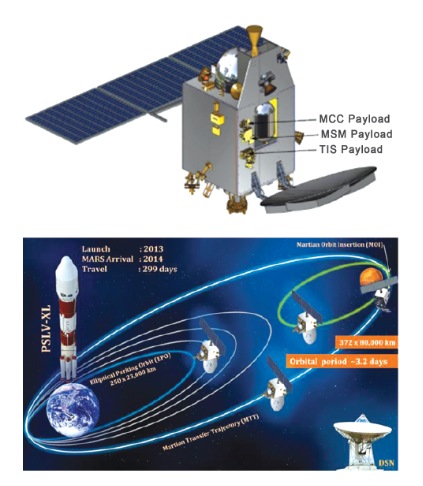
- The 1337 kg spacecraft was carried onboard PSLV C25 on November 5, 2013 from the Indian spaceport at SDSC, SHR.
- The spacecraft was injected precisely into the intended 250 x 23000 km orbit with an inclination of 17.864 degree, marking the beginning of ISRO’s first interplanetary mission to planet Mars.
- The minimum energy transfer opportunity from Earth to Mars occurs once in 26 months. The opportunity in 2013 demanded a cumulative incremental velocity of 2.592 km/sec.
- The following five payloads were included as per the recommendations of the ISRO’s Advisory Committee for Space Sciences (ADCOS).
| PAYLOAD | PRIMARY OBJECTIVE |
|---|---|
| Lyman Alpha Photometer (LAP) | Escape processes of Mars upper atmosphere through Deuterium/Hydrogen |
| Methane Sensor for MARS (MSM) | Detect presence of Methane |
| Martian Exospheric Composition Explorer (MENCA) | Study the neutral composition of the Martian upper atmosphere |
| MARS Colour Camera (MCC) | Optical imaging |
| TIR imaging spectrometer (TIS) | Map surface composition and mineralogy |
The Mars Orbiter spacecraft reached Mars, after a journey of 10 months, in September 2014. It was a period of high solar activity when the exosphere of Mars is expected to be more extended. Thus, the orbital opportunity and time frame of MOM were highly conducive to probe the upper atmosphere-exosphere of Mars.
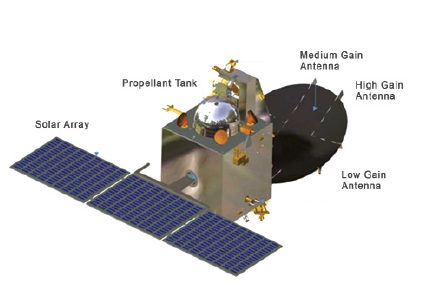
The deployed views of the spacecraft indicating the scientific payloads are shown below.
Significance of MOM
The Mars Orbiter Mission (MOM), also known as Mangalyaan, is significant for several reasons:
- India’s First Interplanetary Mission: MOM marked India’s entry into interplanetary exploration. Launched by the Indian Space Research Organisation (ISRO) in 2013, it made India the first Asian country to reach Mars orbit and the fourth space agency worldwide to do so, after NASA, the Soviet space program, and the European Space Agency.
- Cost-Effectiveness: MOM was completed at the modest price of roughly $74 million USD, rendering it one of the most cost-effective missions for Mars. It has granted ISRO the much-needed credence for carrying out high-impact space missions while spending only a fraction of what other agencies could spend.
- Technological Achievement: The whole mission demonstrated that India could build, test, and launch a complex mission requiring long-duration travel, deep-space communication, and interplanetary navigation. Important technologies were demonstrated successfully, and they included autonomous spacecraft systems, deep-space navigation, and trajectory correction maneuvers.
- Scientific Contributions: MOM was able to accumulate lots of meaningful data regarding the Martian atmosphere, surface, and mineral composition. These were the data collected by some of the key instruments such as the Mars Color Camera and Methane Sensor that pun very high resolution on studying the atmospheric methane levels, thereby contributing to our understanding of Martian potential for life and planetary climate.
- Global Prestige and Influence: MOM bolstered India’s international reputation in space science, earning global recognition and respect. The mission’s success inspired international collaborations and strengthened India’s role as a significant player in space exploration.
- Inspiration for Future Missions: MOM paved the way for ISRO’s subsequent missions, such as Chandrayaan-2, and inspired further Mars missions by emerging space programs around the world.
Read our detailed article on Chandrayaan-2.
Way Forward
The success of the Mars Orbiter Mission (MOM) is opening multiple possibilities for the future of Mars exploration with ISRO and other agencies. Building upon the successes of MOM, the following are some possible future agendas for Mars missions:
1. Mars Orbiter Mission 2 (Mangalyaan-2)
- A post-MOM Mars Orbiter Mission has been proposed by ISRO, which could have more advanced scientific instruments for the detailed study of the Martian atmosphere, climate, and surface. MOM-2 could probably also include a lander or rover for conducting surface experiments, permitting direct studies of the composition of Martian soil and rock.
2. More Advanced Scientific Payload
- More advanced instruments could be hinted for these missions: spectrometers, seismometers, and cameras, among others. These would promulgate high-resolution imaging, atmospheric analysis, and mineralogical mapping, thereby thoroughly investigating Mars’s geology, mineral resources, and evidence of water or biological activities in the past.
3. Collaborative Missions with Other Space Agencies
- ISRO could strengthen its relationships with other space agencies such as NASA, ESA, and JAXA for joint Mars missions. Such collaborative missions could share in the expense and benefits-or combine advanced technology, data, and expertise-and thus enable projects of a greater scale, such as sample return missions or cooperative Mars networks.
4. Mars Sample Returns and Human Exploration
- Building on the success of MOM, ISRO may initiate preparations for a Mars sample return or alternatively participate in an international sample return mission. Such a mission would return Martian soil to Earth for direct analysis with advanced laboratory instruments. This would set the path for eventual human exploration by increasing scientific understanding of the Martian environment.
5. Cutting-edge Technologies for Autonomous Operations
- Later Mars missions could utilize AI and autonomous robots to greatly enhance Mars data collection and analysis. Such AI would be used to autonomously decide, navigate, and optimize data transmission, thereby allowing much longer and more efficient missions.
6. Focus on Mars Climate and Atmospheric Dynamics
- Studying Mars atmosphere and climate is important for human missions in the future. Accordingly, the forward mission could look at long-duration climate, dust storm dynamics, seasonal variability, and atmospheric loss to space-a precondition for the determination of Mars habitability and further exploration.
7. Public Engagement and STEM Education
- In view of MOM’s success, ISRO could embark on further outreach and educational programs that would inspire public interest and develop a new generation of scientists and engineers. Dampening amongst the crowds also engendered increased publicity and transparency around mission planning, thus creating wide support for future Mars missions.
8. ISRU Capability Development
- As part of human robotic exploration, future Mars missions can test technologies for in-situ resource utilization such as oxygen extraction from the Martian atmosphere or construction of infrastructure from Martian soil. These technologies are vital to sustain outposts on Mars.
Building on MOM’s success, all these futuristic steps would not only increase the knowledge about Mars but also thereby place ISRO as a front runner in interplanetary exploration. Every step towards these future missions advances the understanding of our solar system and the potential of humanity in becoming a multi-planetary species.
Conclusion
- The Mars Orbiter Mission was a great achievement for India in that it demonstrated ISRO’s competency in undertaking complex interplanetary missions in a cost-effective manner. It gathered valuable scientific data about Mars that enhanced the existing knowledge of the Red Planet and demonstrated the increasing abilities of India in space exploration.
- The success of MOM yielded international collaborations and inspired the newer generation while laying the framework for subsequent missions. It demonstrated India’s viability to be an up-and-coming leader in space technology, which was contributing immensely to the exploration of Mars globally.
Frequently Asked Questions (FAQs)
Which is India’s first Mars Orbiter Mission?
India’s first Mars Orbiter Mission (MOM), also known as Mangalyaan, was launched by ISRO on November 5, 2013. It marked India’s successful entry into interplanetary exploration, making India the fourth country to reach Mars. The mission’s primary objective was to study the Martian atmosphere, surface, and mineral composition.
Is the Mars Orbiter Mission still active?
Yes, India’s Mars Orbiter Mission (Mangalyaan) is still active, well beyond its expected lifespan. Launched in 2013, it continues to send valuable data from Mars, providing insights into the planet’s atmosphere, surface, and mineral composition. Its success marks a major achievement for ISRO in space exploration.
What was the purpose of the Mars Orbiter Mission?
The purpose of India’s Mars Orbiter Mission (Mangalyaan) was to explore Mars’ surface, morphology, and atmosphere, demonstrating India’s capability in interplanetary exploration. It aimed to study Martian soil, weather, and mineral composition, while also serving as a cost-effective mission to enhance India’s global presence in space research.
What are the achievements of the Mars Orbiter Mission?
India’s Mars Orbiter Mission (Mangalyaan), launched in 2013, made history by being the first Asian mission to reach Mars orbit and the first globally to do so in its maiden attempt. Key achievements include successful Mars orbit insertion, high-resolution imaging, and data on Martian atmosphere, surface, and mineral composition.
Which is the first country to enter Mars orbit on its first attempt?
India became the first country to enter Mars orbit on its first attempt with the successful launch of the Mars Orbiter Mission (Mangalyaan) in 2013. This achievement made India the first nation to reach Mars’ orbit on its maiden mission, showcasing its space capabilities and technological advancements.